
Solar System Exploration Review Honors 22-23
Presentation
•
Science
•
6th Grade
•
Practice Problem
•
Easy
+5
Standards-aligned

Antoinette Longino
Used 7+ times
FREE Resource
15 Slides • 37 Questions
1
Solar System Exploration Review Honors 22-23
Bayside Science Grade 6 22-23
2
I can describe and illustrate the solar system and order the planets
From the Sun
Mercury
Venus
Earth
Mars
Jupiter
Saturn
Uranus
Neptune
22-23
Grade 6
3
Multiple Choice
Students are working on a scale model of the solar system. They are planning to use a table tennis (ping-pong) ball to show Earth.
Which of the following would be the BEST choice to model Mars?
small rubber ball
basketball
softball
beach ball
4
Multiple Choice
Which diagram is the most accurate representation of the orbits of planets in our solar system?
5
Multiple Choice
Based on your knowledge of the solar system and the orbits of planets, which planet will take the longest amount of time to orbit the Sun?
Planet 1
Planet 2
Planet 3
Planet 4
6
Multiple Choice
Based on your knowlege of the orbits of planets, which planet take the least amount of time to orbit the Sun?
Planet 1
Planet 2
Planet 3
Planet 4
7
Multiple Choice
Which planet is labeled #1?
Mercury
Venus
Earth
Mars
8
Multiple Choice
Which planet is labeled #2?
Mercury
Venus
Mars
Jupiter
9
Multiple Select
What conditions are necessary for life to exist on a planet?
the right distance from a star
an atmosphere
liquid water
tectonic activity
10
Multiple Choice
11
I can describe the physical properties, location and movement of the Sun, planets, moons, meteors, asteroids, and comets
Inner planets are rocky
Outer planets are larger and gas giants
Asteroids in the belt orbit like planets - rock and metal
Comets come from the Oort cloud or Kuiper Belt and make an elliptical orbit - ice, rock, dust
22-23
Grade 6
12
Multiple Choice
13
Multiple Choice
14
Multiple Choice
15
Multiple Choice
What is a shooting star?
a comet
an asteriod
a small moon
a meteor in the Earth's atmosphere
16
Multiple Choice
The a year on Earth is 365 days and a year on Mars is 687 days. What does this time period represent on each planet?
time for the planet to rotate on its axis
time for the planet to revolve around the Sun
time for the planet's moons to rotate once around the planet
time for the planet to have day and night
17
Multiple Choice
How many rotations on its axis does Earth make during one revolution around the Sun?
29 days
31 days
365 days
687 days
18
Multiple Choice
Where is the Asteroid Belt located in our solar system?
in the Kuiper Belt
between the orbit of Jupiter and Saturn
Asteroids orbit the sun from the Oort cloud
between the orbits of Mars and Jupiter
19
Multiple Choice
If you look through a telescope and observe the object in the picture, what are you looking at?
an asteriod
a meteor - because it is glowing
a comet - because it has a tail
none of these is correct
20
Multiple Choice
What object from the solar system is described by the characteristics in the chart?
Moon
Comet
Meteor
Asteroid
21
I can compare the size of the sun to other stars in the galaxy
Compare our Sun to the size of other stars in the galaxy.
22-23
Grade 6
22
Multiple Choice
Compared to many other Stars, our Sun is relatively ___________.
Large
Small
23
I can compare the closeness of the Sun to Earth to other stars in the galaxy (Astronomical Units)
1 astronomical unit is equal to the distance from the Sun to the Earth.
Most measurements in space are made in light years - the distance light travels in a year.
Proxima Centauri is the closest star to our Sun - 4 light years away.
22-23
Grade 6
24
Multiple Choice
The closest star to the Sun is Proxima Centauri which is 4 light years away. Why does the Sun appear so much brighter than Proxima Centauri?
Proxima Centauri is a small star
Our Sun is much closer to Earth than Proxima Centauri
There are other larger stars that block the light from Proxima Centauri
All of these are correct
25
I can describe the location of our solar system within the Milky Way
We are in the Milky Way Galaxy on one of the spiral arms - the Sagittarius Arm.
Our solar system is outside the galactic center (there are fewer stars around us than in some parts of the galaxy.
22-23
Grade 6
26
Multiple Choice
Where is our solar system located in the universe?
In the Andromeda Galaxy
In the Cat's Eye Nebula
In the Milky Way Galaxy
By itself and not in a galaxy at all
27
Multiple Choice
Meteors, Comets, Asteroids, Moons, Planets, Stars, Galaxies
Which of the following list above is the largest item in the universe?
Planets
Asteriods
Stars
Galaxies
28
I can identify the physical properties of the only star located in our solar system
Sun is the star closest to Earth
Sun is almost 5 billion years old
Sun is a medium sized yellow star
Sun burns hydrogen and makes helium
Sun is the source of energy for almost all life on Earth
22-23
Grade 6
29
Multiple Choice
Light from the Sun takes 8 minutes to reach Earth. Light from Sirius and Alpha Centauri take _____ to reach Earth.
10 minutes
4+ years
about 30 seconds
6 decades
30
Multiple Choice
All of the energy on Earth comes from the _______.
Asteroid Belt
Sun
Planets
Oort cloud
31
I can define gravity
Gravity is the force of attraction that holds the planets in orbit around the Sun and the Moon in orbit around the Earth
22-23
Grade 6
32
Multiple Choice
33
Multiple Choice
34
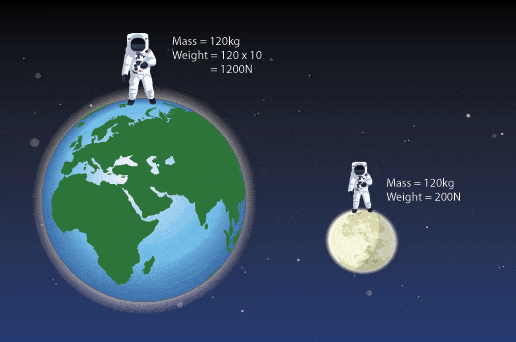
I can explain that all objects with mass have gravity
The Sun has the greatest mass in the solar system and therefore it has the greatest gravity in the solar system to hold all the planets in orbit around it.
22-23
Grade 6
35
Multiple Select
SELECT ALL THAT APPLY
How are mass and weight different?
mass never changes
weight depends on gravity
mass depends on gravity
weight never changes
36
I can explain how gravity of the Sun affects the movement of the planets in their orbits
Gravity holds our solar system together and holds the planets in orbit around the Sun.
22-23
Grade 6
37
Multiple Choice
Why do the planets orbit the Sun instead of moving straight off into space with inertia?
gravitational attraction from the Sun holds the planets in orbit
magnetism of the Sun and planets keeps them in orbit
gravitational attraction between the planets holds them together
electrostatic energy holds the solar system together
38
Multiple Choice
Which object in our solar system has 99% of the mass and matter?
Jupiter
Sun
Pluto
All of the planets put together
39
Multiple Choice
What is the force that holds all of the solar system together?
gravitational attraction from the Sun
the interia of the planets
the gravity of all the planets
mysterious space forces
40
I can explain how mass and distance from an object affects the gravitational attraction
Greater mass = greater force of gravity
Greater distance = less force of gravity
Gravity is stronger on inner planets than outer planets due to distance
22-23
Grade 6
41
Multiple Choice
42
Multiple Choice
43
I can discuss the history of space exploration
Soviet Sputnik started the "Space Race"
US Programs
Project Mercury
Project Gemini
Project Apollo
Skylab
Space Shuttle
International Space Station
Commercial Crew Program
Artemis Program
22-23
Grade 6
44
Multiple Select
Why is it good to send the Mars Rover to Mars before trying to send people there?
Cost of the mission
Long time needed to travel
Dangerous conditions for people
None of these is correct
45
Multiple Choice
Which space vehicle was built to be reusable and people to space?
Saturn 5
Space Station
Rover
Space Shuttle
46
I can identify types of equipment and transportation needed for space travel
Rockets and fuel are needed to escape from the Earth's gravity.
A pressurized cabin with life support equipment is needed to support astronauts and animals. Pressurized and insulated space suits are needed to do space walks and to walk on places like the Moon and Mars.
22-23
Grade 6
47
Multiple Select
In the future of space exploration, what life support systems are important for human space travel?
Equipment ot produce oxygen
Equipment to produce and clean water
Solar panels
Heating and cooling systems
Plants and soil
48
I can predict the future of space exploration
Artemis Program - returning to the Moon
Rovers going to Mars and planning for human flight to Mars.
Space Probes and remote vehicles to the outer solar system and beyond.
22-23
Grade 6
49
Multiple Choice
What is the biggest problem we have to solve if we are going to send humans out to explore space?
making sure people are not bored
having enough fuel
sustaining human life for long journeys
keeping people healthy with no gravity
50
I can use models to make predictions about the real world.
Think about why models of the solar system are necessary to use in order to learn about these things.
22-23
Grade 6
51
Multiple Choice
Why do we have to model our solar system?
Fun activity to do
The solar system is too large to be seen
The solar system is too small to be seen
52
Multiple Choice
For a model to be to scale means...
Sizes are the same relative to one another
Sizes are always larger
Sizes are always smaller
Sizes are random
Solar System Exploration Review Honors 22-23
Bayside Science Grade 6 22-23
Show answer
Auto Play
Slide 1 / 52
SLIDE

Similar Resources on Wayground
48 questions
Chapter 9 Vocabulary Quiz Study Guide
Presentation
•
6th Grade
46 questions
Absolute Value Review
Presentation
•
6th Grade
42 questions
Speed and Distance - Time Graphs
Presentation
•
6th Grade
45 questions
Outer Planets
Presentation
•
6th Grade
49 questions
Egyptian Mummification
Presentation
•
6th Grade
50 questions
Classification of Organisms
Presentation
•
6th Grade
46 questions
Density Guided Lesson/Notes
Presentation
•
6th Grade
Popular Resources on Wayground
10 questions
5.P.1.3 Distance/Time Graphs
Quiz
•
5th Grade
10 questions
Fire Drill
Quiz
•
2nd - 5th Grade
20 questions
Equivalent Fractions
Quiz
•
3rd Grade
22 questions
School Wide Vocab Group 1 Master
Quiz
•
6th - 8th Grade
20 questions
Main Idea and Details
Quiz
•
5th Grade
20 questions
Context Clues
Quiz
•
6th Grade
20 questions
Inferences
Quiz
•
4th Grade
12 questions
What makes Nebraska's government unique?
Quiz
•
4th - 5th Grade
Discover more resources for Science
19 questions
Introduction to Properties of Waves
Presentation
•
6th - 8th Grade
16 questions
Interactions within Ecosystems
Presentation
•
6th - 8th Grade
10 questions
Exploring the Layers of the Earth
Interactive video
•
6th - 10th Grade
15 questions
Punnett Squares
Quiz
•
6th Grade
20 questions
Energy Transformations
Quiz
•
6th - 8th Grade
20 questions
Cell Organelles and Functions
Quiz
•
6th - 8th Grade
10 questions
Ecosystem levels of organization
Quiz
•
6th Grade
20 questions
Levels of Organization
Quiz
•
6th Grade