Search Header Logo
Study Guide Review

Study Guide Review

Assessment

Presentation

•

Science

•

7th Grade

•

Easy

•
NGSS
MS-LS2-4, MS-LS2-1, MS-LS2-3

+7

Standards-aligned

Created by

Levorn Miller

Used 2+ times

FREE Resource

9 Slides • 47 Questions

1

Study Guide Review

By Levorn Miller

2

3

Multiple Choice

What is Ecology?

1

The chemistry of Life

2

The study of money

3

The study of interactions between living and nonliving things in the environment.

4

All of the above.

4

Multiple Choice

Question image
All of the living and nonliving things in an area that interact with each other are called a/an ______.
1
community
2
habitat
3
population
4
ecosystem

5

Multiple Choice

Question image
An organism that needs to eat other organisms to obtain energy is known as a:
1
Autotroph
2
Producer
3
Consumer
4
Mutualist

6

Multiple Choice

Consumer that eats plants
1
heterotroph
2
herbivore
3
producer
4
community

7

Multiple Choice

Where an organism lives
1
habitat
2
niche 
3
heterotrogh
4
biosphere

8

9

Multiple Choice

Organism

1

Something that is not alive

2

A complete living thing

3

Many living things

4

Where something lives

10

Multiple Choice

Species

1

Broadest groups of taxonomy

2

The taxonomic group that follows domains

3

Same type of organism

4

A living thing

11

Multiple Choice

Which of the following correctly lists the levels of organization from most complex to least complex?

1

Community, Organism, Population, Ecosystem

2

Population, Community, Ecosystem, Organism

3

Ecosystem, Community, Population, Organism

4

Organism, Population, Community, Ecosystem

12

Multiple Choice

The biotic and abiotic factors that work together in an area

1

Community

2

Ecosystem

3

Organism

4

Population

13

Multiple Choice

All the organisms that are the same type in a certain area

1

Population

2

Organism

3

Community

4

Ecosystem

14

Multiple Choice

All the different types of organisms living in a certain area

1

Community

2

Ecosystem

3

Organism

4

Population

15

Multiple Choice

The most specific (least complex) level of organization within an ecosystem

1

Community

2

Population

3

Organism

4

Ecosystem

16

Multiple Choice

Jacob is going out to his grandparents farm. On the farm is a stream that he likes to fish at. When he is fishing he sees many differernt speacies of fish as well as maple and oak trees and dragonflies. What Jacob is seeing is an example of what level of organization?

1

organism

2

population

3

community

4

ecosystem

17

Multiple Choice

TRUE or FALSE: A community includes all abiotic and biotic factors.
1
TRUE
2
FASLE

18

Multiple Choice

A population must be of the same ________________?

1

Color

2

Gender

3

Age

4

Species

19

20

Multiple Choice

A collection of organisms that make up a community as well as all of the nonliving aspects of the environment.
1
Population
2
Community
3
Habitat
4
Ecosystem

21

Multiple Choice

Question image
What are the Abiotic factors in this image? 
1
water, sunlight, dirt, air
2
birds and plants
3
birds, water, dirt
4
plants, water

22

Multiple Choice

The nonliving aspects of an ecosystem.
1
Abiotic factors
2
Biotic factors

23

Multiple Choice

The living portions of the ecosystem.

1
Biotic factors
2
Abiotic factors

24

Multiple Choice

Question image

Termites are tiny insects that can cause severe damage to homes and other structures that consist of wood. Termites are an example of what type of factor.

1

Biotic

2

Abiotic

25

Multiple Choice

Question image

The Sun is the source of all energy within an ecosystem. Plants depend on light from the sun in order to perform the process of photosynthesis. Sunlight is an example of what type of factor?

1

Biotic

2

Abiotic

26

Multiple Choice

Question image

Water is a compound that consists of 2 hydrogen atoms and 1 oxygen atom. Up to 60% of an adult human is made up of water. Water is an example of what type of factor?

1

Biotic

2

Abiotic

27

Multiple Choice

Question image

An arctic blast pushed its way through several of the Northern state in the United State. The temperatures dropped below freezing for several days. Temperature is an example of which type of factor?

1

Biotic

2

Abiotic

28

Multiple Choice

Question image

An angler fish has a fleshy growth on its head that gives off light. This part acts as a lure to help the angler fish catch its prey. An anglerfish is an example of which type of factor?

1

Biotic

2

Abiotic

29

Multiple Choice

Which is an example of an abiotic factor in a pond environment?

1

The water

2

A frog

3

A grasshopper

4

A snake

30

Multiple Choice

Which is an example of a biotic factor in the environment?

1

The climate in the region

2

Carnivores that consume other animals

3

Amount of helium gas in the air

4

Flow of water in a river

31

32

Multiple Choice

Limiting factors are sometimes helpful because they can keep the population from getting too large.
1
True
2
False

33

Multiple Choice

Food, water, sunlight, shelter, and space are resources that are  __________.
1
limiting factors
2
wet
3
messy
4
found in rocks

34

Multiple Choice

If the population of a certain predator increases, there is often _______ its prey
1
a decrease the population of
2
an increase of the population of 
3
great news for its prey of
4
no  impact found on

35

Multiple Choice

If there is more food than usual in an ecosystem, then...
1
Populations will stay the same
2
Populations will decrease
3
Populations will increase

36

Multiple Choice

Any thing or organism that regulates the size of a population of another organism is known as __________.
1
a limiting measure
2
a limiting factor
3
factorization
4
materialization of precipitation

37

Multiple Choice

Question image
If a disease destroying barley plants in a field swept through an ecosystem, what would happen to the barley eating bird population in the the field ?
1
The bird population would stay the same
2
The bird population would infinitely increase
3
The bird population would decrease

38

Multiple Choice

Environmental factors that keep a population from increasing. 
1
Carrying Capacity
2
Limiting Factors

39

Multiple Choice

Which is NOT an example of a limiting factor.
1
Climate
2
Available Food & Water
3
Available Space & Shelter
4
Species color

40

41

Multiple Choice

The largest number of organisms that the environment can support. 
1
Carrying Capacity
2
Limiting Factor

42

Multiple Choice

Question image
If the amount of food or resources available increases, the carrying capacity for an animal:
1
Stays the same
2
Increases
3
Decreases
4
Fluctuates

43

Multiple Choice

What happens when an environment reaches its carrying capacity?
1
Populations will decrease
2
Resources such as food, water, and space will be unlimited
3
Populations will increase
4
Nothing, everything will stay the same.

44

Multiple Choice

Question image
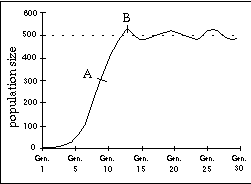
What is the carrying capacity of the graph?
1
around 500
2
more than 500
3
less than 500
4
around 600

45

Multiple Choice

Question image
The total number of individuals a habitat can survive with the resources it has available.
1
Carrying capacity
2
Limiting factors
3
Resources
4
Population

46

Multiple Choice

Question image
What is the carrying capacity of the following graph?
1
1000
2
8000
3
800
4
600

47

48

49

50

Multiple Choice

What type of sediment tends to be the most impermeable?

1

sand

2

clay

3

silt

4

rocks

51

Multiple Choice

If water can easily move between cracks of a rock, we can say that...

1

water is permeable

2

rock is permeable

3

rock is impermeable

4

water is impermeable

52

Multiple Choice

______ is more permeable since water passes through it

1

gravel

2

sand

3

clay

4

Silt

53

Multiple Choice

What is porosity

1

Rocks

2

The percent of the volume of open spaces in rock or sediment

3

Ability rock sediment fluids pass through open spaces/pores

4

Nothing

54

Multiple Choice

Define permeability

1

Water

2

Nothing

3

Percent of volume of open spaces in rock or sediment

4

Ability rock/sediment fluids pass through open spaces/pores

55

Multiple Choice

Decayed organic material in soil is called______.
1
Litter
2
Silt
3
Humus
4
Clay

56

Multiple Choice

Question image
Soil is made of
1
weathered rocks and minerals
2
dead plants and animals
3
air and water
4
all of the above

Study Guide Review

By Levorn Miller

Show answer

Auto Play

Slide 1 / 56

SLIDE