Search Header Logo
Nuclear Review

Nuclear Review

Assessment

Presentation

Physics

9th - 12th Grade

Medium

NGSS
HS-PS1-8, HS-PS3-3, HS-ESS3-2

+2

Standards-aligned

Created by

Grace Brannen

Used 6+ times

FREE Resource

12 Slides • 22 Questions

1

Nuclear Energy Review

2

Poll

How much do you remember about nuclear energy?

Everything - I don't need a review because I'm awesome and a little overconfident

I remember most stuff but need a refresher on the math stuff probably

I know nuclear bomb go boom and its big scary

Nothing I literally was not physically or mentally or spiritually here for this unit.

3

media

4

Multiple Choice

Question image

A nuclear decay which starts with large radioactive reactants and finishes with large radioactive products.

1

Decay reaction

2

Fission Reaction

3

Fusion Reaction

4

Cell division

5

Multiple Choice

Question image

A nuclear decay which starts with small non-radioactive reactants and finishes with small non-radioactive products.

1

Decay reaction

2

Fission Reaction

3

Fusion Reaction

4

Synthesis Reaction

6

media

7

Multiple Choice

This particle can be stopped by a piece of paper.

1

alpha

2

beta

3

gamma

4

all of the ablove

5

none of the above

8

Multiple Choice

This radiation can only be stopped by a thick sheet of lead or several meters of water.

1

alpha

2

beta

3

gamma

4

alpha and beta

5

none of the above

9

Multiple Choice

This type of decay creates a new element

1

alpha

2

beta

3

gamma

4

alpha and beta

5

none of the above

10

media

11

media

12

media

13

Multiple Choice

How does a nuclear reactor produce energy?

1

Atoms, such as uranium, undergo fusion in a reactor. This generates heat which turns water to steam in a turbine which generates electricity.

2

Atoms, such as uranium, undergo fission in a reactor. This generates heat which turns water into steam in a turbine which generates electricity.

3

Atoms, such as uranium, burn in a reactor. This generates heat which turns water to steam in a turbine which generates electricity.

4

We do not currently have the technology to harness nuclear reactions to generate electricity.

14

Multiple Choice

Nuclear Power's source comes from _________________.
1
Uranium or Plutonium
2
Coal
3
Natural Gas
4
Oil and/or Coal

15

Multiple Choice

What product does a nuclear power plant produce for its customers?
1
electricity
2
a turbine
3
hot water
4
steam

16

media

17

Multiple Choice

Which is a benefit of using nuclear power?
1
Makes us less reliant on fossil fuels
2
Exposes workers to hazards in nuclear facilities
3
Generates radioactive nuclear waste
4
Causes thermal pollution to water systems

18

media

19

Multiple Choice

What is a problem commonly associated with nuclear power facilities?

1

A small quantity of energy is produced.

2

Reaction products contribute to acid rain

3

It is impossible to control nuclear fission.

4

It is difficult to dispose of wastes.

20

Multiple Choice

All of the following are problems of nuclear energy except ---
1
storage of radioactive fuel
2
air pollution
3
security concerns
4
natural disasters (tsunamis, earthquakes, etc.)

21

media

22

Multiple Choice

The Chernobyl plant provided power for the city of

1

London

2

Pripyat

3

Moscow

4

Washington DC

23

Multiple Choice

How were the people of Pripyat affected by the meltdown?

1

They weren't

2

They were poisoned by radioactive fallout

3

They gained supwerpowers

4

They were all quietly eliminated by the Soviet government

24

Multiple Choice

What is Pripyat like today?

1

It is a thriving, vibrant city and the center of trade in Russia

2

It was wiped off the map by a tactical nuclear strike launched by the United States in 1991

3

It is still radioactive and not safe to live in today

4

It was absorbed by the expanding Ottoman Empire in 1498

25

media

26

media

27

Multiple Choice

The major drawback to nuclear fission reactors is the difficulty of achieving safe disposal of radioactive waste products.
1
true
2
false

28

Multiple Choice

Radioactivity can be harmful and cause disease because it affects _________.

1

air

2

water

3

cells

4

blood

29

media

30

Multiple Choice

What is a half-life?
1
The average time it takes for any element to disappear completely 
2
The time it takes for a radioactive atom to lose half its neutrons
3
The time it takes for half of any number of radioactive atoms to decay
4
The time it takes for a radioactive atom to lose half its electrons 

31

Multiple Choice

After the third half-life, how much of the sample is left?
1
1/2
2
1/3
3
1/16
4
1/8

32

Multiple Choice

Question image
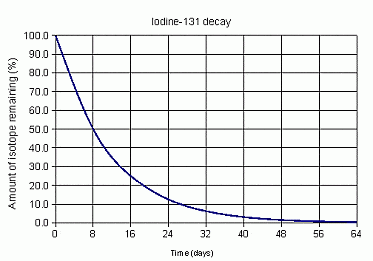
What is the half-life of iodine-131?
1
32 days
2
8 days
3
16 days
4
24 days

33

Multiple Choice

Question image

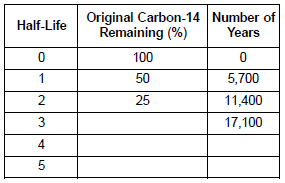
After 22,800 years, approximately what percentage of the original carbon-14 remains?

1

15%

2

12.5%

3

6.25%

4

3.125%

34

Multiple Choice

The half-life of strontium-90 is 25 years. How much strontium-90 will remain after 100 years if the initial amount is 4.0 g?
1
3.0g
2
0.25mg
3
0.3g
4
0.25g

Nuclear Energy Review

Show answer

Auto Play

Slide 1 / 34

SLIDE