Motion unit Review
Presentation
•
Physics, Science
•
6th - 12th Grade
•
Medium
+6
Standards-aligned
B Taylor
Used 7+ times
FREE Resource
7 Slides • 33 Questions
1
Motion, Forces and Simple Machines Unit Review
By Ms. Taylor
2
Speed-distance travelled over time. Measured usually in m/s
Velocity-Speed in a given direction.
Acceleration-Change in velocity over time. Caused by change in speed or direction. Measured in m/s2
Some text here about the topic of discussion.
Kinematics
3
Multiple Choice
4
Multiple Choice
5
Multiple Choice
Gizmo was sitting in the yard. He saw a rabbit and ran after it. After 5.2 seconds his velocity was 6.8 m/s. What was his acceleration?
a= V (end) - V (start)
time
1.30 m/s/s
1.3 m/s/s
0.76 m/s/s
35.4 m/s/s
6
Multiple Choice
7
Ensure that you look at the labels on axes!!
The slope of a distance-time graph gives velocity.
The slope of a speed-time graph gives acceleration!
8
Multiple Choice
9
Multiple Choice
This graph shows an object that is _____.
increasing speed
maintaining a constant speed
decreasing speed
stationary
10
Multiple Choice
11
Multiple Choice
The graph shows Tom's speed for the first 18 seconds of his journey to school. What is happening at 12 to 18 seconds into his trip?
He is speeding up
He is slowing down.
He is coming to a stop.
12
-Balanced forces are equal and act opposite to each other giving no motion.
-Unbalanced forces have a net value of more than 0 so causes motion.
-All object with a mass has a force of gravity. The larger the mass and the closer the objects, the greater will be its force of gravity (hence we are attracted to the earth and not each other).
-Objects of similar size/shape will experience similar force of gravity regardless of mass and fall from same height at same time.
-If same mass, but different surface area, objects will fall at different rate. Smaller first
-Force = mass multiplied by the acceleration
Forces and Gravity
13
Multiple Choice
14
Multiple Choice
Ben conducted an experiment where he drops a bowling ball and an apple from a third-story window. Both objects hit the ground at the same time. From this experiment Ben should conclude that
the apple weighs more than the bowling ball
gravity pulls on both objects, causing them to fall at the same time.
more air friction is acting on the apple than on the bowling ball
15
Multiple Choice
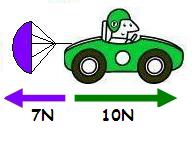
What is the net force?
3 N
3 N, right
17 N, right
3 N, left
16
Multiple Choice
In the district finals, Vanessa kicks the 0.600 kg soccer ball with a force of 80 N. How much does she accelerate the ball?
122 m/s/s
50 m/s/s
133 m/s/s
48 m/s/s
17
-First law also called law of Inertia.
-Inertia is the tendency of a body to resist change.
-The greater the mass, the more force needed and smaller the acceleration.
-Forces act in pairs that are equal in size but opposite in direction
18
Multiple Choice
Which one of Newton's laws is shown
3rd law
2nd law
1st law
19
Multiple Choice
Which of Newton's laws is shown
1st law
3rd law
2nd law
20
Multiple Choice
If there is a big mass, it would need a stronger force to accelerate it. Which law does this describe?
3rd law
1st law
2nd law
21
Multiple Choice
22
Multiple Choice
Earth exerts a stronger gravitational force than the moon because Earth has more________.
stuff
mass
density
gravity
23
Multiple Choice
1st
Law of Motion
2nd
Law of Motion
3rd
Law of Motion
24
-Work is the use of force to move an object over a distance in the direction of the force.
-Work =Force multiplied by distance.
-Work is measured in Joules.
-Simple Machines make work easier by either changing direction of applied force, reducing the force needed or increasing distance over which work is done.
-Examples: Fixed pulleys change direction, inclined planes, screws, wedges and levers increase distance, movable pulleys multiply force applied.
Work and Simple Machines
25
Multiple Choice
You have to push with 15 N of force to move it 10 meters. How much work do you do?
15 Joules
150 Joules
1.5 Joules
.67 Joules
26
Multiple Choice
500 J of work is done by a person who uses a force of 50N to move a box, how far does it go?
10 m
0.1 m
25,000 m
10 J
27
Multiple Choice
For work to be done on an object, the direction and force have to be going the same direction.
True
False
28
Multiple Choice
How can simple machines make work easier?
by decreasing the force needed to complete the task
by increasing the friction between the machine and the object
by adding more work on the object than originally applied
by removing the force of gravity on the object
29
Multiple Choice
Simple machines can make work easier by reducing the input force needed to move an object. However, there is a trade off for decreased input. What is the trade off?
The distance the object is moved is increased.
The distance the object is moved is decreased.
The amount of work is increased.
The amount of work is decreased.
30
-This is how many times the machine multiplies the input force to make work easier.
-MA= Output force/input force
- Movable pulleys, to get input force, find the MA by counting the supporting ropes (or number of movable pulleys) then divide the mass by that number.
-Levers, MA increases if fulcrum is closer to load than the effort force applied. M
Mechanical Advantage
31
Multiple Choice
What is the mechanical advantage of this pulley?
1
2
3
4
32
Multiple Choice
What is the mechanical advantage of this pulley?
4
5
6
7
33
Multiple Choice
34
Multiple Choice
In the diagram how much force must the man be exerting?
100 Newtons
85 Newtons
110 Newtons
0 Newtons
35
Multiple Choice
36
Multiple Choice
37
Multiple Choice
38
Multiple Choice
39
Multiple Choice
40
Multiple Choice
This 2000 N weight is raised 1 meter by pulling 4 meters of rope. What force was required to pull the rope?
Motion, Forces and Simple Machines Unit Review
By Ms. Taylor
Show answer
Auto Play
Slide 1 / 40
SLIDE

Similar Resources on Wayground
37 questions
Expressing Wishes with Querer & Gustaría
Presentation
•
KG - University
35 questions
MS-PS3-4: Energy, Matter, and Temperature
Presentation
•
6th Grade - University
35 questions
Weather & Climate Day 4 Humidity
Presentation
•
5th Grade - University
35 questions
Plant Leaves and anatomy
Presentation
•
7th - 12th Grade
34 questions
History L5
Presentation
•
KG - University
36 questions
How good is your memory?
Presentation
•
6th - 12th Grade
39 questions
Weathering & Erosion
Presentation
•
6th - 12th Grade
32 questions
Days/months
Presentation
•
6th - 12th Grade
Popular Resources on Wayground
20 questions
Math Review
Quiz
•
3rd Grade
15 questions
Fast food
Quiz
•
7th Grade
20 questions
Context Clues
Quiz
•
6th Grade
20 questions
Inferences
Quiz
•
4th Grade
19 questions
Classifying Quadrilaterals
Quiz
•
3rd Grade
20 questions
Figurative Language Review
Quiz
•
6th Grade
20 questions
Equivalent Fractions
Quiz
•
3rd Grade
10 questions
Identify Fractions, Mixed Numbers & Improper Fractions
Quiz
•
3rd - 4th Grade
Discover more resources for Physics
50 questions
Honors Physics - 2nd Semester Finals Review - Part 1
Quiz
•
11th Grade
30 questions
Kinetic Energy Question
Quiz
•
11th Grade
10 questions
Exit Check 8.6: Life Cycle of Stars
Quiz
•
9th Grade
50 questions
Honors Physics - 2nd Semester Finals Review - Part 2
Quiz
•
11th Grade
80 questions
2nd Semester Finals Review
Quiz
•
11th Grade
45 questions
Spring 2026 Final Exam
Quiz
•
9th - 12th Grade
17 questions
Newton's Laws
Quiz
•
KG - University