Physics Final Review
Presentation
•
Physics
•
9th - 12th Grade
•
Medium
+13
Standards-aligned
Stacy King
Used 4+ times
FREE Resource
46 Slides • 47 Questions
1
Physics Final Review
By Stacy King
2
Displacement
direct distance between two points
can be negative or positive
total distance determines how far the object has traveled from its original location
it is always less than the distance covered by an object under consideration
it always happens in a specific direction
3
Multiple Choice
4
Multiple Choice
A baseball player runs 27.4 meters from the batter's box to first base, overruns first base by 3.0 meters, and then returns to first base. What is the total Displacement?
27.4 m
30.4 m
25.4 m
3.0 m
5
Velocity
vector (direction and magnitude)
change in displacement (linear is also distance)/time
m/s
can be in the positive or negative direction
or stated as directional N,E,S,W
6
Multiple Choice
Jose wandered 4 km at 2 km/hr. How long did Jose wander?
2 hours
8 hours
0.5 hours
2 km
7
Fill in the Blank
Type answer...
8
Fill in the Blank
Type answer...
9
10
Multiple Choice
11
Formulas
12
Free Fall
acceleration due to gravity
9.8m/s^2
the rate of change as an objects velocity perpendicular to the ground
initial velocity is usually zero unless otherwise stated
air friction is negated (vacuum or no wind resistance)
13
Multiple Choice
14
Kinetic
KE = 1/2mv2
Potential
PE= mgh
Momentum
p=mv
Potential Kinetic and Momentum
15
Fill in the Blank
Type answer...
16
Work= Force x displacement
W=Fd
Work
17
Multiple Choice
The work done in raising an object must result in an increase in what type of energy that the object possesses?
Potential
Kinetic
Electrical
Chemical
18
Momentum and Impulse
19
Inertia in motion
p is the momentum
p= mass x velocity
p=mv
Momentum
20
Multiple Choice
21
Impulse is the change in momentum.
j = impulse
j= Force x ∆ time
j= mass x ∆velocity
F∆t=m∆v
Impulse
22
Multiple Choice
If the change of momentum of an object is 50kg m/s, we can say the impulse is equal to:
0 kg m/s
25 kg m/s
50 kg m/s
100 kg m/s
23
Fill in the Blank
Type answer...
24
Momentum is conserved
Perfectly Elastic
2 objects bounces off one another
Perfectly inelastic
2 objects stick together
Collisions
25
Multiple Choice
26
m1 = mass of object 1
v1 = velocity of object 1
m2= mass of object 2
v2= velocity of object 2
m1 ▲v1 = -m2 ▲v2
Collisions
27
Multiple Choice
A ball with a momentum of 4.0 m/s hits a wall and bounces straight back without losing any kinetic energy. What is the change in the ball's momentum?
-8.0 m/s
-4.0 m/s
0.0 m/s
8.0 m/s
28
Simple Harmonic Motion
29
Fill in the Blank
Type answer...
30
Kinetic- energy due to motion
Potential- energy that is stored
Total mechanical energy- energy acquired by the objects upon which work is done
Energy and Oscillation Pendulum
31
Multiple Choice
At what point in the swing of a pendulum is the bob moving fastest?
at the top of the arc
at the bottom of the arc
32
Multiple Choice
On the pendulum shown, where is the speed the greatest?
A
B
C
The speed is the same at all positions
33
KE = 1/2 mv2
KE increases as the object moves toward equilibrium
Some text here about the topic of discussion.
Calculating Kinetic Energy Pendulum
34
Multiple Choice
On the pendulum shown, where is the kinetic energy the greatest?
A and D (highest positions)
B
C (lowest position)
The kinetic energy is the same at all positions
35
PE= mgh
Potential energy is greatest at maximum displacement
Some text here about the topic of discussion.
Calculting Potential Energy Pendulum
36
Multiple Choice
On the pendulum shown, where is the potential energy the greatest?
A and D (highest positions)
B
C (lowest position)
The potential energy is the same at all positions
37
Waves
38
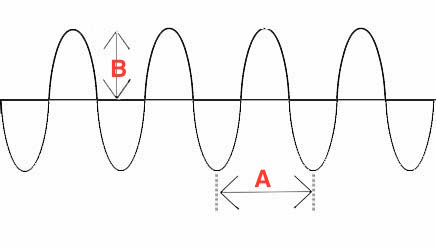
transverse wave is a wave in which particles of the medium move in a direction perpendicular to the direction that the wave moves
Transverse Waves
39
Multiple Choice
40
Transverse Wave Anatomy
41
Multiple Choice
42
longitudinal wave is a wave in which particles of the medium move in a direction parallel to the direction that the wave moves
Longitudinal wave
43
Multiple Choice
44
Longitudinal Wave Anatomy
45
Multiple Choice
46
synchronized oscillations of electric and magnetic fields.
Does not require a medium and can travel through space
light
microwaves
radio
Electromagnetic Waves
47
Frequency is how many cycles are completed each second.
Frequency f is measured in hertz, or Hz.
Frequency
Write This Down
48
Multiple Choice
How often a wave occurs is the wave's
frequency
amplitude
wavelength
velocity
49
states that when a wave reflects off a surface, the angle of incidence is equal to the angle of reflection
When a wave encounters an impassable barrier or obstacle
Law of Reflection
50
Multiple Choice
51
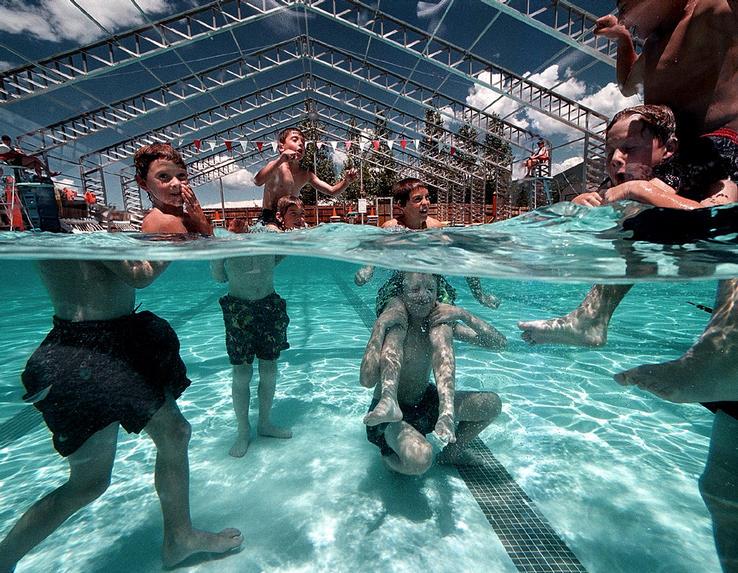
a change in direction of waves when they pass through different mediums
Refraction
52
Multiple Choice
53
Change in waves as they pass around a barrier or through an opening
Diffraction
54
Multiple Choice
Definition: The spreading out of waves as they pass through an opening or around objects.
Reflection
Refraction
Diffraction
Resonance
55
Resonance
when one object vibrating at the same natural frequency of a second object forces that second object into vibrational motion
Forced Vibration
56
Multiple Choice
Definition: When one object vibrating at the same natural frequency of a second object forces that second object into vibrational motion.
Reflection
Refraction
Diffraction
Resonance
57
interference that occurs at any location along the medium where the two interfering waves have a displacement in the same direction
Constructive
58
Multiple Choice
The two blue and purple waves will undergo _________________ when they meet.
Constructive interference
Destructive interference
59
interference that occurs at any location along the medium where the two interfering waves have a displacement in the opposite direction
Destructive
60
Multiple Choice
The image of the two waves depicts
Constructive interference
Destructive interference
61
Constructive
displacement + displacement
Destructive
Displacement - Displacement
Principal of Superposition
62
Light
63
Normal: an imaginary line drawn perpendicular to the reflecting surface where the light ray strikes it.
Angle of incidence: the angle between the incident ray and the normal, θi.
Angle of reflection: the angle between the reflected ray and the normal θr.
Law of Reflection
64
Multiple Choice
This diagram best represents
reflection
refraction
absorption
dispersion
65
reflection= mirrors
refraction= lenses
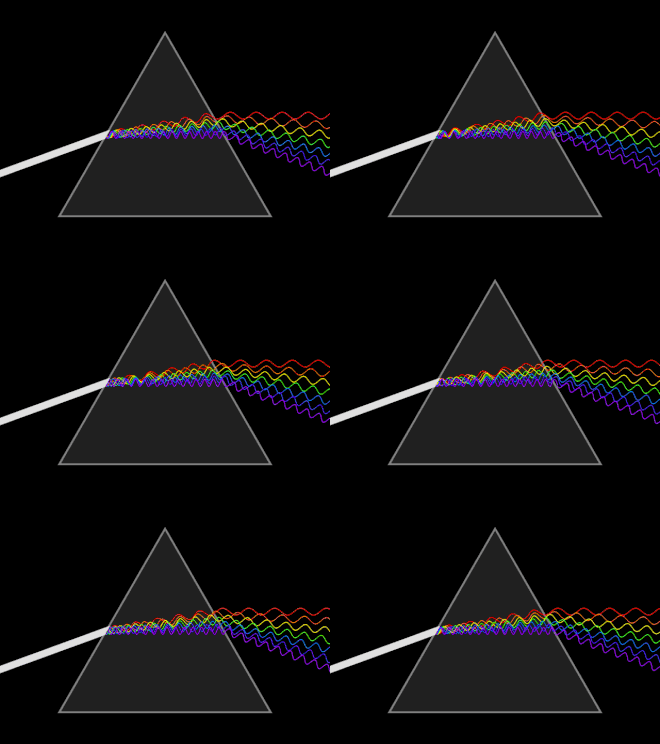
some devices use both reflection and refraction such as prisms
Optic devices
66
Multiple Choice
67
Types of Lenses
Concave
thinner in the middle
divergent refraction
Convex
thicker in the middle
convergent refraction
68
Multiple Choice
which type of lens
opaque
convex
concave
plano
69
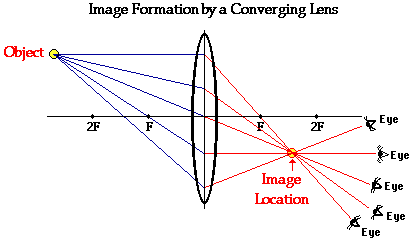
Image Formation
Location of image
Orientation
upright or upside down
Size
larger or smaller
Type
real
70
Multiple Choice
which type of lens
concave
convex
opaque
plano
71
Convex Image Formation
L
in front of focal point
O
upright
Size
larger
Type
imaginary
72
Multiple Choice
When an object is placed between the focal point and the optical centre of the convex lens, the image produced is ___.
real, diminished, and inverted
real, enlarged, and inverted
virtual, enlarged, and erect
virtual, diminished and erect
73
Convex Image Formation
L
behind the focal point
O
upside down
Size
smaller
Type
real
74
Multiple Choice
This image is.....
inverted and smaller
inverted and larger
not inverted and smaller
not inverted and larger
75
Convex Image Formation
L
at focal point
No IMAGE
76
Multiple Choice
77
Concave Image Formation
Always
upright
smaller
virtual
78
Multiple Choice
79
80
Multiple Choice
An object is located 35.0 cm from a converging lens. The lens forms a real image at a distance of 15.0 cm. What is the focal length?
0.0953 cm
10.5 cm
26.2 cm
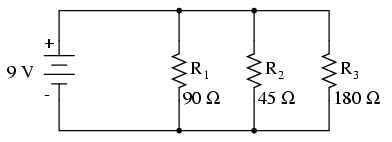
0.0678 cm
81
Electricity and Magnetism
82
I= current= Amperes
V= voltage = volts
R= resistance = ohm's
V=IR
Ohm's Law
83
Multiple Choice
84
Series
R total= R1 + R2 +R3...
I (current) is always constant
Parallel
1/R total= 1/R1 +1/R2 + 1/R3...
Voltage is always constant
Cuircuits
85
Multiple Choice
One light bulb in the kitchen burns out and suddenly several lights go out in the house. This would provide evidence that the bulbs were wired in _____________________.
Series
Parallel
Tangent
Askew
86
Multiple Choice
What is the total resistance (RT) across this circuit?
3 kΩ
10 kΩ
13 kΩ
18 kΩ
87
Multiple Choice
88
Fill in the Blank
Type answer...
89
the rate at which energy is absorbed or produced within a circuit.
P = power = Watts
Power
90
Fill in the Blank
Type answer...
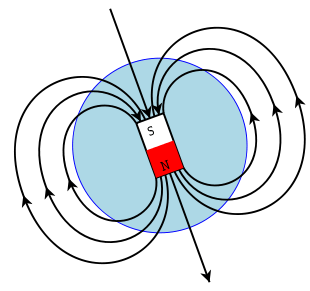
91
Moving electric charges due to orientation of charges (domains)
The Earth's (metal) core creates a natural protective magnetic field
Magnetic Fields
92
Multiple Choice
The area of magnetic force around a magnet is known as its _____________.
magnetic field
magnetic declination
magnetic fan lines
magnetic tan lines
93
Multiple Choice
Dylan puts two magnetic toy trains very close to each other on a track. What will happen next, and why?
The trains will not move because the magnets are not touching.
The trains will move closer to each other because the magnetic force will pull the trains together.
The trains will move away from each other because the magnetic force will push the trains apart.
The trains will move away from each other because the magnets are not touching.
Physics Final Review
By Stacy King
Show answer
Auto Play
Slide 1 / 93
SLIDE

Similar Resources on Wayground
88 questions
Linguagens
Presentation
•
9th - 12th Grade
87 questions
Memory
Presentation
•
9th - 12th Grade
87 questions
Ch. 7 L. 3 Cell Structure and Organelles
Presentation
•
9th - 12th Grade
84 questions
AP Psychology Unit IX - Developmental Psychology
Presentation
•
9th - 12th Grade
93 questions
Physics Final Exam
Presentation
•
9th - 12th Grade
85 questions
Federalism
Presentation
•
9th - 12th Grade
90 questions
Key Features of Graphs
Presentation
•
9th - 12th Grade
87 questions
Senderos 1 CH 5 LAS VACACIONES
Presentation
•
9th - 12th Grade
Popular Resources on Wayground
10 questions
5.P.1.3 Distance/Time Graphs
Quiz
•
5th Grade
10 questions
Fire Drill
Quiz
•
2nd - 5th Grade
20 questions
Equivalent Fractions
Quiz
•
3rd Grade
22 questions
School Wide Vocab Group 1 Master
Quiz
•
6th - 8th Grade
20 questions
Main Idea and Details
Quiz
•
5th Grade
20 questions
Context Clues
Quiz
•
6th Grade
20 questions
Inferences
Quiz
•
4th Grade
12 questions
What makes Nebraska's government unique?
Quiz
•
4th - 5th Grade
Discover more resources for Physics
25 questions
Unit 8: Universe Review
Quiz
•
9th Grade
12 questions
Properties of Waves
Quiz
•
11th Grade
20 questions
Unit 10 - Acceleration Mini-Test
Quiz
•
9th Grade
10 questions
Fomative 7A: Speed, Distance, Time
Quiz
•
9th Grade
22 questions
Wave Basics
Quiz
•
9th Grade
14 questions
Bill Nye Waves
Interactive video
•
9th - 12th Grade
6 questions
Conservation of Energy
Presentation
•
9th - 12th Grade
14 questions
Series Electrical Circuits and Parallel Electrical Circuits
Quiz
•
9th - 12th Grade