

Forces Notes Part 2

Presentation
•
Physics
•
9th - 12th Grade
•
Medium
+2
Standards-aligned

Teresa Schlueter
Used 4+ times
FREE Resource
62 Slides • 30 Questions
1

2
Objectives
The students will be able to:
Rank objects based on amount of inertia
Rank objects based on amount of momentum.
Given a scenario, identify and explain which law is at work.
Find net force on an object based on a picture or diagram.
Calculate weight of an object, given its mass.
3

Net Force: the combining of forces when two or more forces act on an object.
F= 2 N
F= 5 N
4
Forces on an object can be balanced or unbalanced.
Balanced Forces: forces that are equal in size and opposite in direction.
Does not cause a change in motion because the net force on the object is 0.
F= 4 N
F= 4 N
5
Multiple Choice
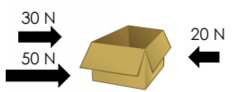
6
Multiple Choice
7
Law of Universal Gravitation: Any two masses exert an attractive force on each other.


8
Newton’s 2nd Law: A net force acting on an object causes the object to accelerate in the direction of the net force.
9
Newton’s 2nd Law: A net force acting on an object causes the object to accelerate in the direction of the net force.
The greater the mass, the greater the force needed to accelerate it.
10
Newton’s 2nd Law: A net force acting on an object causes the object to accelerate in the direction of the net force.
The greater the mass, the greater the force needed to accelerate it.
The greater the net force, the greater the acceleration.
11
Newton’s 2nd Law: A net force acting on an object causes the object to accelerate in the direction of the net force.
The greater the mass, the greater the force needed to accelerate it.
The greater the net force, the greater the acceleration.

The ball will accelerate in the direction of the net force the mallet applies.
12
Newton’s 2nd Law: A net force acting on an object causes the object to accelerate in the direction of the net force.
The greater the mass, the greater the force needed to accelerate it.
The greater the net force, the greater the acceleration.
The ball will accelerate in the direction of the net force the mallet applies.
The greater the force applied, the faster the ball will move.
13
Can be summarized as an equation:
F= force | m = mass | a = acceleration |
|---|---|---|
Measured in Newtons (N) | measured in kilograms (kg) | measured in m/s |
F = m x a
14
Multiple Choice
What is the formula for calculating Force?
F=m x a
a=F÷m
m=F x a
F=m÷a
15
Multiple Choice
What is the formula for calculating acceleration?
a=F÷m
F=m x a
m=F÷a
a=F x m
16
Multiple Choice
What is the formula for calculating mass?
a=F÷m
F=m x a
m=F÷a
m=F x a
17
Multiple Choice

What does this picture represent
Force,magnetism,acceleration
Force, money, Apples
Force, Mass, Acceleration
Funny, monkeys, Arrive
18
Example #1: You are pushing a friend on a sled. You push with a force of 40N. Your friend and the sled together have a mass of 80 kg. Ignoring friction, what is the acceleration of your friend on the sled?
F = m x a
19
Example #1: You are pushing a friend on a sled. You push with a force of 40N. Your friend and the sled together have a mass of 80 kg. Ignoring friction, what is the acceleration of your friend on the sled?
F = m x a
20
Example #1: You are pushing a friend on a sled. You push with a force of 40N. Your friend and the sled together have a mass of 80 kg. Ignoring friction, what is the acceleration of your friend on the sled?
F = m x a
F = 40 N
m = 80 kg
a = ?
21
Example #1: You are pushing a friend on a sled. You push with a force of 40N. Your friend and the sled together have a mass of 80 kg. Ignoring friction, what is the acceleration of your friend on the sled?
F = m x a
F = 40 N
m = 80 kg
a = ?
a = F ÷ m
22
Example #1: You are pushing a friend on a sled. You push with a force of 40N. Your friend and the sled together have a mass of 80 kg. Ignoring friction, what is the acceleration of your friend on the sled?
F = m x a
F = 40 N
m = 80 kg
a = ?
a = F ÷ m
a = 40 N ÷ 80 kg
23
Example #1: You are pushing a friend on a sled. You push with a force of 40N. Your friend and the sled together have a mass of 80 kg. Ignoring friction, what is the acceleration of your friend on the sled?
F = m x a
F = 40 N
m = 80 kg
a = ?
a = F ÷ m
a = 40 N ÷ 80 kg
a = 0.5 m/s2
24
Weight: The force of gravity on an object
25
Weight: The force of gravity on an object
Because it is a force, you can always calculate weight using
F = m x a
26
Weight: The force of gravity on an object
Because it is a force, you can always calculate weight using
When finding weight, acceleration due to gravity is always used = 9.8 m/s2
F = m x a
27
Example #2: Find the weight of a suitcase that has a mass of 42 kg.
F = m x a
28
Example #2: Find the weight of a suitcase that has a mass of 42 kg.
F = m x a
29
Example #2: Find the weight of a suitcase that has a mass of 42 kg.
F = m x a
F (weight) = ?
m = 42 kg
30
Example #2: Find the weight of a suitcase that has a mass of 42 kg.
F = m x a
F (weight) = ?
m = 42 kg
a = 9.8m/s2
31
Example #2: Find the weight of a suitcase that has a mass of 42 kg.
F = m x a
F (weight) = ?
m = 42 kg
a = 9.8m/s2
F = m x a
32
Example #2: Find the weight of a suitcase that has a mass of 42 kg.
F = m x a
F (weight) = ?
m = 42 kg
a = 9.8m/s2
F = m x a
F = 42 x 9.8
33
Example #2: Find the weight of a suitcase that has a mass of 42 kg.
F = m x a
F (weight) = ?
m = 42 kg
a = 9.8m/s2
F = m x a
F = 42 x 9.8
F (weight) = 411.6 N
34
Multiple Choice
Which law of motion says that you must push or pull objects harder if they have more mass?
1st
2nd
3rd
4th
35
Multiple Choice
36 N
12 N
3 N
0.33 N
36
Multiple Choice
zero
2 m/s/s
4 m/s/s
5 m/s/s
37
Multiple Choice
80000
60000
40000 N
20000
38
Multiple Choice
What Unit do we Measure Force in?
Newtons
Joules
Force
Kilograms
39
Mass = the amount of matter in an object.
40
Mass = the amount of matter in an object.
Weight = the force of gravity on an object
41
Mass = the amount of matter in an object.
Weight = the force of gravity on an object
Meaning it can change based on location!
42
Mass = the amount of matter in an object.
Weight = the force of gravity on an object
Meaning it can change based on location!
The further from Earth you are, the lower your weight
43
Mass = the amount of matter in an object.
Weight = the force of gravity on an object
Meaning it can change based on location!
The further from Earth you are, the lower your weight
On the moon your weight would be 1/6th what it is now.
44
Mass = the amount of matter in an object.
Weight = the force of gravity on an object
Meaning it can change based on location!
The further from Earth you are, the lower your weight
On the moon your weight would be 1/6th what it is now.
If you could be on another planet your weight would change based on the gravity of that planet
45
Mass = the amount of matter in an object.
Weight = the force of gravity on an object
Meaning it can change based on location!
The further from Earth you are, the lower your weight
On the moon your weight would be 1/6th what it is now.
If you could be on another planet your weight would change based on the gravity of that planet
On Jupiter your weight would be over twice as much as it is now.
46
Multiple Choice
Measure of acceleration due of gravity =
9.8 kg
9.8 N
9.8 m/s2
47
Multiple Choice

If there is a big mass, it would need a stronger force to accelerate it. Which law does this describe?
3rd law
1st law
2nd law
48
Multiple Choice
Measure of the amount of matter
Mass
Weight
49
Multiple Choice
Measure of the force of gravity
Mass
Weight
50
Multiple Choice
Constant no matter your location in the universe
mass
weight
51
Multiple Choice
Changes with location in the universe
mass
weight
52
Multiple Choice
Measure of the amount of force
mass
weight
53
Multiple Choice
Moon has more mass, and therefore more gravity
Moon has less mass, and therefore more gravity
Moon has more mass, and therefore less gravity
Moon has less mass and therefore less gravity
54
55
Newton’s 3rd Law: every action has an equal and opposite reaction.

56
Newton’s 3rd Law: every action has an equal and opposite reaction.
When one object exerts a force on a second object, the second one exerts a force on the first that is equal in size and opposite in direction.
57
Newton’s 3rd Law: every action has an equal and opposite reaction.
When one object exerts a force on a second object, the second one exerts a force on the first that is equal in size and opposite in direction.
Ex. When you jump on a trampoline, the trampoline exerts the same force on you but pushes you in the opposite direction.
58
Multiple Choice

This is Newton's 3rd law
True
False
59
Multiple Choice
Letting go of a balloon full of air is demonstrating Newton's ______ _______ ________ _________ because the air comes out of the back and the balloon moves forward.
1st law of motion
2nd law of motion
3rd law of motion
13th law of motion
60
Momentum: (p) mass in motion.
p = m x v
p = momentum | m = mass | v -velocity |
|---|---|---|
measured in kg*m/s | measured in kilograms (kg) | measured in m/s |
p = m x v
61
Momentum: (p) mass in motion.
p = m x v
p =momentum | m = mass | v = velocity |
|---|---|---|
measured in kg*m/s | measured in kilograms (kg) | measured in m/s |
p = m x v
All moving objects have momentum.
Momentum is transferred between objects in a collision.
62
In a collision, because the forces acting on the two objects are equal and opposite (Newton’s 3rd Law), the transfer of momentum must be the same.
p = m x v

63
In a collision, because the forces acting on the two objects are equal and opposite (Newton’s 3rd Law), the transfer of momentum must be the same.
p = m x v
à Law of Conservation of Momentum: momentum is never created or destroyed in a collision, it only is transferred.
64
Multiple Choice
The equation for momentum is?
momentum = force - mass
momentum = acceleration / mass
momentum = mass x acceleration
momentum = mass x velocity
65
Multiple Choice
Like velocity, acceleration, and force, momentum is described by its direction as well as its quantity. This Means it is a _______
scalar quantity
vector quantity
66
Multiple Choice
What is true about the relationship between mass and momentum.
The less mass an object has, the more momentum it will have.
The more mass an object has, the less momentum it will have.
The more mass an object has, the more momentum it will have.
Mass has nothing to do with momentum.
67
Multiple Choice
Even if an object has a smaller mass, it can have a larger momentum if it has a high _______.
velocity
displacement
weight
68
Example #3: What is the momentum of a car with a mass of 1300 kg traveling at a speed of 28 m/s?
p = m x v

69
Example #3: What is the momentum of a car with a mass of 1300 kg traveling at a speed of 28 m/s?
p = ?
m = 1300 kg
v = 28m/s
p = m x v
70
Example #3: What is the momentum of a car with a mass of 1300 kg traveling at a speed of 28 m/s?
p = ?
m = 1300 kg
v = 28m/s
p = m x v
p = m x v
71
Example #3: What is the momentum of a car with a mass of 1300 kg traveling at a speed of 28 m/s?
p = ?
m = 1300 kg
v = 28m/s
p = m x v
p = 1300 x 28
p = m x v
72
Example #3: What is the momentum of a car with a mass of 1300 kg traveling at a speed of 28 m/s?
p = ?
m = 1300 kg
v = 28m/s
p = m x v
p = m x v
p = 1300 x 28
p= 36,400 kg*m/s
73
Example #3: Ball #1 is rolling 11 m/s directly toward a 0.17 kg ball #2 at rest. During the collision, ball #1 stops and ball #2 is launched forward at 9 m/s. What is the mass of ball #1? (think about the Law of Conservation of Momentum)
p = m x v
74
Example #3: Ball #1 is rolling 11 m/s directly toward a 0.17 kg ball #2 at rest. During the collision, ball #1 stops and ball #2 is launched forward at 9 m/s. What is the mass of ball #1? (think about the Law of Conservation of Momentum)
p = m x v
m2 = 0.17 kg
m1 = ?
v1 = 11 m/s
v2 = 9 m/s
75
Example #3: Ball #1 is rolling 11 m/s directly toward a 0.17 kg ball #2 at rest. During the collision, ball #1 stops and ball #2 is launched forward at 9 m/s. What is the mass of ball #1? (think about the Law of Conservation of Momentum)
p1 = ?
m1 = ?
v1 = 11m/s
p = m x v
m2 = 0.17 kg
m1 = ?
v1 = 11 m/s
v2 = 9 m/s
76
Example #3: Ball #1 is rolling 11 m/s directly toward a 0.17 kg ball #2 at rest. During the collision, ball #1 stops and ball #2 is launched forward at 9 m/s. What is the mass of ball #1? (think about the Law of Conservation of Momentum)
p1 = ?
m1 = ?
v1 = 11m/s
p2 = ?
m2 = 0.17 kg
v2 = 9m/s
p = m x v
m2 = 0.17 kg
m1 = ?
v1 = 11 m/s
v2 = 9 m/s
77
Example #3: Ball #1 is rolling 11 m/s directly toward a 0.17 kg ball #2 at rest. During the collision, ball #1 stops and ball #2 is launched forward at 9 m/s. What is the mass of ball #1? (think about the Law of Conservation of Momentum)
p1 = ?
m1 = ?
v1 = 11m/s
p2 = ?
m2 = 0.17 kg
v2 = 9m/s
p = m x v
p = m x v
m2 = 0.17 kg
m1 = ?
v1 = 11 m/s
v2 = 9 m/s
78
Example #3: Ball #1 is rolling 11 m/s directly toward a 0.17 kg ball #2 at rest. During the collision, ball #1 stops and ball #2 is launched forward at 9 m/s. What is the mass of ball #1? (think about the Law of Conservation of Momentum)
p1 = ?
m1 = ?
v1 = 11m/s
p2 = ?
m2 = 0.17 kg
v2 = 9m/s
p = m x v
p = m x v
m2 = 0.17 kg
m1 = ?
v1 = 11 m/s
v2 = 9 m/s
Due to the Law of conservation of momentum....
79
Example #3: Ball #1 is rolling 11 m/s directly toward a 0.17 kg ball #2 at rest. During the collision, ball #1 stops and ball #2 is launched forward at 9 m/s. What is the mass of ball #1? (think about the Law of Conservation of Momentum)
p1 = ?
m1 = ?
v1 = 11m/s
p2 = ?
m2 = 0.17 kg
v2 = 9m/s
p = m x v
p = m x v
m2 = 0.17 kg
m1 = ?
v1 = 11 m/s
v2 = 9 m/s
p1= p2
Due to the Law of conservation of momentum....
80
Example #3: Ball #1 is rolling 11 m/s directly toward a 0.17 kg ball #2 at rest. During the collision, ball #1 stops and ball #2 is launched forward at 9 m/s. What is the mass of ball #1? (think about the Law of Conservation of Momentum)
p1 = ?
m1 = ?
v1 = 11m/s
p2 = ?
m2 = 0.17 kg
v2 = 9m/s
p = m x v
Due to the Law of conservation of momentum....
p1= p2
p = m x v
m2 = 0.17 kg
m1 = ?
v1 = 11 m/s
v2 = 9 m/s
p2 = m2 x v2
81
Example #3: Ball #1 is rolling 11 m/s directly toward a 0.17 kg ball #2 at rest. During the collision, ball #1 stops and ball #2 is launched forward at 9 m/s. What is the mass of ball #1? (think about the Law of Conservation of Momentum)
p1 = ?
m1 = ?
v1 = 11m/s
p2 = ?
m2 = 0.17 kg
v2 = 9m/s
p = m x v
Due to the Law of conservation of momentum....
p1= p2
p = m x v
m2 = 0.17 kg
m1 = ?
v1 = 11 m/s
v2 = 9 m/s
p2 = m2 x v2
p2 = 0.17 x 9
82
Example #3: Ball #1 is rolling 11 m/s directly toward a 0.17 kg ball #2 at rest. During the collision, ball #1 stops and ball #2 is launched forward at 9 m/s. What is the mass of ball #1? (think about the Law of Conservation of Momentum)
p1 = ?
m1 = ?
v1 = 11m/s
p2 = ?
m2 = 0.17 kg
v2 = 9m/s
p = m x v
Due to the Law of conservation of momentum....
p1= p2
p = m x v
m2 = 0.17 kg
m1 = ?
v1 = 11 m/s
v2 = 9 m/s
p2 = m2 x v2
p2 = 1.53 kg*m/s
p2 = 0.17 x 9
83
Example #3: Ball #1 is rolling 11 m/s directly toward a 0.17 kg ball #2 at rest. During the collision, ball #1 stops and ball #2 is launched forward at 9 m/s. What is the mass of ball #1? (think about the Law of Conservation of Momentum)
p1 = ?
m1 = ?
v1 = 11m/s
p2 = ?
m2 = 0.17 kg
v2 = 9m/s
p = m x v
Due to the Law of conservation of momentum....
p1= p2
p = m x v
m2 = 0.17 kg
m1 = ?
v1 = 11 m/s
v2 = 9 m/s
p2 = m2 x v2
p2 = 1.53 kg*m/s
p1= p2
p2 = 0.17 x 9
84
Example #3: Ball #1 is rolling 11 m/s directly toward a 0.17 kg ball #2 at rest. During the collision, ball #1 stops and ball #2 is launched forward at 9 m/s. What is the mass of ball #1? (think about the Law of Conservation of Momentum)
p1 = ?
m1 = ?
v1 = 11m/s
p2 = ?
m2 = 0.17 kg
v2 = 9m/s
p = m x v
Due to the Law of conservation of momentum....
p1= p2
p = m x v
m2 = 0.17 kg
m1 = ?
v1 = 11 m/s
v2 = 9 m/s
p2 = m2 x v2
p2 = 1.53 kg*m/s
p1 = 1.53 kg*m/s
p1= p2
p2 = 0.17 x 9
85
Example #3: Ball #1 is rolling 11 m/s directly toward a 0.17 kg ball #2 at rest. During the collision, ball #1 stops and ball #2 is launched forward at 9 m/s. What is the mass of ball #1? (think about the Law of Conservation of Momentum)
p1 = ?
m1 = ?
v1 = 11m/s
p2 = ?
m2 = 0.17 kg
v2 = 9m/s
p = m x v
Due to the Law of conservation of momentum....
p1= p2
p = m x v
m2 = 0.17 kg
m1 = ?
v1 = 11 m/s
v2 = 9 m/s
p2 = m2 x v2
p2 = 1.53 kg*m/s
m1 = p1 ÷ v1
p1 = 1.53 kg*m/s
p1= p2
p2 = 0.17 x 9
86
Example #3: Ball #1 is rolling 11 m/s directly toward a 0.17 kg ball #2 at rest. During the collision, ball #1 stops and ball #2 is launched forward at 9 m/s. What is the mass of ball #1? (think about the Law of Conservation of Momentum)
p1 = ?
m1 = ?
v1 = 11m/s
p2 = ?
m2 = 0.17 kg
v2 = 9m/s
p = m x v
Due to the Law of conservation of momentum....
p1= p2
p = m x v
m2 = 0.17 kg
m1 = ?
v1 = 11 m/s
v2 = 9 m/s
p2 = m2 x v2
p2 = 1.53 kg*m/s
m1 = p1 ÷ v1
p1 = 1.53 kg*m/s
p1= p2
p2 = 0.17 x 9
m1 =1.53 ÷ 11
87
Example #3: Ball #1 is rolling 11 m/s directly toward a 0.17 kg ball #2 at rest. During the collision, ball #1 stops and ball #2 is launched forward at 9 m/s. What is the mass of ball #1? (think about the Law of Conservation of Momentum)
p1 = ?
m1 = ?
v1 = 11m/s
p2 = ?
m2 = 0.17 kg
v2 = 9m/s
p = m x v
Due to the Law of conservation of momentum....
p1= p2
p = m x v
m2 = 0.17 kg
m1 = ?
v1 = 11 m/s
v2 = 9 m/s
p2 = m2 x v2
p2 = 1.53 kg*m/s
m1 = p1 ÷ v1
p1 = 1.53 kg*m/s
p1= p2
p2 = 0.17 x 9
m1 =1.53 ÷ 11
m1 =0.14 kg
88
Fill in the Blanks
What is the momentum of a bird with a mass of 0.018 kg flying at 15 m/s?
Type answer...
89
Multiple Choice
20000 N
20000 Joules
20000 Kg * m/s south
10000 kg * m/s south
90
Multiple Choice
5 m/s
2.5 m/s
10 m/s
7.5 m/s
91
Multiple Choice
18.6 m/s
9.3 m/s
7.5 m/s
1.86 m/s
92
Multiple Choice
Newton's third law states that any action will have a(n) _______ and ______ reaction
Equal and similar
Equal and opposite
Equal and different
Greater and opposite
Show answer
Auto Play
Slide 1 / 92
SLIDE
Similar Resources on Wayground

85 questions
Types of Reactions - Double Displacement and Combustion
Presentation
•
9th - 12th Grade
85 questions
Ch. 8 Covalent Bonding
Presentation
•
9th - 12th Grade
85 questions
Unit 7 Probability Notes
Presentation
•
9th - 12th Grade
90 questions
Key Features of Graphs
Presentation
•
9th - 12th Grade
87 questions
Senderos 1 CH 5 LAS VACACIONES
Presentation
•
9th - 12th Grade
87 questions
Memory
Presentation
•
9th - 12th Grade
87 questions
Ch. 7 L. 3 Cell Structure and Organelles
Presentation
•
9th - 12th Grade
85 questions
Federalism
Presentation
•
9th - 12th Grade
Popular Resources on Wayground
10 questions
Safety Day 2026 – Student Review

Quiz
•
9th Grade
21 questions
Continents and Oceans
Quiz
•
6th Grade
20 questions
Parts of Speech
Quiz
•
5th Grade
16 questions
Subject & Predicate
Quiz
•
5th Grade
25 questions
Multiplication Facts
Quiz
•
5th Grade
12 questions
Map Skills
Quiz
•
3rd Grade
22 questions
Continents and Oceans
Quiz
•
5th Grade
15 questions
Rounding Decimals
Quiz
•
5th Grade
Discover more resources for Physics
20 questions
Position vs. Time Graphs
Quiz
•
9th Grade
10 questions
Exit Check 5.1 - Forms of Energy
Quiz
•
9th Grade
11 questions
Electricity Explained

Interactive video
•
9th - 12th Grade
87 questions
25-26 Unit 1.2 Review - Radioactivity & Earth's Age
Quiz
•
8th - 10th Grade
15 questions
Position vs. Time and Velocity vs. Time Graphs
Quiz
•
10th - 12th Grade
18 questions
Quiz #8 Practice: Forces on an Incline
Quiz
•
9th Grade
25 questions
Newton's Laws of Motion
Quiz
•
9th Grade