Search Header Logo
Key Features of Quadratic Functions

Key Features of Quadratic Functions

Assessment

Presentation

Mathematics

9th - 12th Grade

Medium

CCSS
HSF-IF.C.7A, 8.F.A.1, HSA-REI.B.4B

+4

Standards-aligned

Created by

Susan Joyce

Used 43+ times

FREE Resource

17 Slides • 35 Questions

1

Key Features of Quadratic Functions

By Susan Joyce

2

media

1, Domain is the set of all input or x-values.

2. Domain is usually the set of all real numbers unless there is an "x" variable in the denominator (i.e. 5/x)

3. Domain may also be restricted if the graph only refers to discrete points, and not the line connecting them (i.e. only integer values)

4. We write the set of real numbers in several ways:​

​ {x∈ |R (x element of Real Numbers}

As interval: (-∞​, +∞ )

As inequality (​-∞​ < x< +∞)

Domain

3

media

Range​

1. The range is the set of all output, or y-values.

2. Since the graph of a quadratic

function has a maximum or minimum, the range will be limited by its lowest, or highest, value

3. If the domain is restricted, it may also limit the range of the output.

​4. If the graph has a minimum value, the range will be all values greater than or equal to the value: y ≥ min

​5. If the graph has a maximum, then the range will be all values less than or equal to the maximum: y≤ max

4

Multiple Choice

Question image
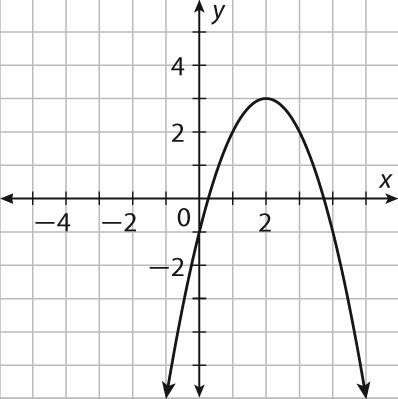
What is the domain of the function?
*Hint: Domain is the set of all x-values included in the function.
1
x≥3
2
x≤3
3
All real numbers
4
-1≤x≤5

5

media

1. Domain and Range

2. Axis of Symmetry

3. Vertex

4. Maximum or Minimum

5. Increasing, Decreasing

6. x-intercepts, zeroes, roots, solutions

7. y-intercept​

What are key features of quadratic functions?

6

Multiple Choice

Question image

What is the range of the function?

*Hint: Range is all of the y-values included in the function.

1

<y3-\infty<y\le3

2

3y<-3\le y<\infty

3

All real numbers

4

-6≤y≤3

7

Multiple Choice

Question image

What is the range?

1

-3 ≤ y < ∞

2

-1 ≤ y < ∞

3

All real numbers

4

-∞ < y ≤ -1

8

Multiple Choice

Question image

Identify the domain and range of the function.

1

Domain: -6 ≤ x ≤ 2

Range: -3 ≤ y ≤ 5

2

Domain: All real number

Range: -3 ≤ y ≤ 5

3

Domain: All real numbers

Range: -∞ < y ≤ 3

4

Domain: All real numbers

Range: 3 ≤ y < ∞

9

Multiple Choice

Question image

What is the domain of the graph?

Notice there are no arrows at the ends of the graph, but endpoints. Pay attention to open circle or closed circle.

1
-3 ≤ x ≤ 3
2
3 ≤ x ≤ -3
3
-2 ≤ x ≤ 10
4
-3 ≤ x ≤ 10

10

Multiple Choice

Question image

What is the range of the graph?

Notice there are no arrows at the ends of the graph, but endpoints. Pay attention to open circle or closed circle.

1
-2 < y < 10
2
-3 < x < 3
3
-2 ≤ y ≤ 10
4
-3≤ x ≤ 3

11

media

1. The Axis, or Line, of Symmetry is a vertical line that divides the parabola into two congruent parts.

2. There is a corresponding y-value on either side of the axis of symmetry​

3. Since the AOS is a vertical line, it has the form of a vertical line: x = #

4. To find the AOS algebraically, set x = -b/2a.​

5. y = 2x2 - 12x + 15​

a = 2, b = -12, c = 15

x = -(b)/2a x = -(-12)/2(2)​

x = 12/4 = 3

Axis of Symmetry (AOS)

12

media

1. The AOS is the x-value of the vertex.

2. To find the AOS on the calculator,

find the max or min, and set x = x value of max or min.

3. 2nd. TRACE. Max or Min. ENTER

4. Set the cursor to the left of the max (min) for left bound. ENTER. Set the cursor to the right of max (min) for right bound. ENTER. When you see "Guess" ENTER again.​

5. The AOS is the x-value. The y-value is the max or min​

AOS on the Calculator

13

Multiple Choice

A parabola has a vertex at (-3,2).
Where is the axis of symmetry?
1
y = -2
2
x = 3
3
x = -3
4
y = 2

14

Multiple Choice

Find the axis of symmetry for

f(x) = x2- 8x + 15.

1

x = -4

2

x = 4

3

y = 4

4

y = -4

15

Multiple Choice

What's the axis of symmetry of y = 3x2 - 6x + 4

1

x=1

2

x=-6

3

x=2

4

x=-1

16

media

1. The vertex is the coordinate point of the maximum, or minimum, point of the parabola.

2. To find the verte​x algebraically, find the axis of symmetry by the formula:

x = -b/2a. Use that value as the x-value of the vertex. For the y-value, substitute the AOS x-value into the function equation.

3. y = 2x2 - 8x + 7

​a = 2, b = -8, c = 7 AOS = -(-8)/2(2) = 2

y = ​2x2 - 8x + 7 = 2(2)2 - 8(2) + 7 = -8+7 = -1

Vertex = (2, -1)​

Vertex

17

Multiple Choice

The graph of a quadratic function is called
1
a line
2
a hyperbola
3
a parabola
4
a cubic

18

Multiple Choice

Standard form of a quadratic equation
1
y=x²
2
y=ax²+bx+c
3
y=mx+b
4
y=x

19

Multiple Choice

Which of the following is NOT a quadratic function
1
f(x) = -3x2
2
f(x) = -5x - x2
3
y = 3x3 - 4x + 5
4
A = pi.r2

20

Multiple Choice

The formula x = -b/2a is used to find
1
the roots
2
the x-value of the vertex
3
the y-intercept
4
the axis of symmetry

21

Multiple Choice

What is the vertex of the quadratic function:
y = x2 - 6x + 11?
1
(3,2)
2
(-3,-2)
3
(-3,2)
4
(3,-2)

22

Multiple Choice

What is the vertex of the quadratic equation

y = 4x2 - 6x + 11?

Find AOS first by x = -b/2a

1

(4, -6)

2

(3/4, 35/4)

3

(-3/4, -35,4)

4

(-3/4, 35/4)

23

media

1, To find the vertex from a table of values, find the y-value where there are corresponding equal y-values to either side.

Vertex from a table of values

24

Multiple Choice

Question image

y=(x+3)(x+5)y=\left(x+3\right)\left(x+5\right)  

What is the vertex of the quadratic equation? (hint: look at the table and see where the y changes)

1

(-4,-1)

2

(-6,3)

3

(-3,0)

4

(-5,0)

25

Multiple Choice

Question image

What is the vertex of the function given in the table?

1

(-2,-1)

2

(2,-1)

3

(-1,2)

4

(0,3)

26

media

1. The maximum or minimum value of a function is the y-value at the vertex

2. If the graph points up (a >0), the the vertex is a minimum

3.If the graph points down (a<0), the the vertex is a maximum

4. To find the maximum or minimum, find the AOS (x = -b/2a) and substitute that value into the function

5. y = 3x2 - 6x + 9, a = 3, b = -6, c = 9

x = -(-6)/2(3) = 6/6 = 1

y = 3(1)2 - 6(1) +9 = -3+6 = 3 = min

Maximum or minimum

27

media

1. The Max or Min is the y-value of the vertex.

2. To find the MAX or MIN on the calculator,

find the max or min, and set y = y value of max or min.

3. 2nd. TRACE. Max or Min. ENTER

4. Set the cursor to the left of the max (min) for left bound. ENTER. Set the cursor to the right of max (min) for right bound. ENTER. When you see "Guess" ENTER again.​

5. The AOS is the x-value. The y-value is the max or min​

MAX or MIN on the Calculator

28

Multiple Choice

Question image
Is this a max or min?
1
max
2
min
3
cannot be determined

29

Multiple Choice

Question image
Is this point a max or min?
1
max
2
min

30

Multiple Choice

Question image
Is this point a max or min?
1
max
2
min

31

Multiple Choice

Question image
Does the quadratic have a max/min vertex, and does the graph open up/down?
1
max/ opens down
2
min/ opens up
3
max/ opens up
4
min/ opens down

32

media

1. Increasing Interval: Over what values of x is the graph rising?

2. Draw a line next to the graph? Does that line have a + slope and rise up from left to right.​ Look on the x-axis to see for what values of x that slope is positive.

3. Decreasing Interval: Over what values of x is the graph falling?​

​4. Draw a line next to the graph? Does that line have a (-) slope and fall from left to right.​ Look on the x-axis to see for what values of x that slope is negative.

5. The graph will switch from increasing to decreasing, or vice versa, at the vertex.​

Increasing and Decreasing intervals

33

Multiple Choice

Question image

What is the increasing interval on the function shown?

1

(, 1)\left(-\infty,\ 1\right)

2

(, 2)\left(-\infty,\ 2\right)

3

(2, )\left(2,\ \infty\right)

4

(1, )\left(1,\ \infty\right)

34

Multiple Choice

Question image

What is the decreasing interval on the function shown?

1

(, 1)\left(-\infty,\ 1\right)

2

(, 2)\left(-\infty,\ 2\right)

3

(2, )\left(2,\ \infty\right)

4

(1, )\left(1,\ \infty\right)

35

Multiple Choice

Question image
Where is the function decreasing?
1
y≤1
2
y≥1
3
y≤2
4
y≥2

36

Multiple Choice

Question image
Where is the function increasing?
1
y≤1
2
y≥1
3
y≥-2
4
y≤-2

37

media

1. X-intercepts are the places where the graph crosses the x-axis. There may be 1, 2, or none.

2. They are also called solutions, roots and zeroes.

3. The y-value of the x-intercept is 0.

4. To find x-intercepts algebraically, factor the quadratic function and set each factor = 0.

5. y = x2 + 5x + 6; Look for factors of 6 that all up to 5. 2 and 3. Factors of the quadratic are (x + 2)(x + 3). Set each factor = 0, and solve.

x + 2 = 0, x = -2; x + 3 = 0, x = -3​

6. Zeros/Solutions will always have the opposite sign of the factor​

X-Intercepts, roots, Zeroes, Solutions

38

media

1. x intercepts are also called zeroes

2. Go to 2ND TRACE

3. ​Choose option "Zeroes", #2

4. Use the cursor to go to the left side of the zero on the graph for left bound. ENTER.

Use the cursor to go the right side of the zero for right bound. ENTER

When you see "GUESS", ENTER again.

5. If you did the process correctly, you should have a value for x, and the y-value should be 0.

6. Remember to repeat this process for each x-intercept.​

Finding x-intercepts on the calculator

39

media

1. The quadratic formula uses the "a", "b" and "c" of the quadratic function in standard form

2. The formula is

x = - (b) ±​ √(b2 - 4ac)/2a

3. The part under the radical (square root), ​(b2 - 4ac) is called the discriminant, and it will tell you how many real roots there are.

4. if (b2 - 4ac)​ = 0, there is 1 real root

if (b2 - 4ac)​ is negative, then there are no real roots, only imaginary/complex roots

If (b2 - 4ac)​ > 0, then there are 2 real roots. They may be rational or irrational (includes a square root)

Finding the x-intercepts with the Quadratic formula

40

media

41

Multiple Choice

Factor the quadratic expression

d2 - 10d + 25

1

(d + 5) (d - 5)

2

(d - 15) (d + 10)

3

(d + 5) (d - 20)

4

(d - 5) (d - 5)

42

Multiple Choice

Question image
Which is a zero of the graph?
1
0
2
-1
3
1.5
4
-3

43

Multiple Choice

If a quadratic function is represented as f(x) = (x - 7)(x + 8), find the zeroes.

1

x = - 7 and x = 8

2

x = 7 and x = -8

44

Multiple Choice

Solve by factoring: x2 + 3x - 18 = 0
1
x = -3 and x = 6
2
x = 3 and x = -6
3
x = -9 and x = 2
4
x = 9 and x = -2

45

Multiple Choice

What are the zeros of x2+9x+14
1
2, 7
2
-2, -7
3
2, -7
4
-2, 7

46

media

1. The y-intercept is the point where the graph intersects the y-axis.

2. It is the constant of the quadratic function.

3. It is sometimes called the beginning value in quadratic problems where a ball is thrown off a ledge.​

4. The x-value for the y-intercept is 0. ​

5. To find on the calculator, you can graph, or you could go to 2nd TRACE, value, and set value = 0.​

Y-Intercept

47

media

1. To find the x-intercepts (solutions, roots, zeroes) on a table, look for the places where y = 0.

2. To find the y-intercepts on a table, look for the places where x = 0.

Find X and Y intercepts from a table

48

Multiple Choice

Question image

y-intercept

1

1

2

-1/2

49

Multiple Choice

Find the y-intercept of
f(x) = 2x2-2x + 1

1
2
2
-2
3
1
4
-1

50

Multiple Select

Question image

Identify the y-intercept

(Find where x = 0)

1

x = -3

2

x = -1

3

x = 1

4

(-1, 4)

5

(0, 3)

51

Multiple Choice

What's the y-intercept of y = 3x2- 6x + 4
1
(4,0)
2
(-4,0)
3
(0,-4)
4
(0,4)

52

Multiple Choice

What is the vertex?
f(x)=x2-8x+3
1
(-8, 3)
2
(4, -13)
3
(4, 0)
4
(-4, 51)

Key Features of Quadratic Functions

By Susan Joyce

Show answer

Auto Play

Slide 1 / 52

SLIDE