Separating a Mixture
Presentation
•
Chemistry
•
9th - 12th Grade
•
Practice Problem
•
Easy
Standards-aligned
Michaela Bratsch
Used 222+ times
FREE Resource
10 Slides • 15 Questions
1
Separating a Mixture
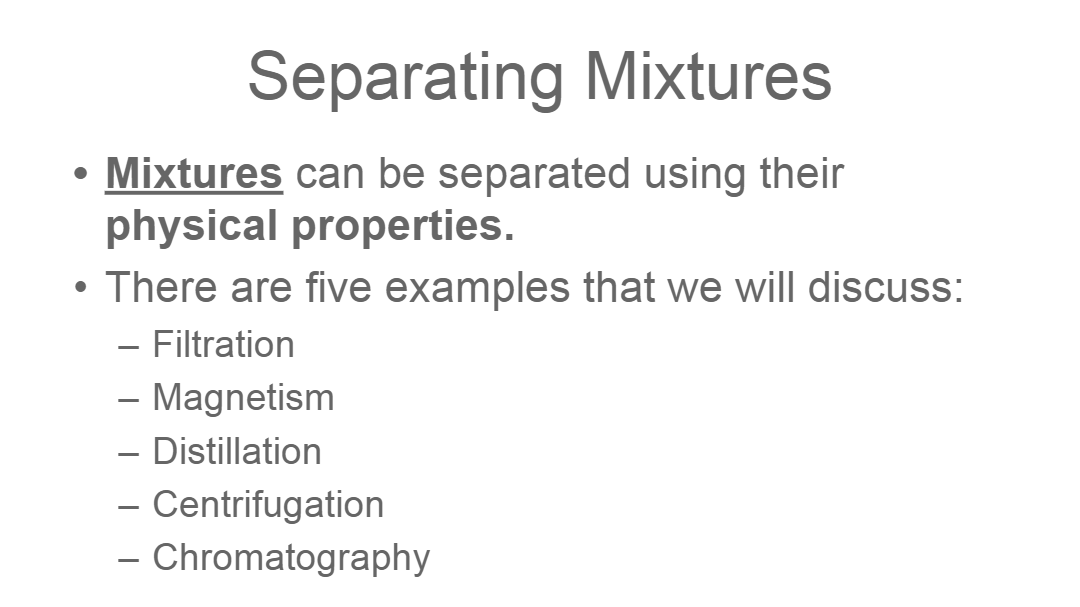
Mixtures can be separated through physical means. These are some common ways to separate a mixture.
2
3
Multiple Choice
Substances in a mixture can be separated by physical methods.
TRUE
FALSE
4
5
Multiple Choice
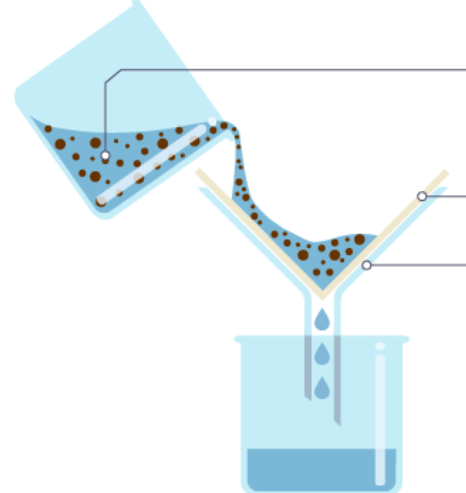
This method separates substances due to differences in the sizes of their particles.
Filtration
Evaporation
Distillation
Chromatography
6
Multiple Choice
Which method is this a picture of?
Filtration
Evaporation
Distillation
Chromatography
7
Multiple Choice
What method of separation would work best to separate water and rubber pellets?
filtration
sifting
evaporation
magnetic attraction
8
9
Multiple Choice
What tool can be used to separate plastic beads and metal paper clips?
filter
magnet
strainer
cloth
10
Multiple Choice
You can boil them.
You can use centrifugation.
11
12
13
Multiple Choice
Which method separates substances based on them having different boiling points?
Filtration
Centrifugation
Distillation
Chromatography
14
Multiple Choice
The process of separating the substances from a liquid mixture by using selective boiling and condensation is called _____.
Decomposition
Filtration
Distillation
Magnetism
15
Multiple Choice
John wants to separate salt from water. What separation technique should he use?
boiling/distillation
filtration
decanting
magnetism
16
17
18
Multiple Choice
magnetism
distillation
19
Multiple Choice
The process where a mixture is separated through spinning is called ______.
Magnetism
Chromatography
Distilling
Centrifuging
20
Multiple Choice
What separation technique is used for separating blood into its 4 components?
Evaporation
decantation
filtration
centrifuging
21
22
23
Multiple Choice
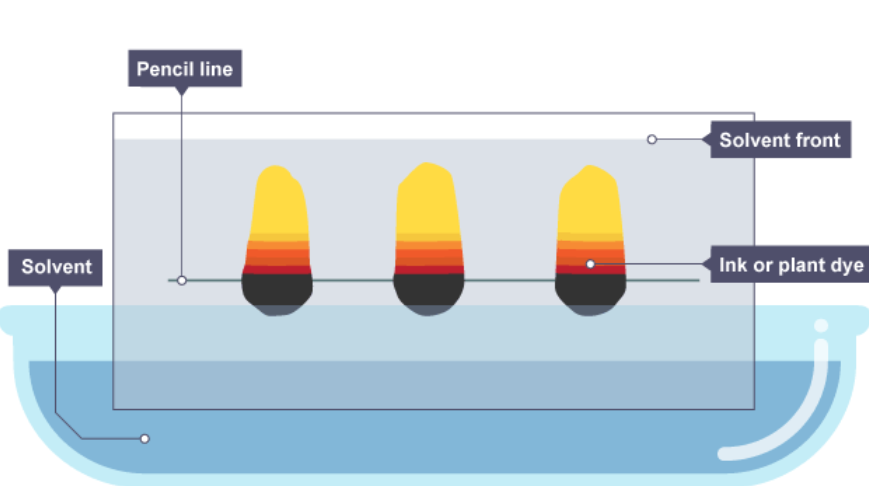
This method separates dissolved substances based on differences in how well they dissolve in a solvent.
Filtration
Evaporation
Distillation
Chromatography
24
Multiple Choice
If a substance is insoluble in water, it ___________.
dissolves in water
cannot dissolve in water
forms a solution when mixed with water
cannot be separated from water
25
Multiple Choice
Which method is this a picture of?
Filtration
Evaporation
Distillation
Chromatography
Separating a Mixture
Mixtures can be separated through physical means. These are some common ways to separate a mixture.
Show answer
Auto Play
Slide 1 / 25
SLIDE

Similar Resources on Wayground
21 questions
Chemistry Phase Diagrams
Lesson
•
9th - 12th Grade
21 questions
Elements Compounds Mixtures Particle Diagrams
Lesson
•
9th - 12th Grade
17 questions
Solutions part 2: Dilutions, Solubility, and Saturation
Lesson
•
10th - 12th Grade
21 questions
Chemical Reactions Intro
Lesson
•
9th - 12th Grade
21 questions
Elements, Compounds, Mixtures
Lesson
•
9th - 12th Grade
17 questions
Gas Laws - Dalton's Partial Pressure
Lesson
•
9th - 12th Grade
20 questions
Properties of Water
Lesson
•
9th - 12th Grade
19 questions
9.1 & 9.2 Entropy
Lesson
•
9th - 12th Grade
Popular Resources on Wayground
10 questions
5.P.1.3 Distance/Time Graphs
Quiz
•
5th Grade
10 questions
Fire Drill
Quiz
•
2nd - 5th Grade
20 questions
Equivalent Fractions
Quiz
•
3rd Grade
15 questions
Hargrett House Quiz: Community & Service
Quiz
•
5th Grade
20 questions
Main Idea and Details
Quiz
•
5th Grade
20 questions
Context Clues
Quiz
•
6th Grade
20 questions
Inferences
Quiz
•
4th Grade
15 questions
Equivalent Fractions
Quiz
•
4th Grade
Discover more resources for Chemistry
20 questions
Acids and Bases
Quiz
•
10th Grade
30 questions
Element compound mixture review quiz
Quiz
•
10th - 12th Grade
10 questions
Determining Protons, Neutrons, and Electrons from the Periodic Table
Interactive video
•
6th - 10th Grade
10 questions
Identifying Types of Chemical Reactions
Interactive video
•
6th - 10th Grade
20 questions
U4 Reaction Types
Quiz
•
10th - 12th Grade
25 questions
Potential Energy Diagram Checkpoint
Quiz
•
11th Grade
46 questions
Quantum, E Config, Periodic Trends
Quiz
•
11th Grade
10 questions
Exploring Types of Chemical Reactions
Interactive video
•
6th - 10th Grade