2.1: Limiting Factors and Pop Growth, 2.2: Comp, Coex, Coop
Presentation
•
Science
•
8th Grade
•
Medium
+3
Standards-aligned
Nancy Osborne
Used 5+ times
FREE Resource
22 Slides • 13 Questions
1

2
Multiple Choice
3
Multiple Choice
Which are the following examples of biological indicators
Nutrients, hormones, phosphorus, DO, pH
living organisms
turbidity, temperature, odour, taste, colour
4
Multiple Choice
Which photo shows eutrophication on a water body (lake) as a result of human activities that continue to overload water systems with excess nutrients?
5
6
7
8
9
Multiple Choice
10
11
Multiple Choice
An example of a population is
all trees in a forest
all maple trees in a forest
all plants in a forest
all animals in a forest
12
Multiple Choice
13
14
Multiple Choice
15
16
Multiple Choice
Since lynx prey on hares, an increase in the hare population causes an increase in the lynx population.
Density-Dependent: Competition
Density-Independent: Competition
Density-Dependent: Predator-Prey
Density-Independent: Predator-Prey
17
Multiple Choice
A severe flood in the Red River Valley causes a decline in the deer population.
Density-Dependent
Density-Independent
18
19
20
21
Multiple Choice
The largest number of individuals that an environment can support long term is...
carrying capacity
emigration
immigration
population density
22
Multiple Choice
What happens if a population grows past its carrying capacity?
The population keeps growing
The population starts to die off
The entire species will go extinct
The carrying capacity just increases
23
Multiple Choice
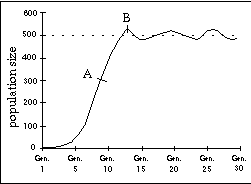
What is the carrying capacity of the graph?
around 500
more than 800
less than 300
around 700
24
25
26
27
28
29
30
Match
Intraspecific competition
Interspecific competition
Coexistence
Cooperation
Carrying Capacity
Competition between members of one species for the same resources.
Competition between two or more different species (community) for the same resources.
Two species living together in the same area without competing
Organisms working together toward a common end or purpose
the maximum number of individuals of a species that an ecosystem can supportEL
Competition between members of one species for the same resources.
Competition between two or more different species (community) for the same resources.
Two species living together in the same area without competing
Organisms working together toward a common end or purpose
the maximum number of individuals of a species that an ecosystem can supportEL
31
32
33
34
35
Show answer
Auto Play
Slide 1 / 35
SLIDE

Similar Resources on Wayground
33 questions
Chemical Properties
Presentation
•
8th Grade
28 questions
Atomic Structure
Presentation
•
8th Grade
27 questions
Phases and Eclipses
Presentation
•
8th Grade
30 questions
Measuring Matter
Presentation
•
8th Grade
26 questions
Energy In = Energy Out
Presentation
•
8th Grade
25 questions
Atoms & Periodic Table
Presentation
•
8th Grade
25 questions
Chemical Bonds
Presentation
•
8th Grade
33 questions
Wave Interaction Notes
Presentation
•
8th Grade
Popular Resources on Wayground
19 questions
Naming Polygons
Quiz
•
3rd Grade
10 questions
Prime Factorization
Quiz
•
6th Grade
20 questions
Math Review
Quiz
•
3rd Grade
15 questions
Fast food
Quiz
•
7th Grade
20 questions
Main Idea and Details
Quiz
•
5th Grade
20 questions
Context Clues
Quiz
•
6th Grade
20 questions
Inferences
Quiz
•
4th Grade
19 questions
Classifying Quadrilaterals
Quiz
•
3rd Grade
Discover more resources for Science
16 questions
Interactions within Ecosystems
Presentation
•
6th - 8th Grade
12 questions
PS.8.1.2, PS.8.1.3, PS.8.1.5 Review
Quiz
•
8th Grade
20 questions
Moon Phases and Eclipses
Quiz
•
6th - 8th Grade
22 questions
6th & 8th Grade Science Material SOL Review
Quiz
•
6th - 8th Grade
49 questions
NC Released EOG 8 Science (2024)
Quiz
•
8th Grade
48 questions
8th Grade NC Science EOG Review 2
Quiz
•
8th Grade
19 questions
Renewable and Nonrenewable Resources (CK)
Quiz
•
8th Grade
20 questions
8th Grade Science STAAR Review
Quiz
•
8th Grade