Search Header Logo
1a /1b

1a /1b

Assessment

Presentation

Science

11th - 12th Grade

Hard

Created by

ELIJAH Diaz

FREE Resource

4 Slides • 64 Questions

1

Multiple Choice

Question image
What is label G
1
Trench
2
Mid ocean ridge
3
abyssal plain
4
sea mount

2

Multiple Choice

Scientists use ______ to map the ocean floor

1

radar

2

pulsar

3

lidar

4

sonar

3

Multiple Choice

Question image

What is label D

1

Trench

2

Mid ocean ridge

3

abyssal plain

4

sea mount

4

Multiple Choice

Question image

What is the process happening at G?

1

Deep ocean trench

2

mid ocean ridge

3

subduction

4

creation of new sea floor

5

Multiple Choice

The material that is rising up from the mantle to form new ocean crust is called?

1

Lava

2

Slate

3

Sedimentary Rocks

4

Magma

6

Multiple Choice

New crust is always formed at the...
1
mid-ocean ridge
2
deep-ocean trench
3
asthenosphere

7

Multiple Choice

Question image
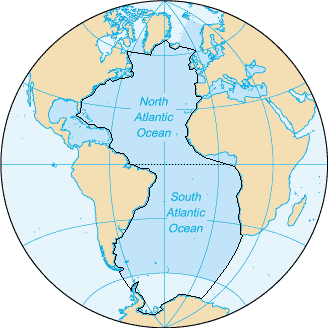
In the Atlantic ocean, where is the youngest seafloor located?
1
Towards the edges, near the eastern and western continents
2
Towards the middle of the ocean
3
Towards the north and south poles
4
Young seafloor is located randomly throughout the ocean

8

Multiple Choice

How is it possible for new crust to be formed without increasing the surface area of the Earth?

1

Crust is recycled in subduction zones at the same time it is created at mid-ocean ridges

2

New crust is underwater where it sinks

3

New crust breaks more easily than old crust

4

The oldest crust just breaks apart as the plates move

9

Multiple Choice

Rock at the mid ocean ridges...

1

is the oldest rock on the earth.

2

is older than continental rock.

3

is younger than continental rock.

10

Multiple Choice

Question image

Seafloor spreading...

1

creates new oceanic crust

2

destroys or recycles crust

3

creates new continental crust

4

creates old crust

11

Multiple Choice

Question image

The average density of continental crust is 2.8 g/cm3 and the average density of oceanic crusts is 3.2 g/cm3. If these two plates came together, what would happen?

1

The two plates would push apart and form a rift zone.

2

The oceanic plate would rise up over the continental plate.

3

The oceanic plate would sink under the continental plate.

4

The two plates would meet head on and rise up to form mountains.

12

Multiple Choice

Question image
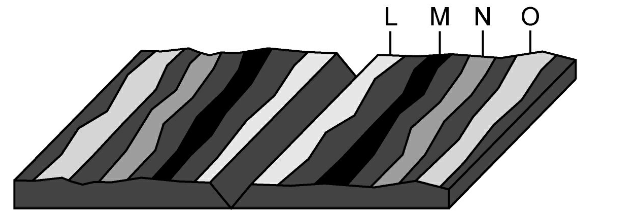
Where would the oldest rock be found?
1
L
2
M
3
N
4
O

13

Multiple Choice

The San Andreas Fault in California is known as an active earthquake area. What type of boundary is it?

1

Converging

2

Diverging

3

Transform

4

Sea Floor Spreading

14

Multiple Choice

Passive continental margins are known for having a lot of earthquakes and active volcanoes

1

True

2

Fasle

15

Multiple Choice

Transform boundaries are most likely to produce what phenomenon?
1
volcanoes
2
deep sea trenches
3
underwater mountain ranges
4
earthquakes

16

Multiple Choice

Question image

As the depth of the ocean water increases, the temperature...

1

increases (warmer)

2

decreases (colder)

17

Multiple Choice

The landforms of the ocean are different than the ones on land

1

True

2

false

18

Multiple Choice

This part of the ocean floor is relatively shallow water and surrounds land.

1

Continental Drift

2

Continental Slope

3

Continental Shelf

4

Continental Breakfast

19

Multiple Choice

Question image

Where are you walking when you are wading in the ocean?

1

Ocean Trench

2

Abyssal Plain

3

Continental Slope

4

Continental Shelf

20

Multiple Choice

The steep slope where the continental shelf drops to the ocean floor is called the...

1

Continetal drop

2

Ocean ridge

3

Oceanic slope

4

Continental Slope

21

Multiple Choice

The gently sloping transition between the continental slope and the deep ocean floor is called the...

1

Oceanic Trenches

2

Seamounts

3

Continental Rise

4

Continental Drop

22

Multiple Choice

Question image
What is letter C pointing to? 
1
abyssal plain
2
seamount
3
mid-ocean ridge
4
continental shelf

23

Multiple Choice

Question image
Which letter is pointing to a trench?
1
A
2
D
3
G
4
B

24

Multiple Choice

Question image

What is the deepest part of the ocean?

1

Abyssal Hill

2

Oceanic Crust

3

Ocean Trenches

4

Volcano

25

Multiple Choice

Question image
Letter D is pointing to the...
1
continental slope
2
continental shelf
3
trench
4
mid-ocean ridge

26

Multiple Choice

A mountain that rises above the ocean floor but stays below the surface of the water is called ...

1

Sea Hills

2

Oceanic Crust

3

Continental Shelf

4

Seamount

27

Multiple Choice

Question image

An underwater volcano that eventually forms an island is an.....

1

Mid-Ocean Ridge

2

Volcanic Island

3

Hawaii

4

None are correct

28

Multiple Choice

Question image

Identify #3 and #9

1

Continental shelf

2

Continental slope

3

Continental rise

4

Seamount

5

Rift Valley

29

Multiple Choice

Question image

Identify #1 and #11

1

Continental shelf

2

Continental slope

3

Continental rise

4

Seamount

5

Rift Valley

30

Multiple Choice

What is the steep slope at the edge of the continental shelf?
1
seamount
2
mid-ocean ridge
3
continental slope
4
rift zone

31

Multiple Choice

Where is the shallowest part of the ocean floor?
1
continental slope
2
continental shelf
3
abyssal plains
4
rift zones

32

Multiple Choice

Question image
Which landform is represented by letter A?
1
continental shelf
2
continental slope
3
abyssal plain
4
trench

33

Multiple Choice

Question image

Identify #4 and #8

1

Continental shelf

2

Continental slope

3

Continental rise

4

Seamount

5

Rift Valley

34

Multiple Choice

Question image

Identify #5 and #7

1

Continental shelf

2

Abyssal plain

3

Continental rise

4

Seamount

5

Rift Valley

35

Multiple Choice

Heat breaks the hydrogen bonds

1

True

2

False

36

Multiple Choice

Question image

Which letter indicates where water is in both the solid and liquid phase at the same time?

1

A

2

B

3

C

4

D

5

E

37

Multiple Choice

Which property explains why ice floats?

1

adhesion

2

density

3

cohesion

4

heat capacity

38

Multiple Choice

A high specific heat means...
1
It heats up quickly with energy added
2
It requires more energy to change temperature

39

Multiple Choice

The amount of energy required to raise the temperature 1ºC for every kilogram is called____?
1
Thermal Energy
2
Specific Heat
3
Temperature
4
Kinetic Energy

40

Multiple Choice

Water has a low rate of vaporization which is why there is a lot of ocean water

1

True

2

False

41

Multiple Choice

Water is a universal solvent

1

True

2

False

42

Multiple Choice

Ocean salinity is approx....

1

.35%

2

35%

3

3.5%

43

Multiple Choice

What would cause a body of water to have a higher salinity?

1

decreasing condensation

2

increasing transpiration

3

increasing evaporation

4

decreasing evaporation

44

Multiple Choice

As we go deeper into the ocean, salinity ___________. 
1
Doubles
2
Decreases 
3
Increases
4
Remains the same 

45

Multiple Choice

______ causes deep ocean currents

1

The Coriolis Effect

2

gravity

3

wind

4

density differences

46

Multiple Choice

What process brings the deep cold ocean currents up to the surface?
1
Conduction
2
Global Wind Patterns
3
Convection Currents
4
Temperature and salinity

47

Multiple Choice

In addition to salinity, what factor affects the density of seawater?
1
depth
2
latitude
3
temperature
4
salt content

48

Multiple Choice

Why are surface currents at the surface of the ocean?
1
colder temperature
2
colder temperature & more salinty
3
warmer temperature & less salinty
4
less salinty

49

Multiple Choice

Question image
What two elements make up water?
1
Helium and oxygen
2
Hydrogen and oxygen
3
helium and carbon
4
oxygen and carbon

50

Multiple Choice

Question image
When a molecule has an opposite electrical charge on each end, it is known as what?
1
cohesion
2
polar molecule
3
hydrogen bond
4
solution

51

Multiple Choice

How much of Earth's water is salt water?
1
50%
2
66%
3
75%
4
97%

52

Multiple Choice

How much of Earth's water is available to drink?

1

2%

2

12%

3

1%

4
97%

53

Multiple Choice

Question image

The ability of water molecules to stick to each other, creating surface tension is called:

1

Cohesion

2

Adhesion

3

Insulation

4

Ph

54

Multiple Choice

Question image

The fact that water can stick to other substances is called:

1

Ph

2

Adhesion

3

Cohesion

4

Insulation

55

Multiple Choice

Water is a universal solvent because it...
1
It can be found anywhere
2
It freezes when it gets cold
3
floats when frozen
4
Dissolves most substances

56

Multiple Choice

Question image
When water molecules stick easily to other water molecules, this is called what?
1
cohesion
2
adhesion
3
solution
4
polar molecule

57

Multiple Choice

Large bodies of water, such as lakes and oceans, do not quickly fluctuate in temperature. What is the reason for this phenomenon?
1
Water is an acid.
2
Water is a versatile solvent.
3
Water has a high heat capacity.
4
 Water acts as a buffer.

58

Multiple Choice

Why does ice float?
1
As water freezes, it expands and its density decreases.
2
As water freezes, it takes up more hydrogen from the atmosphere, causing it to have a greater buoyancy.
3
As water freezes, air becomes trapped between the hydrogen bonds of water molecules.
4
As water freezes, it takes up more oxygen from the atmosphere, causing it to have a greater buoyancy.

59

Multiple Choice

Question image

This molecule structure is

1

Ice

2

Water

3

Vaporized water

60

Multiple Choice

Question image

This molecule structure is

1

Ice

2

Water

3

Vaporized water

61

Multiple Choice

Question image

This molecule structure is

1

Ice

2

Water

3

Vaporized water

62

Multiple Choice

Colder water rises

1

True

2

False

63

Multiple Choice

Warmer water is less dense than cold water

1

True

2

False

64

Multiple Choice

Currents are essential to life in the ocean

1

True

2

false

65

Explanation Slide...

media

66

Explanation Slide...

media

67

Explanation Slide...

media

68

Explanation Slide...

media
Question image
What is label G
1
Trench
2
Mid ocean ridge
3
abyssal plain
4
sea mount

Show answer

Auto Play

Slide 1 / 68

MULTIPLE CHOICE