Search Header Logo
After Mid Term Remediation

After Mid Term Remediation

Assessment

Presentation

Biology

9th Grade

Medium

Created by

Anissa Gaines

Used 2+ times

FREE Resource

0 Slides • 58 Questions

1

Multiple Choice

Proteins are made of monomers called ___________
1
Nucleotides
2
Monosaccharides
3
Amino Acids
4
Glycerol and fatty acids

2

Multiple Choice

The element _______is found in all of the organic compounds.
1
Iron
2
Nitrogen
3
Carbon
4
Oxygen

3

Multiple Choice

DNA and RNA are examples of 
1
Carbohydrates
2
Lipids
3
Proteins
4
Nucleic Acids

4

Multiple Choice

Nucleotides are monomers of
1
Carbohydrates
2
Lipids
3
Proteins
4
Nucleic Acids

5

Multiple Choice

Monosaccharides are monomers of
1
Carbohydrates
2
Lipids
3
Proteins
4
Nucleic Acids

6

Multiple Choice

Glycerol and fatty acids are the monomers of
1
Carbohydrates
2
Lipids
3
Proteins
4
Nucleic Acids

7

Multiple Choice

What is the function of nucleic acids?
1
store genetic information
2
store energy (long-term)
3
store energy (short-term)
4
build skin, hair, nails, muscles

8

Multiple Choice

Which of the following organic compounds is the main source of energy for living things?
1
carbohydrates
2
lipids
3
nucleic acids
4
proteins

9

Multiple Choice

Carbohydrates are made of... 
1
C H O
2
C H O N
3
C H O N P
4
C H O N S

10

Multiple Choice

Proteins are made of... 
1
C H O
2
C H O N
3
C H O N P
4
C H O N S

11

Multiple Choice

What is a substance called if it speeds up a chemical reaction?
1
reusable
2
catalyst
3
specific
4
fragile

12

Multiple Choice

With what 3 letters do enzymes typically end?
1
-ose
2
-ase
3
-ese
4
-tic

13

Multiple Choice

Enzymes are an example of

1

Lipids

2

Carbohydrate

3

Protein

4

Nucleic Acid

14

Multiple Choice

Each enzyme only has 1 substrate that will fit its active site.  What is this called?
1
reusable
2
catalyst
3
specific
4
fragile

15

Multiple Choice

Question image
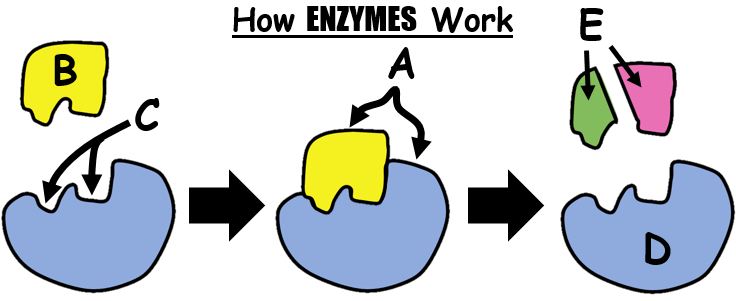
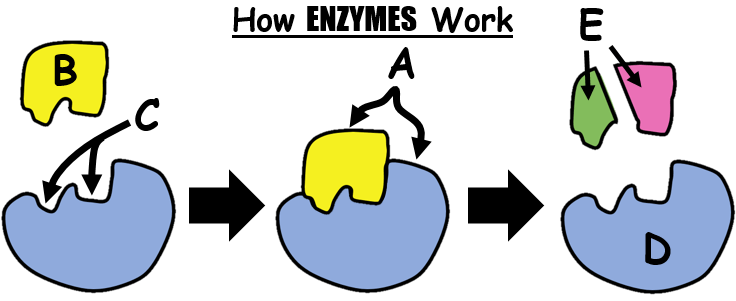
In the diagram, what is letter A? 
1
product
2
substrate
3
enzyme-substrate complex
4
active site

16

Multiple Choice

Question image
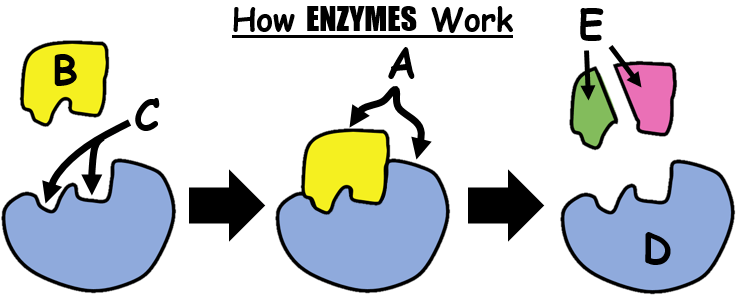
Letter D...
1
active site
2
enzyme
3
substrate
4
products

17

Multiple Choice

Question image
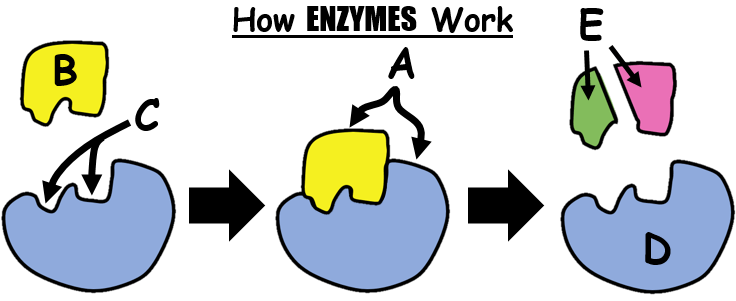
Letter B...
1
active site
2
enzyme
3
substrate
4
products

18

Multiple Choice

Question image
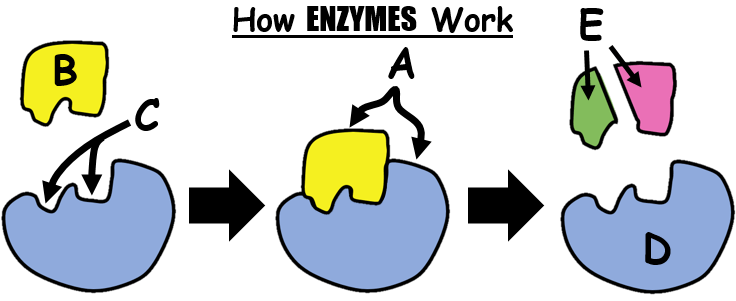
Letter C...
1
active site
2
enzymes
3
substrate
4
products

19

Multiple Choice

Question image
Letter E...
1
active site
2
enzyme
3
substrate
4
products

20

Multiple Choice

Question image
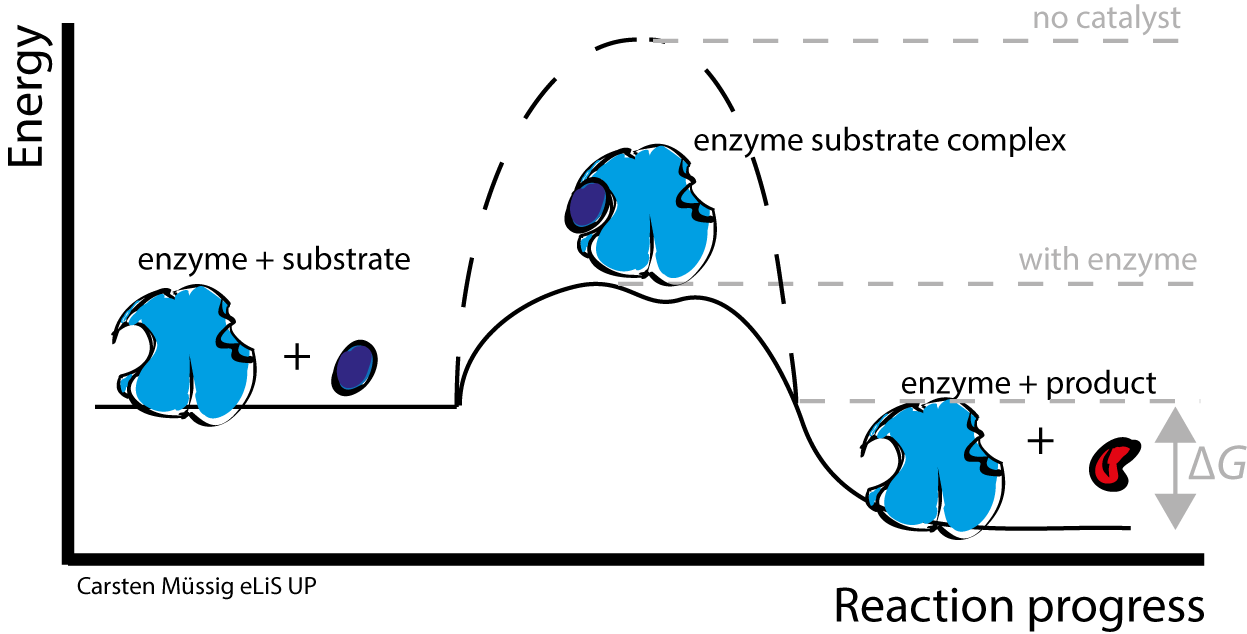
An enzyme speeds up a reaction by
1
lowering the activation energy.
2
raising the activation energy.
3
releasing energy.
4
absorbing energy.

21

Multiple Choice

What happens when enzymes are heated to a high temperature?

1

The enzymes die.

2

The shape of the enzyme are changed and it denatures

3

The enzymes' amino acid sequence changes.

4

The enzymes remain the same

22

Multiple Choice

Question image
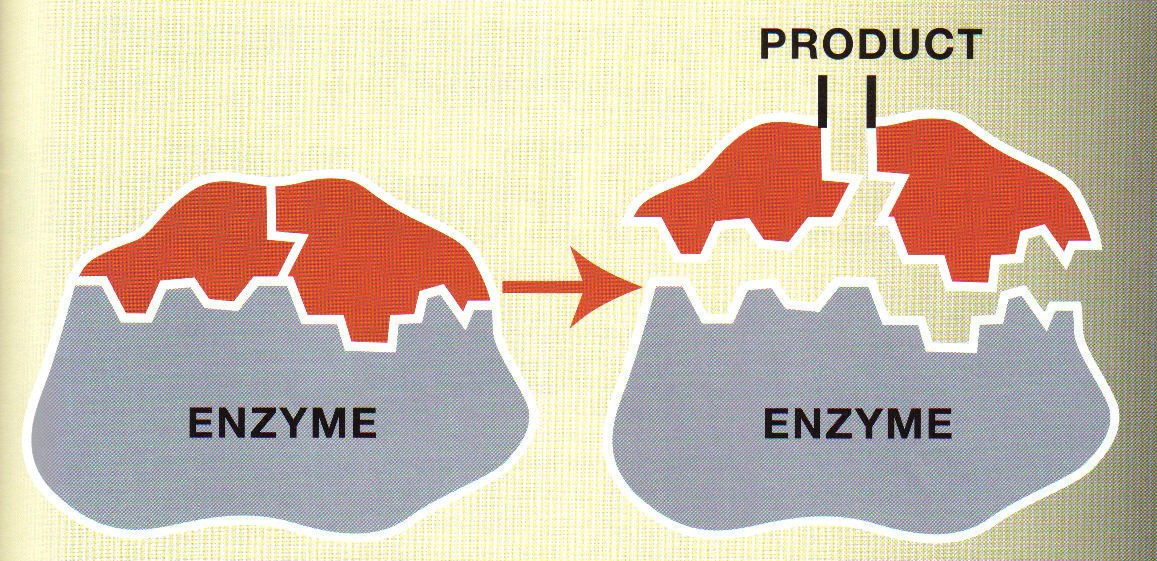
The molecule an enzyme is working on is called the:
1
Substrate
2
Solvent
3
Allosteric Inhibitor
4
CoEnzyme

23

Multiple Choice

Which of these is NOT true?
1
Enzymes can denature (change shape) when the temperature gets too high.
2
Enzymes can only be used once in a chemical reaction. 
3
Extreme pH can denature enzymes.
4
Enzymes speed up chemical reactions. 

24

Multiple Choice

Question image
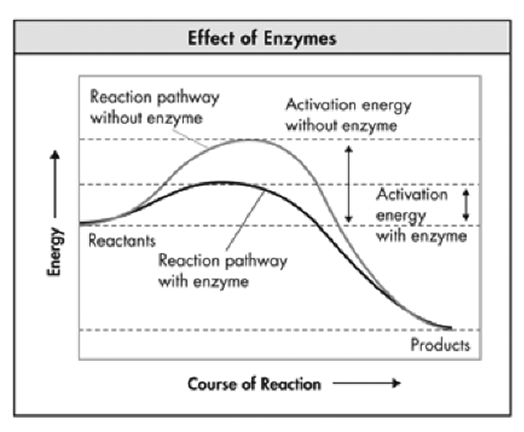
The graph shows how enzymes affect reactions in cells. Which statement best summarizes the information shown in the graph?
1
Enzymes increase the energy of the reactants.
2
Enzymes decrease the energy level of the products.
3
Enzyme decrease the activation energy of the reaction.
4
Enzymes reverse the direction of the reaction.

25

Multiple Choice

What is the function of an enzyme?
1
enzymes break themselves into small pieces
2
enzymes slow down chemical reactions
3
enzymes speed up chemical reactions
4
enzymes combine products to form reactants 

26

Multiple Choice

Enzymes will make a reaction go _______ and use ______ energy.
1
faster, less
2
faster, more
3
slower, less
4
slower, more

27

Multiple Choice

What happens to an enzyme when it is denatured?
1
Activation energy is lowered.
2
It becomes stronger.
3
It loses its shape.
4
Activation energy is raised.

28

Multiple Choice

Every enzyme has a optimal temperature and pH. True or False?
1
True 
2
False

29

Multiple Choice

Which organelle contains DNA and controls the cell?

1

Cell membrane

2

nucleus

3

nucleolus

4

lysosme

30

Multiple Choice

___ is particle movement from an area of lower concentration to an area of higher concentration.

1

Active transport

2

Passive transport

31

Multiple Choice

___ is particle movement from an area of lower concentration to an area of higher concentration.

1

Active transport

2

Passive transport

32

Multiple Choice

Which organelle controls what goes in and out of the cell?

1

nucleus

2

nucleolus

3

cell membrane

4

nuclear membrane

33

Multiple Choice

Which type of passive transport focuses on the movement of water through the membrane?

1

Facilitated diffusion

2

Osmosis

3

Diffusion

34

Multiple Choice

Which type of passive transport focuses on the movement of water through the membrane?

1

Facilitated diffusion

2

Osmosis

3

Diffusion

35

Multiple Choice

What term describes a solution that has the same solute concentration inside of and outside of the cell?

1

Hypertonic

2

Hypotonic

3

Isotonic

36

Multiple Choice

This pigment is found in chloroplasts.

1

rhodopsin

2

chlorophyll

3

thylakoid

4

stroma

37

Multiple Choice

Question image

The cell shrunk in size, which means it was placed in a ____ solution.

1

Isotonic

2

Hypertonic

3

Hypotonic

38

Multiple Choice

What term describes a solution that has the same solute concentration inside of and outside of the cell?

1

Hypertonic

2

Hypotonic

3

Isotonic

39

Multiple Choice

What is the diffusion of water across a cell or semi-permeable membrane?

1
Osmosis
2
Diffusion
3
Active Transport
4
Passive Transport

40

Multiple Choice

Proteins are produced at this organelle.

1

golgi body

2

ribosome

3

cytoskeleton

4

cilia

41

Multiple Choice

In which case would a cell most likely shrink?
1
when placed in a solution containing a high salt concentration
2
when placed in a isotonic solution
3
when placed in a solution containing a low pH
4
when placed in a solution containing distilled water

42

Multiple Choice

Question image

The cell shrunk in size, which means it was placed in a ____ solution.

1

Isotonic

2

Hypertonic

3

Hypotonic

43

Multiple Choice

Active transport requires energy because...
1
The cell is moving something against a concentration gradient
2
The cell is moving something with a concentration gradient

44

Multiple Choice

this organelle makes ATP.

1

chloroplast

2

mitochondria

3

ribosome

4

nucleolus

45

Multiple Choice

A student noticed that placing wilted lettuce in a bowl of cool water caused the lettuce to become more crisp and firm. What is the best explanation for his observation?
1
Water moved into the lettuce cells by active transport.
2
Water moved into the lettuce cells by osmosis.
3
Salt moved into the lettuce cells by diffusion.
4
Water moved out of the lettuce cells by osmosis.

46

Multiple Choice

What is the diffusion of water across a cell or semi-permeable membrane?

1
Osmosis
2
Diffusion
3
Active Transport
4
Passive Transport

47

Multiple Choice

Question image

What part of the cell regulates what can enter and leave the cell?  

1
Cell Membrane
2
Nucleus
3
Mitochondria
4
Cytoplasm

48

Multiple Choice

The ____________ packages and processes material before it exports out of the cell.
1
Vacuoles
2
mitochondria
3
Golgi apparatus 
4
nucleus 

49

Multiple Choice

Question image
The picture below is an example of _________________.
1
osmosis
2
isotonic
3
diffusion
4
active transport

50

Multiple Choice

In which case would a cell most likely shrink?
1
when placed in a solution containing a high salt concentration
2
when placed in a isotonic solution
3
when placed in a solution containing a low pH
4
when placed in a solution containing distilled water

51

Multiple Choice

Which of the following is an enzyme filled organelle that breaks down waste in the cell?
1
lysosomes
2
chloroplast
3
mitochondria 
4
Golgi apparatus 

52

Multiple Choice

Active transport requires energy because...
1
The cell is moving something against a concentration gradient
2
The cell is moving something with a concentration gradient

53

Multiple Choice

Which of the following is found inside a prokaryote?
1
cytoplasm
2
DNA
3
ribosomes
4
all of these

54

Multiple Choice

A student noticed that placing wilted lettuce in a bowl of cool water caused the lettuce to become more crisp and firm. What is the best explanation for his observation?
1
Water moved into the lettuce cells by active transport.
2
Water moved into the lettuce cells by osmosis.
3
Salt moved into the lettuce cells by diffusion.
4
Water moved out of the lettuce cells by osmosis.

55

Multiple Choice

Both Eukaryotic and Prokaryotic cells have __________.

1

ribosomes

2

nucleus

3

ribosomes and a nucleus.

56

Multiple Choice

Question image

What part of the cell regulates what can enter and leave the cell?  

1
Cell Membrane
2
Nucleus
3
Mitochondria
4
Cytoplasm

57

Multiple Choice

Prokaryotic cells do not have…….

1

membrane bound organelles

2

cell membrane

3

DNA

4

genetic material

58

Multiple Choice

Question image
The picture below is an example of _________________.
1
osmosis
2
isotonic
3
diffusion
4
active transport
Proteins are made of monomers called ___________
1
Nucleotides
2
Monosaccharides
3
Amino Acids
4
Glycerol and fatty acids

Show answer

Auto Play

Slide 1 / 58

MULTIPLE CHOICE