

Periodic Table

Presentation
•
Science
•
9th Grade
•
Hard

yamna Alketbi
Used 86+ times
FREE Resource
33 Slides • 5 Questions
1

The Periodic Table
Lesson 3
2

Why is part of the periodic table separate
and below the rest of it?
Focus Question
3

electron dot diagram
group
period
periodic table
New Vocabulary
4
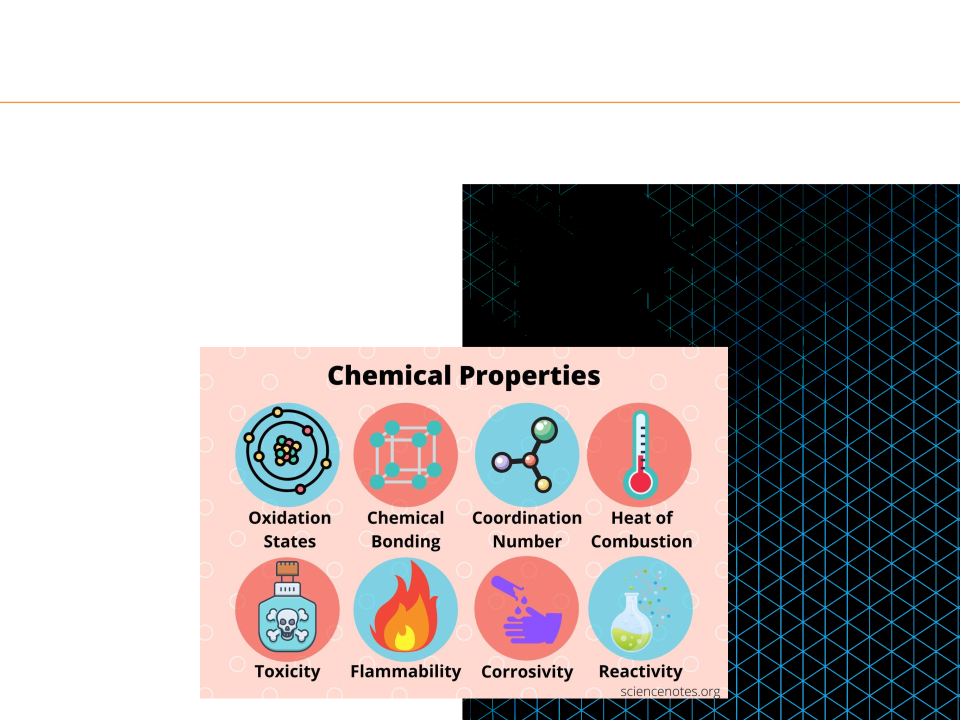
chemical property: any characteristic of a
substance that indicates whether it can undergo
a certain chemical change
Review Vocabulary
5

What do you see in this picture
Periodic
6

7
8

In the late 1800s, a Russian chemist named Dmitri
Mendeleev presented a way to organize
all the known elements.
•
He arranged elements in rows based on increasing
atomic mass.
•
He arranged elements in columns based on
elements that shared similar physical and chemical
properties.
•
He left blank spaces and predicted properties for
elements not yet discovered.
Organizing the Elements
9

Mendeleev’s Predictions
Predicted Properties of
Ekasilicon (Es)
Actual Properties of
Germanium (Ge)
Existence predicted:1871
Actual Discovery:1886
Atomic mass= 72
Atomic mass=72.61
High melting point
Melting point=938oC
Density=5.5g/cm3
Density=5.323 g/cm3
Dark gray metal
Gray metal
Density of EsO2=4.7g/cm3
Density of GeO2=4.23g/cm3
Scientists later confirmed the identities of the missing elements and found
that their properties were similar to what Mendeleev had suggested.
10

In the modern periodic table, the elements are
arranged by increasing atomic number—not
atomic mass—and by periodic changes in
physical and chemical properties.
Organizing the Elements
11

Changes in Periodic table
Increasing
atomic mass
12
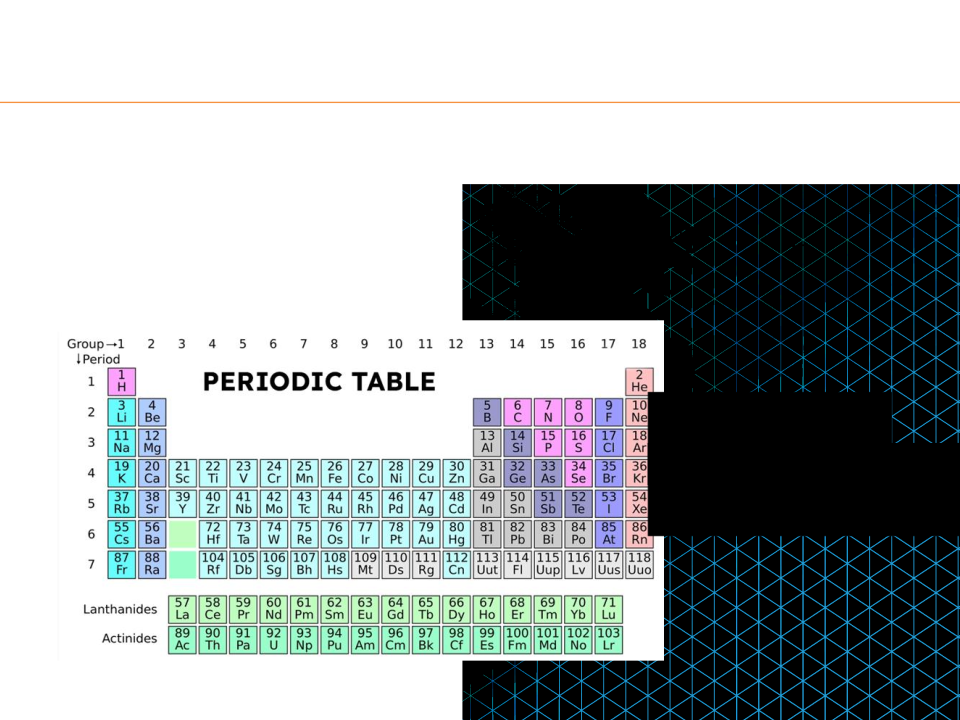
Changes in Periodic table
In 1913, A young English scientist named Henry G.J Moseley arranged all the
known elements based on increasing atomic number ( the number of protons).
This new arrangement seemed to solve the problem of fluctuating mass.
Increasing
atomic number
13
Multiple Choice
What was Henry Moseley’s improvement to the periodic table?
He arranged elements by atomic mass.
He arranged elements by atomic number.
He placed elements with similar properties in columns.
He placed elements with similar properties in rows.
14

•
The modern periodic table consists of boxes,
each containing information such as element
name, symbol, atomic number, and atomic
mass.
•
The horizontal rows of elements in the
periodic table are called periods and are
numbered 1 through 7.
•
The vertical columns in the periodic table are
called groups (also called families), and they
are numbered 1 through 18.
The Atom and the Periodic Table
15
16
17

Knowing in which region an element is located
allows you to know its likely properties.
Regions of the Periodic Table
18
19
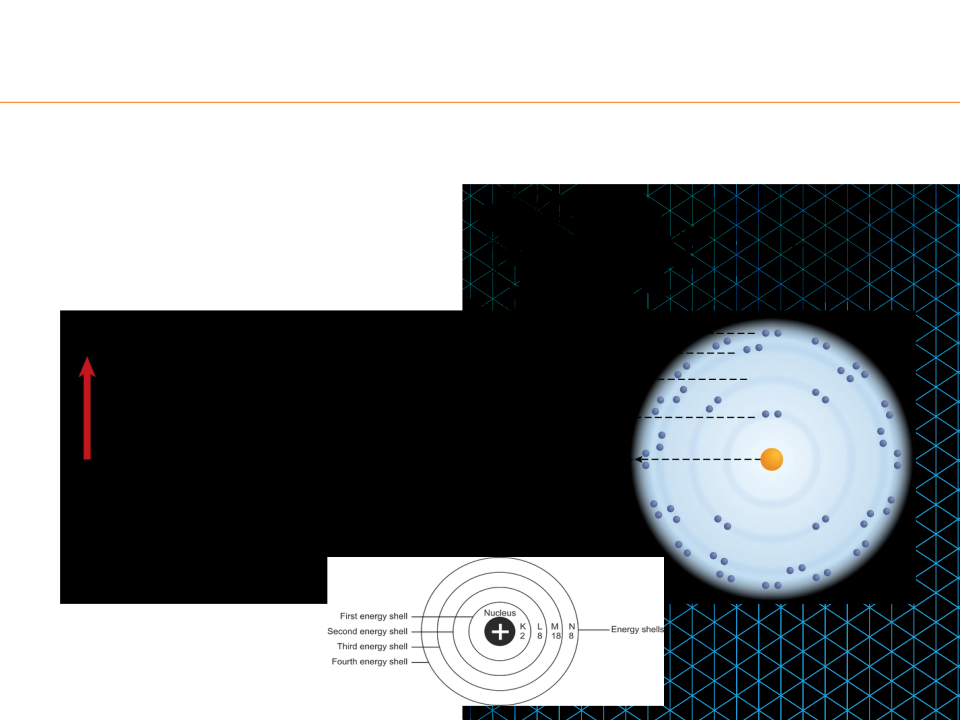
Scientists have discovered that electrons within an
electron cloud have different amounts of energy.
Scientists model the energy differences between
electrons by placing electrons in energy levels.
Electron cloud structure
Step 1=less energy
Step4=more energy
20
Multiple Choice

How many more electrons can energy level 4 hold than energy level 3?
14
18
32
50
21

Electron cloud structure
22

Electron cloud structure
Elements in the same group have the same number of electrons in their outermost energy
(valence electrons) which determines the chemical properties of each individual element.
23
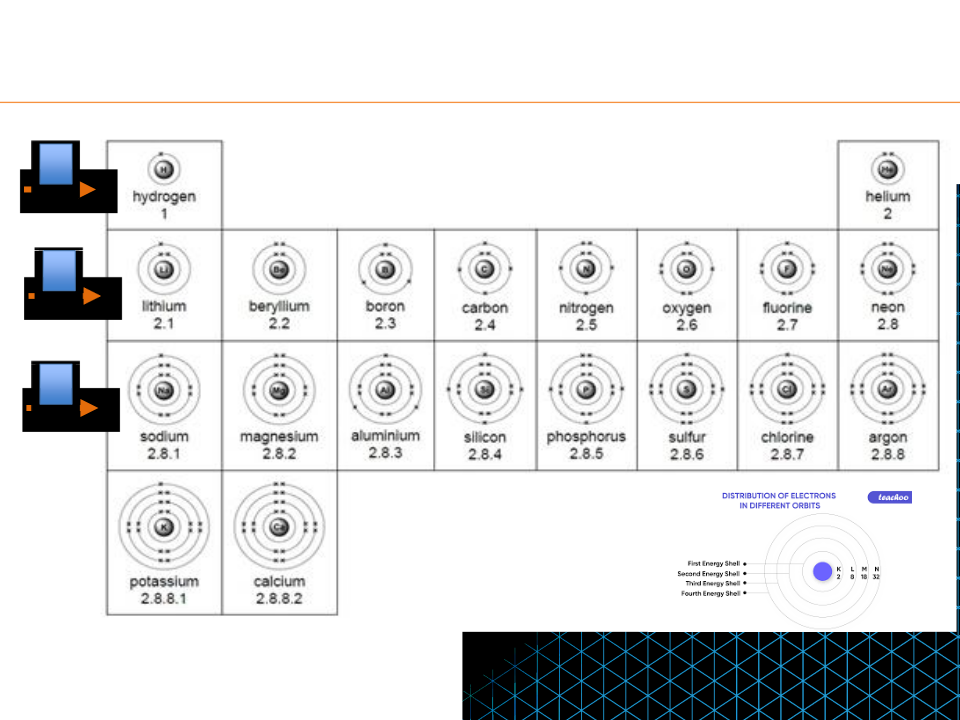
Electron cloud structure
Energy levels coincide with the number of rows on the periodic table. ( 1 to 7 )
1
2
3
24

An electron dot diagram
consists of the chemical
symbol of an element
surrounded by dots to
represent the number of
electrons in the outermost
energy level. Elements in the
same group have the same
number of electrons in their
outermost energy levels.
The Atom and the Periodic Table
25

The Atom and the Periodic Table
26
27

28

An electron dot diagram can provide
information about how an atom might react,
the substance it could form, and why an atom
might be nonreactive.
The Atom and the Periodic Table
29

30
Multiple Choice

What can you determine about this element from its electron dot diagram?
It is from group 1 and is reactive.
It is from group 18 and is reactive.
It is from group 1 and is unreactive.
It is from group 18 and is unreactive.
31
32

New Elements
Scientists around the world continue their research into the synthesis elements.
Elements
Roentgenium (Rg)
Element 111 officially approved
in 2004
Copernicium (Cn)
Element 112 in 2010
Scientists have synthesized elements 113 through 118.
The search for elements with higher atomic numbers continues.
These elements are produced in the laboratory by joining smaller atom into a
single larger atom.
33


34

•
Many of the same elements are found
throughout the universe.
•
Many scientists think that hydrogen and helium
are the building blocks of all other elements.
•
Atoms fuse within stars to produce heavier
elements with atomic numbers greater than
hydrogen and helium.
Elements in the Universe

35
Multiple Choice

Which best describes magnesium based on its location ?
It’s a metal and is likely shiny
It’s a nonmetal and is likely shiny.
It’s a metal and is likely a gas.
It’s a nonmetal and is likely a gas.
36
37
38
Multiple Choice
Which statement correctly describes the periodic table?
Elements in a group have similar properties but different numbers of outermost electrons.
Elements in a period have similar properties but different numbers of outermost electrons.
Elements in a group have similar properties and the same number of outermost electrons.
Elements in a period have similar properties and the same number of outermost electrons.
The Periodic Table
Lesson 3
Show answer
Auto Play
Slide 1 / 38
SLIDE
Similar Resources on Wayground

31 questions
Intro to Genetics Lesson
Presentation
•
10th Grade
33 questions
Diffusion and Osmosis Notes
Presentation
•
9th Grade
33 questions
Wave Interaction Notes
Presentation
•
8th Grade
33 questions
Chemical Properties
Presentation
•
8th Grade
35 questions
Cell Organelles
Presentation
•
9th Grade
31 questions
Cell division terms 2 - mitosis prep
Presentation
•
10th Grade
35 questions
Chapter 10 Forces and Motion Lesson 1 & 2
Presentation
•
8th Grade
34 questions
Pax Romana & Contributions
Presentation
•
9th Grade
Popular Resources on Wayground
10 questions
Safety Day 2026 – Student Review

Quiz
•
9th Grade
21 questions
Continents and Oceans
Quiz
•
6th Grade
20 questions
Parts of Speech
Quiz
•
5th Grade
16 questions
Subject & Predicate
Quiz
•
5th Grade
25 questions
Multiplication Facts
Quiz
•
5th Grade
12 questions
Map Skills
Quiz
•
3rd Grade
22 questions
Continents and Oceans
Quiz
•
5th Grade
15 questions
Rounding Decimals
Quiz
•
5th Grade
Discover more resources for Science
10 questions
Exploring Chemical and Physical Changes

Interactive video
•
6th - 10th Grade
20 questions
Atomic Structure
Quiz
•
9th Grade
10 questions
Exploring the Electromagnetic Spectrum for Middle School Science
Interactive video
•
6th - 10th Grade
10 questions
Exploring Force and Motion Concepts
Interactive video
•
6th - 10th Grade
10 questions
Exploring Air Masses and Weather Fronts
Interactive video
•
6th - 10th Grade
10 questions
Exploring the States of Matter
Interactive video
•
6th - 10th Grade
10 questions
Exploring Forces: Net Force, Normal Force, Gravity, and Friction
Interactive video
•
6th - 10th Grade
10 questions
Differentiating Thermal Energy and Temperature
Interactive video
•
6th - 10th Grade