Unit 2 Lesson 2: Relative Dating
Presentation
•
Science
•
6th Grade
•
Medium
+6
Standards-aligned
Jesse Jayne
Used 34+ times
FREE Resource
13 Slides • 22 Questions
1
2
Open Ended
An example of something old...
3
Open Ended
An example of something young...
4
Open Ended
An example of something that is horizontal...
5
Open Ended
An example of something older than you...
6
Multiple Choice
The hardened remains of a living thing that died long ago.
fossil
extinct
endangered
minerals
7
Multiple Choice
Which type of rock are most fossils found?
sedimentary rock
metamorphic rock
igneous rock
fossils
8
9
10
Multiple Choice
Which of these is the best indication of the relative age of a rock layer?
The chemical make-up of the layer
The thickness of the layer
The position of the layer compared to another layer
The distance of the layer extending over Earth
11
Multiple Choice
Using Absolute and Relative Age
This tiny speck is a crystal that was found in a sandstone rock in Australia. It's about 4.2 billion years old. The person holding it is Simon Wilde, who discovered it in 1984. Is this an example of Relative Age or Absolute Age
Absolute Age
Relative Age
12
Multiple Choice
Relative age of a rock is the number of years that have passed since the rock formed?
True
False
13
Multiple Choice
This coin is the newest in my collection .
Is the statement describing (A) absolute age or (R) relative age?
Relative Age
Absolute Age
14
15
Multiple Choice
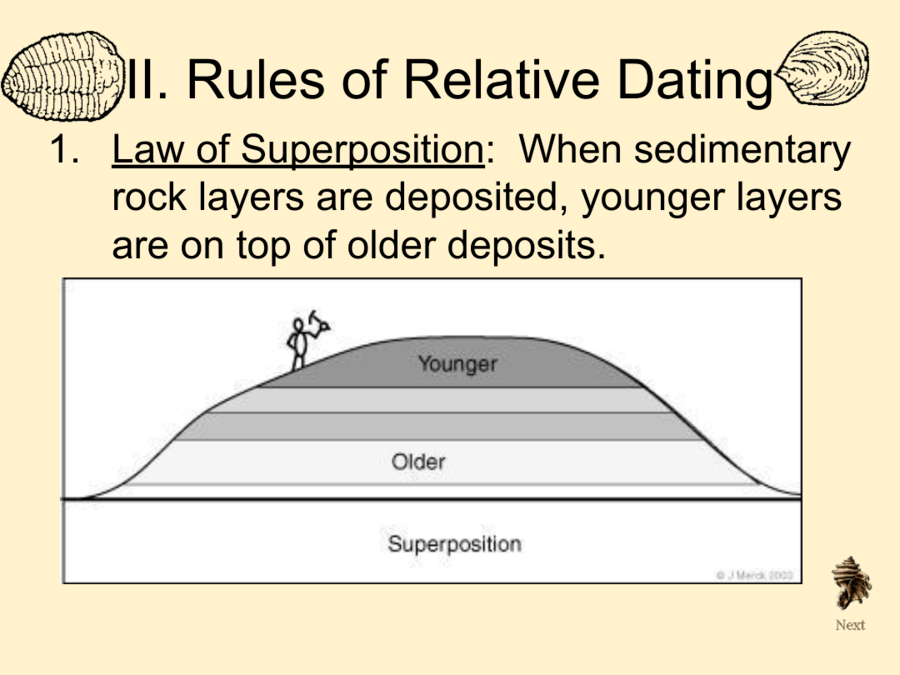
Summarize the Law of Superposition
The youngest rocks are located at the bottom of the rock layers
The oldest rocks are located at the bottom of the rock layers
The ages of the rocks are mixed between the layers of the rock
The ages of all the rocks are the same throughout all the layers
16
17
Multiple Choice
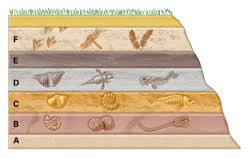
Which layer is the oldest?
A
B
C
D
18
19
Multiple Choice
What does the Law of Original Horizontality mean?
Sedimentary Rocks nautrally form vertical layers and then they fall horizontally
Sedimentary Rocks form in horizontal layers
Sedimentary Rocks form vertical and horizontal layers
Sedimentary Rocks cannot change direction once formed
20
21
Multiple Choice
Using the information from the previous slides. Which Rock layer is the oldest?
1
2
3
4
22
Multiple Choice
Using the information from the prevous slides. Which rock layer is the youngest?
1
2
3
4
23
Multiple Choice
24
Multiple Choice
Which of the following is true?
A fault is younger than the rock layers that it goes through.
A fault is older than the rock layers that it goes through.
The rock layers are younger than the fault that cuts through it.
25
Multiple Choice
Which of the following is true?
An igneous intrusion is older than the rock layers that it goes through.
An igneous intrusion is younger than the rock layers that it goes through.
The rock layers are younger than the intrusion that cuts through it.
26
27
28
Multiple Select
What are two ways that a rock layer can cause a gap in the geologic record?
when an intrusion occurs
when a rock layer is eroded
when a fault breaks and separates rock layers
when sediment is not deposited for a very long time
29
30
31
32
Multiple Choice
33
Multiple Choice
34
Multiple Choice
The fossil record shows that horseshoe crabs have existed with very little change for about 1 billion years. Would horseshoe crabs be useful as an index fossil?
Yes, because they were around for a very long time
No, because horseshoe crabs can never be used as index fossils
No, because they were around for TOO LARGE of an amount of time
Yes, because horseshoe crabs can always be used as index fossils
35
Relative dating can also be done by comparing the relative ages of rock layers in different areas.
A geologic column is an ordered arrangement of rock layers that is based on the relative ages of the rocks with the oldest rocks at the bottom of the column.
Not an actual rock layer, but a comparison of two different rock layers.
Geologic Column
Show answer
Auto Play
Slide 1 / 35
SLIDE

Similar Resources on Wayground
32 questions
Models of the Solar System
Presentation
•
6th Grade
26 questions
Tides
Presentation
•
6th Grade
29 questions
6.11B Air & Water pollution
Presentation
•
6th Grade
32 questions
Changes in Communities/Photosynthesis
Presentation
•
6th Grade
27 questions
Newtons Laws
Presentation
•
6th Grade
27 questions
Kinetic Energy and Potential Energy
Presentation
•
6th Grade
30 questions
Populations
Presentation
•
6th Grade
28 questions
Comparing/contrasting the planets based on size, etc.
Presentation
•
6th Grade
Popular Resources on Wayground
20 questions
STAAR Review Quiz #3
Quiz
•
8th Grade
20 questions
Equivalent Fractions
Quiz
•
3rd Grade
6 questions
Marshmallow Farm Quiz
Quiz
•
2nd - 5th Grade
20 questions
Main Idea and Details
Quiz
•
5th Grade
20 questions
Context Clues
Quiz
•
6th Grade
20 questions
Inferences
Quiz
•
4th Grade
19 questions
Classifying Quadrilaterals
Quiz
•
3rd Grade
12 questions
What makes Nebraska's government unique?
Quiz
•
4th - 5th Grade
Discover more resources for Science
19 questions
Introduction to Properties of Waves
Presentation
•
6th - 8th Grade
16 questions
Interactions within Ecosystems
Presentation
•
6th - 8th Grade
45 questions
Food Webs
Quiz
•
6th - 8th Grade
15 questions
Punnett Squares
Quiz
•
6th Grade
20 questions
Energy Transformations
Quiz
•
6th - 8th Grade
23 questions
Cartoon Trivia
Quiz
•
6th Grade
20 questions
Levels of Organization
Quiz
•
6th Grade
20 questions
Cells! Cell Theory and Characteristics of Eukaryotes/Prokaryotes
Quiz
•
6th Grade