

Molecular Genetics (Central Dogma - Protein Synthesis) Review

Presentation
•
Biology
•
9th - 12th Grade
•
Medium
+2
Standards-aligned

Laura Rodriguez
Used 22+ times
FREE Resource
12 Slides • 22 Questions
1

Central Dogma - Protein Synthesis
2

Chargaff - base pairing rules
Franklin - X-Ray of DNA double helix
Watson & Crick - credited with discovering DNA structure
Discovery of DNA
3
Multiple Choice
Building the first accurate model of DNA
Isolating strains of pneumonia causing bacteria
Determining base pairing rules
Discovering the process of genetic transformation
4
Multiple Choice

Francis Crick
James Watson
Rosalind Franklin
Watson and Crick
5
Multiple Choice
Which of these are the correct way for "bases" to pair in DNA?
A-T and C-G
A-C and T-G
A-G and T-C
A-A, T-T, C-C, G-G
6
Multiple Choice
In a DNA molecule, 31% of the bases are Adenine. What % would be Thymine?
38%
19%
31%
68%
7

Repeating sequence of nucleotides
Nucleotide structure: phosphate, deoxyribose sugar, nitrogen base
Adenine pairs with Thymine
Cytosine pairs with Guanine
Genetic code is in the sequence of bases (ATC-TAA-CGG)
DNA Structure
8

Process that happens during S-phase of Interphase
Function of replication is to provide an exact copy of the genetic code
Replication is semi-conservative
DNA Replication
9
Multiple Choice
Which of the following units are repeatedly joined together to form a strand of DNA?
Amino Acids
Nucleotides
Fatty Acids
Polysaccharides
10
Multiple Choice
The process of DNA replication is called semi conservative because it results in
none of these
Two DNA molecules. One original molecule and one with two new strands
two exact copies with new strands
two DNA molecules, each with 1 original strand and one new.
11
Multiple Choice
The enzyme used to separate the double helix into 2 single strands is:
Nuclease
Primase
Helicase
DNA polymerase III
12
Multiple Choice
In a molecule of double-stranded DNA, the amount of Adenine present is always equal to the amount of
Cytosine
Guanine
Thymine
Uracil
13
Multiple Choice
Which enzyme joins together Okazaki fragments?
DNA pol I
Helicase
Ligase
Primase
14
Multiple Choice
The DNA sequence of the parent strand is 5'-ATGCTCAGCT-3'. What is the sequence of the daughter strand?
3'-UACGAGUCGA-5'
5'-UACGAGUCGA-3'
3'-TACGAGTCGA-5'
5'-TACGAGTCGA-3'
15
Multiple Choice
Why would it be important to replicate DNA before a cell divides in mitosis or meiosis?
In order for the DNA to be contained in the nucleus.
In order for the cell to re-order the DNA sequencing in the new cells.
In order for the cell to be able to increase in size.
In order for genetic information to be transferred into daughter cells.
16

Repeating sequence of nucleotides
RNA nucleotide: phosphate, ribose sugar, nitrogen base
Adenine on DNA pairs with Uracil on RNA
Thymine on DNA pairs with Adenine on RNA
Cytosine on DNA pairs with Guanine on RNA
Guanine on DNA pairs with Cytosine on RNA
RNA Structure
17

Occurs in the nucleus
DNA is the template
Creates mRNA - a copy of the genetic code held by the DNA
mRNA copies a section of DNA - a gene
Transcription
18
Multiple Choice

GCUAUA
CGATAT
CGAUAU
GCUTUT
19
Multiple Choice

translation
transcription
transformation
replication
20
Multiple Choice
RNA has what base that is instead of thymine?
guanine
adenine
thymine
uracil
21
Multiple Choice
nucleus
cytoplasm
ribosome
22

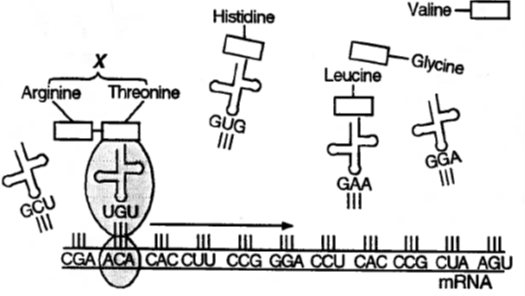
Genetic code from mRNA is translated to proteins
Occurs in the cytoplasm at the ribosome
Codons on mRNA determine the amino acid sequence
Translation
23

Creation of a protein from a segment of DNA (gene)
Steps of Protein Synthesis
mRNA made from DNA template
mRNA moves to ribosome
tRNA transfers amino acids to ribosome & bind to mRNA
Amino acids are linked with peptide bonds
Protein Synthesis
24
Multiple Choice
Transcription
Translation
Replication
All the above
25
Multiple Choice
mRNA is created in the Nucleus
mRNA is decoded to form a protein
glucose molecules are made
is where lipids are synthesised
26
Multiple Choice
ATG GGA ACT CCA
4
2
6
12
27
Multiple Choice
carry a message that, when translated, forms proteins
form a portion of ribosomes
string together complementary RNA and DNA strands
bring amino acids from the cytoplasm to the ribosomes
28
Multiple Choice
How many nucleotides code for 1 amino acid?
1
2
3
4
29
Match
Match the following to where they occur
nucleus
cytoplasm
nuclear pore
transcription
translation
mRNA leaves through
transcription
translation
mRNA leaves through
30
Fill in the Blanks
Based on the mRNA strand in the video
AUGCCCGGCUUA
How many amino acids will be coded for?
Type answer...
31
The 't' in tRNA stands for transfer, it transfers the amino acids from the cytoplasm to the ribosome.
32
Remember, a sequence of 3 bases code for each amino acid.

33

34
This is translation as the mRNA code is being translated by the ribosome into the primary amino acid sequence.
Central Dogma - Protein Synthesis
Show answer
Auto Play
Slide 1 / 34
SLIDE
Similar Resources on Wayground

29 questions
Cell Terms Part 1
Presentation
•
9th - 12th Grade
25 questions
Macromolecules
Presentation
•
9th - 12th Grade
26 questions
Evolution
Presentation
•
8th - 12th Grade
31 questions
Evolution terms part 1
Presentation
•
9th - 12th Grade
27 questions
Natural Selection EOC Review
Presentation
•
9th - 12th Grade
23 questions
Transport in Plants
Presentation
•
9th - 12th Grade
27 questions
LAB: Fruit Fly Single Cross Trait (Part 1)
Presentation
•
9th - 12th Grade
26 questions
Matter cycles
Presentation
•
9th - 12th Grade
Popular Resources on Wayground
10 questions
Safety Day 2026 – Student Review

Quiz
•
9th Grade
21 questions
Continents and Oceans
Quiz
•
6th Grade
20 questions
Parts of Speech
Quiz
•
5th Grade
16 questions
Subject & Predicate
Quiz
•
5th Grade
25 questions
Multiplication Facts
Quiz
•
5th Grade
12 questions
Map Skills
Quiz
•
3rd Grade
22 questions
Continents and Oceans
Quiz
•
5th Grade
15 questions
Rounding Decimals
Quiz
•
5th Grade
Discover more resources for Biology
20 questions
Cell organelles and functions
Quiz
•
10th Grade
20 questions
Cell Transport
Quiz
•
9th - 12th Grade
25 questions
photosynthesis and cellular respiration
Quiz
•
9th Grade
20 questions
Cell Cycle
Quiz
•
9th Grade
8 questions
DNA vs. RNA
Presentation
•
9th - 12th Grade
14 questions
Ecological Succession: Primary and Secondary
Quiz
•
9th Grade
20 questions
Macromolecules
Quiz
•
10th Grade
20 questions
Characteristics of Life
Quiz
•
9th - 10th Grade