Search Header Logo
2D Kinematics and Newton's Laws

2D Kinematics and Newton's Laws

Assessment

Presentation

Physics

11th Grade

Medium

NGSS.HS-PS2-1, NGSS.HS-PS2-4, I am the standard

+4

Standards-aligned

Created by

Benjamin Toner

Used 35+ times

FREE Resource

45 Slides • 59 Questions

1

media

Coefficient of Friction Examples:

Surfaces in contact with each other

μs

μk

STEEL ON STEEL

0.74

0.57

ALUMINUM ON STEEL

0.61

0.47

COPPER ON STEEL

0.53

0.36

RUBBER ON CONCRETE

1.0

0.8

LUBRICATED METAL ON METAL

0.15

0.06

ICE ON ICE

0.10

0.03

TEFLON ON TEFLON

0.04

0.04

SYNOVIAL JOINT OF HUMANS

0.01

0.003

COLLEGE PHYSICS FOR THE AP® PHYSICS 1 COURSE

2

Multiple Choice

Question image

A marble traveling at 3 m/s rolls off the edge of a 1 m high table. What is its initial vertical speed?

1

-10 m/s

2

0 m/s

3

-3 m/s

4

-15 m/s

3

Multiple Choice

As a projectile moves through the air, the motion on y axis is best described as ____,
1
free fall acceleration
2
uniform motion
3
varying speeds
4
constant velocity

4

Multiple Choice

Once a projectile is launched, what is the only force that affects its motion?

1

mass

2

friction

3

inertia

4

gravity

5

Multiple Choice

Question image

Two projectiles are fired horizontally with the same velocity but from different heights as shown in the picture. Which one will hit the ground first?

1

The one on the left.

2

The one on the right

3

They will hit at the same time.

4

Not enough information.

6

Multiple Choice

Question image

Which best describes the horizontal motion of a projectile, assuming no air resistance?

1

Acceleration of -10 m/s2

2

Acceleration of -5 m/s2

3

An increasing acceleration every second

4

Constant velocity

7

Multiple Choice

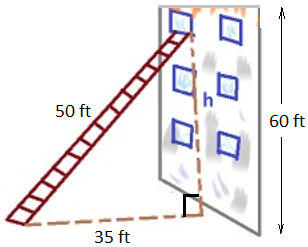
Question image
Find h
1
35.60
2
35.00
3
35.71
4
61.03

8

Multiple Choice

The _______ of two or more vectors is the sum of the vectors.
1
components
2
scalar
3
resultant
4
magnitude

9

Multiple Choice

Question image
If a boomerang is thrown 20 m in a straight line and returns exactly to the spot it was thrown what is its displacement?
1
20m
2
40m
3
0m
4
-20m

10

Multiple Choice

Question image
In practice B of the figure, which displacement is the vertical component? 
1
40 km, South
2
40 km, North
3
30 km, East
4
30 km, West

11

Multiple Choice

Question image
In practice B of the figure, which displacement is the horizontal component?
1
30 km, East
2
30 km, West
3
40 km, North
4
40 km, South

12

Multiple Choice

Question image
What is the height of the tree? Round the the nearest foot. 
1
38 ft
2
63 ft
3
20 ft
4
98 ft

13

Multiple Choice

Question image
Neglecting air resistance, what is the acceleration at C?
1
5 m/s2
2
0 m/s2
3
-10 m/s2
4
-30 m/s2

14

Multiple Choice

What is viy for a horizontal launch ALWAYS?
1
0 m/s
2
-10 m/s
3
10 m/s
4
Depends on vx

15

Multiple Choice

Question image
Find the direction and magnitude of the resultant vector for the drawing of two forces.
1
Direction 90°
Magnitude 139.0N
2
Direction 52.3°
Magnitude 195N
3
Direction 52.3°
Magnitude 139.0N
4
Direction 37.7°
Magnitude 139.0N

16

Multiple Choice

A vector is a ray with both ____________ and _____________.

1

Wings and halos

2

Space and time

3

Direction and magnitude

4

Radicals and exponents

17

Multiple Choice

Question image
Find the measure of the missing angle. Round to the nearest degree. 
1
49o
2
50o
3
41o
4
33o

18

Multiple Choice

An airplane flies due north at 150 km/h with respect to the air. There is a wind blowing at 75 km/h due east. What are the plane's speed with respect to the ground?

1

167.7 km/h at 26.6 degrees north of east

2

225 km/h at 26.6 degrees east of north

3

167.7 km/h at 63.4 degrees north of east

4

129.9 km/h at 63.4 degrees north of east

5

129.9 km/h at 26.6 degrees east of north

19

Multiple Choice

Question image

What is the x component of the vector?

1

14cos(30)

2

14sin(30)

3

14tan(30)

4

14tan-1(30)

20

Multiple Choice

Question image
What is the y component of the vector?
1
14sin(30)
2
-14sin(30)
3
14cos(30)
4
-14cos(30)

21

Multiple Choice

Question image

The direction of the 10 N vector would be said to be

1

North of West

2

North of East

3

East of North

4

West of North

22

Multiple Choice

Question image

Vector A (15 m, 90O), Vector B (9.0 m, 0O), and Vector C (11 m, 300O) combine to form Vector R. Which of the following describe Vector R?

1

15 m, 69O

2

15 m, 21O

3

16 m, 69O

4

16 m, 21O

23

Multiple Choice

If a ball thrown straight up into the air takes 4 seconds to reach the top (peak), how long will it take to travel from the peak back to the original position?

1

0s

2

1s

3

3s

4

4s

24

Multiple Choice

Which hits the ground first if they start at the same height: a dropped ball or a ball launched with a

horizontal velocity?

1

the launched ball

2

the dropped ball

3

they both hit at the same time

25

Multiple Choice

A frisbee is thrown 3.4 m/s East. The Frisbee curves and falls down 188.356 m. How far East did the Frisbee travel?

1

188.356 m

2

19.22 m

3

21.08 m

4

3.4 m

26

Multiple Choice

Question image

In a lab experiment, a ball is rolled down a ramp so that it leaves the edge of the table with a horizontal velocity v. If the table has a height h above the ground, how far away from the edge of the table, a distance x, does the ball land? You may neglect air friction in this problem.

1

2v2g\frac{2v^2}{g}

2

v2hgv\sqrt[]{\frac{2h}{g}}

3

2vhg\frac{2vh}{g}

4

2hg\frac{2h}{g}

5

none of these

27

Multiple Choice

A projectile is launched at a speed off 56 m/s at and angle of 73o, what was the hang time?

1

3.3 seconds

2

21.8 seconds

3

5.5 seconds

4

10.9 seconds

28

Multiple Choice

A projectile is launched at a speed off 56 m/s at and angle of 73o, what is the range (x)?

1

178.8 m

2

90.2 m

3

293.2 m

4

581.0 m

29

Multiple Choice

A projectile is launched at a speed off 48 m/s at and angle of 45o, what was the max height (y)

1

6.7 m

2

33.9 m

3

233.91 m

4

58.6 m

30

media

16
Dynamics

Warm up: Picking Formulas Write the formula you would use for
each, solve one.
A ball starts moving at 2 m/s completes a trip of 80 meters
over the course of 4 seconds. What was the ball's acceleration
during this time interval?
It takes an airplane 40 seconds to go from rest to 80 m/s for
takeoff. What was the acceleration of the during this time
interval?
A boat travels for 100 meters. It started with a velocity of 5
m/s and eventually sped up to 12 m/s. What was the boat's
acceleration during this trip?
A wheel rolling at 3 m/s is pushed for 5 seconds with an
acceleration of 6 m/s^2. What is the final velocity of the
wheel?

31

media

What makes an object accelerate?

So far, we have studied acceleration, without ever

knowing what makes objects accelerate

If a single force is exerted on an object, then the
object will accelerate in the direction of the single

force.

Acceleration: changing magnitude and/or direction of velocity.

If no force is exerted on an object, then the object

willnot accelerate.

32

media
media

With your group members...

Define mass.

33

media

The physics definition of mass.

Mass- A measurement of an object’s inertia.

Also known as Inertial Mass.

34

media
media

In order for a person to
ride a bicycle
(acceleration) there are
many forces occurring.

Discuss with your
group members…

What forces are
involved in riding a
bike?

35

media

Newton’s First Law of Inertia

An object at rest tends to stay at rest,

and

an object in uniform motion tends to stay in motion

with the same speed and in the same direction,

unless

a net external force is exerted upon the object.

Inertia-a property of matter dependent on mass that

prevents an object from changing its motion.

36

media
media

37

media

Force

A force is an interaction between two objects.

person

Force called

pull

rope

Force called

tension

rope

ball

38

media

Newton’s Third Law of Action- Reaction
If object A exerts a force on object B,

object B will exert a force on object A of
the same magnitude but in the opposite

direction, forces act in pairs.

F

F

A

B

39

media

Newton’s Third Law

F

F

No matter how hard you pull, the readings on

the two scales are identical.

Newton’s third law involves only two

objects.

Two forces can be a force pair only if they are

exerted between the same two objects.

40

media
media

41

media

Newton’s Second Law

The acceleration is in the direction of the net force.
Only external forces can cause acceleration.

42

media

Newton’s Second Law

3

F = 6 N
m = 2 kg

F = ma

m = 2 kg

F = ma

F = 6 N

F = 7 N

F = 6 N
m = 20 kg

F = ma

F = 6 N

F = 10 N

COLLEGE PHYSICS FOR THE AP® PHYSICS 1 COURSE

43

media
media

44

Multiple Choice

What explains why objects resist changes in their state of motion?

1

gravity

2

inertia

3

force

4

friction

45

Multiple Choice

Question image
A person steps out of the boat and onto the dock.  As the person moves forward onto the dock, the boat moves backward.  Which statement best describes the backward motion of the boat as the person steps forward?
1

For every action there is an equal and opposite reaction.

2

Every mass exerts a force on every other mass.

3

An object at rest tends to stay at rest.

4

Friction opposes the motion of an object.

46

Multiple Choice

An empty truck and a fully loaded truck are next to each other at a traffic light. When the light turns green, the lighter truck increases speed more quickly. Which of these best explains this situations
1

Newton's first law

2

Newton's second law

3

Newton's third law

4

Conservation of momentum

47

Multiple Choice

Question image
The combination of all the forces acting on an object is the...
1

net force

2

action force

3

reaction force

4

balance force

48

media
media
media
media

16
Dynamics

Warm up: Hanging Hashtag
Write what you think a Free Body Diagram might be.

Using the QR code on the left write a summary on
what a Free Body Diagram is.

Make 2 Hashtags that describe a Free Body

Diagram

Angled
Projectile
Motion Help

49

media

Fg: weight Fg = mg weight = mg

Fg : weight (The gravitational force on an object)


Using Newton’s second law

The gravitational force on an object is

called weight, and also Fg.

Fg

FNormal
m

50

media

Calculate the force of gravity on the bowling ball
(m = 4500g) and the ping pong ball (m = 2.7g).

51

media

Inertial Mass vs. Gravitational Mass

Using the spring scales and the mass set. Verify
that inertial and gravitational mass are the same.

52

media
media

53

media

The normal force, FN1

Fg

The bowling ball’s acceleration is zero.

Therefore the net force on the ball is zero.

Therefore a force must exist that’s equal and

opposite to the ball’s weight.

Therefore the table must be pushing up on the

ball


This contact force is called a normal force, Fn.

Fn is always perpendicular to a surface.

Why do we buy tables and chairs?

To provide normal forces to stop objects falling!

table

Fn

54

media

The Normal Force, FN2

Calculate the sum of the forces. ∑F=
Calculate the normal force. ∑F=ma

2 kg

Elevator at

Constant velocity

55

media

The Normal Force, FN3

This elevator has an downward
acceleration of 3 m/s2, so there must
be downward net force on the ball,
therefore, in this example, |FN| < |Fg|

F = ma

COLLEGE PHYSICS FOR THE AP® PHYSICS 1 COURSE

2 kg

56

media

The Normal Force, FN3

This elevator has an upward
acceleration of 4 m/s2, so there must
be upward net force on the ball,
therefore, in this example, |FN| > |Fg|

F = ma

COLLEGE PHYSICS FOR THE AP® PHYSICS 1 COURSE

2 kg

57

Multiple Choice

Question image

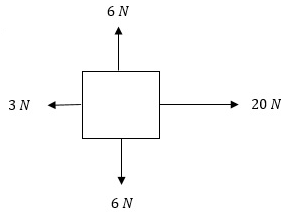
What is the NET FORCE of this diagram?

1

17 N, right

2

17 N, left

3

23 N, right

4

12 N, up

58

Multiple Choice

Question image

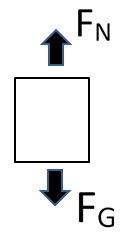
Which of the following is true about this free-body diagram?

1

the forces are are balanced

2

the object is free-falling

3

the object is moving upward

4

the forces are unbalanced

59

Multiple Choice

8 N to the left , and 4 N to the right. Find the net force. Is this balanced 
1

12 N Right  No

2

4 N Left  No

3

12 N Right  Yes

4

4 N Left  Yes

60

Multiple Choice

"If we apply a ___________ to an object, its __________________ will change and it will  ______________."
1

force, accelerate, gravity

2

accelerate, inertia, gravity

3

force, velocity, accelerate

4

velocity, gravity, inertia

61

Multiple Choice

What can force do to an object?

1

Accelerate an object

2

Slow down an object

3

Have the object remain in place

4

Have the object change shape

5

All of the above

62

Multiple Choice

An apple of mass 0.15kg and weight 1.5N falls from a tree. At one point during its fall, the air resistance on the apple is 0.60N upwards.

What is the acceleration of the apple at this point?

1

4 m/s2

2

6 m/s2

3

10 m/s2

4

14 m/s2

63

Multiple Choice

Question image

The cart of mass of 20 Kg shown here moves without friction loss on a level table. A 20N force pulls the card to the left. Another force is applied at a 45 degree angle to 30N. What is the magnitude of the horizontal acceleration of the cart?

1

0.51 m/s2

2

1.1 m/s2

3

1.6 m/s2

4

2.1 m/s2

64

media
media
media
media
media
media

Warm up- Atwoods Machine- Extremely Common AP
Problem
Determine the acceleration of the blocks and the tension in the cord if m1 = 8 kg,
m2 = 12 kg, and the table surface is frictionless.

AtwoodsInclined Magic TrickExit Ticket Style T/WFfk Extention

65

Multiple Choice

Question image

In the modified Atwood machine block J sits on a frictionless table and the system has an acceleration of A. If blocks J and K switched places what would the new acceleration be?

1

No change to A, because the total mass remained the same

2

No chance to A, because the difference between the masses stayed the same

3

Decreased due to a reduced net force

4

Increased do to changing net force

66

Fill in the Blanks

media image

67

Fill in the Blanks

media image

Type answer...

68

Multiple Choice

Question image

In the modified Atwood machine block J sits on a frictionless table and the system has an acceleration of A. If blocks J and K switched places what would the new acceleration be?

1

No change to A, because the total mass remained the same

2

No chance to A, because the difference between the masses stayed the same

3

Decreased due to a reduced net force

4

Increased do to changing net force

69

media

Static Friction and Kinetic Friction

COLLEGE PHYSICS FOR THE AP® PHYSICS 1 COURSE

If you push or pull on an object to make it slide but it doesn’t move, we

call the force that is preventing sliding a static frictionforce, Ffs.

If the object is moving, we call the force that opposes this motion a kinetic

frictionforce, Ffk.

Fpull = 3N

Fs = 3N

Fpull = 4N

Fs = 4N

Fpull = 5N

Fs = 5N

Fpull = 7N

Fs = 7N

Fk = 4N

Fk = 4N

Fk = 4N

70

media

The force of static friction has a maximum value.

The maximum magnitude can be determined by using

the following formula:

Ffs,max = μsFn

μs : Coefficient of static friction
Rougher contact surfaces have a greater magnitude of μs .

Fn : the normal force
The more the contact surfaces are pressed together, the
greater the maximum magnitude of Ffs.

71

media

The Force of Kinetic Friction

The force of kinetic friction resists motion.
Ffk = μkFn

μk : Coefficient of kinetic friction
Rougher contact surfaces have a greater magnitude of μk .

Fn : the normal force
The more the contact surfaces are pressed together, the
greater the magnitude of Ffk.

COLLEGE PHYSICS FOR THE AP® PHYSICS 1 COURSE

72

Multiple Choice

A block of mass 2 kg lies on a horizontal surface having coefficient of static friction to be 0.2. What is the force of friction acting on the block when no other horizontal force acts on it? (take g = 10ms210ms^{-2}  )

1

0

2

4N

3

40N

4

any value between zero and 4N

73

Multiple Choice

Question image
What type of friction is not moving?
1

static

2

sliding

3

fluid

4

rolling

74

Multiple Choice

FN=100N, Ff=20N

1

μ=5.0

2

μ=0.2

3

μ=1.2

4

μ=0.1

75

Multiple Choice

What is the coefficient of static friction if it takes 44 N of force to move a box that weighs 86 N? 
1
0.78
2
0.51
3
0.78 N
4
0.58 N

76

Multiple Choice

The mass of a brick is 5kg, and it is stationary. What is the maximum static friction if the coefficient is 0.66?

1

3.3

2

33

3

3.3N

4

33N

77

Multiple Choice

There are 25N of friction that keep a 10kg brick moving at a constant rate. What is the coefficient of friction?

1

0.25

2

0.25N

3

4

4

4N

78

Fill in the Blanks

media image

Type answer...

79

Fill in the Blanks

media image

Type answer...

80

media
media

Warm up- Atwoods Machine- Extremely Common AP
Problem
Determine the acceleration of the blocks and the tension in the cord if m1 = 8 kg,
m2 = 12 kg, and the table surface is frictionless.

81

media

In AP® physics, ignore area of contact in friction problems.

In AP® physics, the area of contact between the
two surfaces that are in contact does not affect

the force of static or kinetic friction, or the

maximum force of static friction.

3 kg

3

kg

3 kg
3 kg

3 kg

82

media

Example

A box is pulled with the maximum force
before it starts to slide. If the force is 12N
and the mass is 13 kg, calculate the
coefficient of static friction, 𝜇s.

83

media

Inclined Class Example

84

media

Example

A skier with a mass of 60.0 kg is sliding down a
25° snowy slope. Find the coefficient of
kinetic friction,𝛍k, for the skier if friction is
known to be 45.0N.

85

media
media

To analyze the characteristics and performance of the brakes on a 1500 kg car,
researchers collected the data shown in the table above. It shows the car’s speed
when the brakes are first applied and the corresponding braking distance required
to stop the car. The magnitude of the average braking force on the car is most
nearly

86

media
media

Tension

• Tension is defined as a force transmitted along a

rope, chain, or wire.

• Tension will remain constant throughout the length

of the rope.

• Tension is treated as a force in force diagrams and

calculations

• Tension is measured in newtons (N).

87

media

Question One answer part 1 (a)

2 kg

3 kg

FT
FT

3 kg

2 kg
FT
FT

5 kg

5 kg

COLLEGE PHYSICS FOR THE AP® PHYSICS 1 COURSE

88

media

Question One answer part 1 (b)

2 kg

20 N

FT

a = 2 m/s2

Calculate tension, FT ;

3 kg

30 N

FT

a = 2 m/s2

Calculate tension, FT ;

COLLEGE PHYSICS FOR THE AP® PHYSICS 1 COURSE

89

media

Hooke’s Law

Hooke’s Law relates the amount of force a spring exerts to the amount
of distance a spring stretches and it is directly proportional.

y = mx

=

Fs
k x

Spring Force

Spring
Constant

Stretch
Distance

90

Multiple Choice

Question image

The original length of a spring is 5 cm.

Based on the graph, what is the length of the spring when the spring is loaded by a 40g mass?

1

1 cm

2

11 cm

3

cannot be determined

4

6 cm

91

Multiple Choice

A spring has a spring constant of 330 N/m.  How far is the spring compressed if 150 N of force are used?
1

2.2 m

2

0.0014 m

3

5.0 m

4

0.45 m

92

Multiple Choice

Question image

The force of gravity on the surface of Moon is much less than on Earth. A rock has a weight of 100 newtons on Earth. What do you know about the weight of the rock on the Moon?  

1

The rock will weigh exactly 100 newtons.

2

The rock will weigh more than 100 newtons.

3

The rock will weigh less than 100 newtons.

4

There is not enough information to know if the rock weighs the same, more, or less on Mercury.

93

Multiple Choice

Question image

The data of mass vs force of gravity as measured by a spring scale was plotted. What pattern best summarizes the data?

1

The graph is non-linear. As mass increases, force of gravity decreases.

2

The graph is non-linear. As mass increases, force of gravity increases.

3

The graph is linear. As mass increases, force of gravity increases. Slope is positive.

4

The graph is linear. As mass increases, force of gravity increases. Slope is negative.

94

Multiple Select

Question image

What is the best description of the relationship shown in this graph?

1

In this graph, the relationship between force and extension is linear.

2

In this graph, the relationship between force and extension is non-linear.

3

In this graph, the relationship between force and extension is unclear

4

In this graph, there is no relationship between force and extension.

95

Multiple Choice

Question image

Select a logical prediction for the investigation.

1

As the force applied to the spring increases, the extension of the spring will decrease.

2

As the force applied to the spring increases, the extension of the spring will stay the same

3

As the force applied to the spring increases, the extension of the spring will also increase.

96

Multiple Choice

If the original length of a spring is 20m and its extended length is 30m. What is the extension?

1

20m

2

12m

3

75m

4

45m

5

10m

97

Multiple Choice

What is the spring constant of a bungee rope in N/m if a person weighs 100 N if we want it to extend (stretch) 20m?

1

5N/m

2

5N/cm

3

5N

4

10N

5

10N/m

98

media

Hooke’s Law

Describes the relationship
between the force on an

ideal spring and the

extension of the spring

Fs : Spring Force (N)
k : Spring constant (N/m)
x : Extension of spring (m)

0.00 m 0.200 m

0.800 m

0.400 m 0.600 m

30.0 N

40.0 N

20.0 N

10.0 N

0.00 N

Fs

x: Extension or compression of spring

k = 50

N/m

k = 12.5 N/m

k = 80 N/m

stiffer

spring

weaker spring

Hooke’s Law:

An ‘ideal spring’ is a spring that obeys Hooke’s Law.

COLLEGE PHYSICS FOR THE AP® PHYSICS 1 COURSE

99

media
media

1.From the diagram,

calculate the spring
constant.

2. A spring whose force constant is 48 N/ m
has a 0.25 kg mass suspended from it. What
is the extension of the spring?

100

media
media

16
Dynamics

Warm up: Hanging Hashtag
Write what you think Hooke’s Law might be.

Using the QR code on the left write a summary on
what Hooke’s Law is.

Make 2 Hashtags that describe a Hooke’s law

Hooke’s Law

101

media
media
media

Warm Up

The system shown above is released from rest. If friction is negligible, the
acceleration of the 4.0 kg block sliding on the table shown above is most
nearly what?

Two 0.60-kilogram objects are connected by a thread that passes over a light,
frictionless pulley, as shown above. The objects are initially held at rest. If a third
object with a mass of 0.30 kilogram is added on top of one of the 0.60-kilogram
objects as shown and the objects are released, the magnitude of the acceleration
of the 0.30-kilogram object is most nearly

102

media

Warm up

An incline has an angle of inclination that is adjustable.
A 20 kg block is put on the incline and the angle is increased
until the block begins to slide.
If the coefficient of static friction is 0.6 between the block and
the incline, find the angle that causes the block to slide.

103

media

Warm up

Calculate the time needed to accelerate a 50 kg object

from 2 m/s to 12 m/s if a force of 5 N is applied.

104

media
media
media
media

Two identical spheres are released from a device at time t = 0 from the
same height H, as shown above. Sphere A has no initial velocity and falls
straight down. Sphere B is given an initial horizontal velocity of
magnitude v0 and travels a horizontal distance D before it reaches the
ground. The spheres reach the ground at the same time tf , even though
sphere B has more distance to cover before landing. Air resistance is
negligible.

(a) The dots below represent spheres A and B. Draw a free-body diagram
showing and labeling the forces (not components) exerted on each

sphere at time tf/2.

(b) On the axes below, sketch and label a graph
of the horizontal component of the velocity of
sphere A and of sphere B as a function of time.

media

Coefficient of Friction Examples:

Surfaces in contact with each other

μs

μk

STEEL ON STEEL

0.74

0.57

ALUMINUM ON STEEL

0.61

0.47

COPPER ON STEEL

0.53

0.36

RUBBER ON CONCRETE

1.0

0.8

LUBRICATED METAL ON METAL

0.15

0.06

ICE ON ICE

0.10

0.03

TEFLON ON TEFLON

0.04

0.04

SYNOVIAL JOINT OF HUMANS

0.01

0.003

COLLEGE PHYSICS FOR THE AP® PHYSICS 1 COURSE

Show answer

Auto Play

Slide 1 / 104

SLIDE

Discover more resources for Physics