Search Header Logo
Natural Selection vs. Selective Breeding

Natural Selection vs. Selective Breeding

Assessment

Presentation

Science

7th Grade

Medium

NGSS
MS-LS4-4, MS-LS4-2, HS-LS4-2

+9

Standards-aligned

Created by

Samantha Palomares

Used 10+ times

FREE Resource

1 Slide • 22 Questions

1

Natural Selection vs. Selective Breeding Practice

In the next slides you will be answering questions about Natural Selection and Selective Breeding. You may use your notes. If you miss a question, it must be written down to receive credit on your Quizizz. You need an 80% or higher to move on to creating your butterfly.

Some text here about the topic of discussion

2

Multiple Choice

Question image

Change over time

1

Natural Selection

2

Evolution

3

Selective Breeding

4

Homeostasis

3

Multiple Choice

"Survival of the fittest" describes which theory

1

Natural selection

2

Selective breeding

4

Multiple Choice

Which organisms are most likely to survive?

1

The strongest

2

The best adapted

3

The fittest

4

The most athletic

5

Multiple Choice

Question image

The long and sharp beak of a woodpecker is an example of

1

natural selection

2

selective breeding

6

Multiple Choice

Question image

Natural selection is where ___________ decides which traits should be passed on.

1

nature

2

a human

3

traits

4

evolution

7

Multiple Choice

Which statement best describes natural selection?

1

A lion eating another animal.

2

A farmer selecting the cows that will breed.

3

A dog breeder.

4

A botanist creating a new colored flower.

8

Multiple Choice

Adaptations can be:

1

camouflage

2

ability to survive cold weather

3

hunting skills

4

all of the above

9

Multiple Choice

Differences in traits are called:

1

natural selection

2

genetic variations

3

artificial selection

4

adaptations

10

Multiple Choice

A species could go extinct if:

1

food becomes more plentiful.

2

members of the species have adaptations to enhance survival.

3

the environment changes drastically and no one can adapt.

4

there is less competition for resources.

11

Multiple Choice

Question image

What is most likely to happen to moth populations in the picture shown?

1

Light moths--hunted easily, dark moths--population increase

2

Dark moths--hunted easily, dark moths--population increase

3

Light moths--hunted easily, light moths--population increase

4

Lights moths will change their color to match dark moths.

12

Multiple Choice

Survival of the Fittest and Evolution were proposed by what scientist?
1

Charles Darwin

2

Albert Einstein

3

Steven Hawking

4

Isaac Newton

13

Multiple Choice

What is the advantage of having different shaped beaks?
1

To look different from other species.

2

To be able to eat the food readily available in the environment.

3

To protect itself against predators.

4

To protect itself against prey.

14

Multiple Choice

Question image
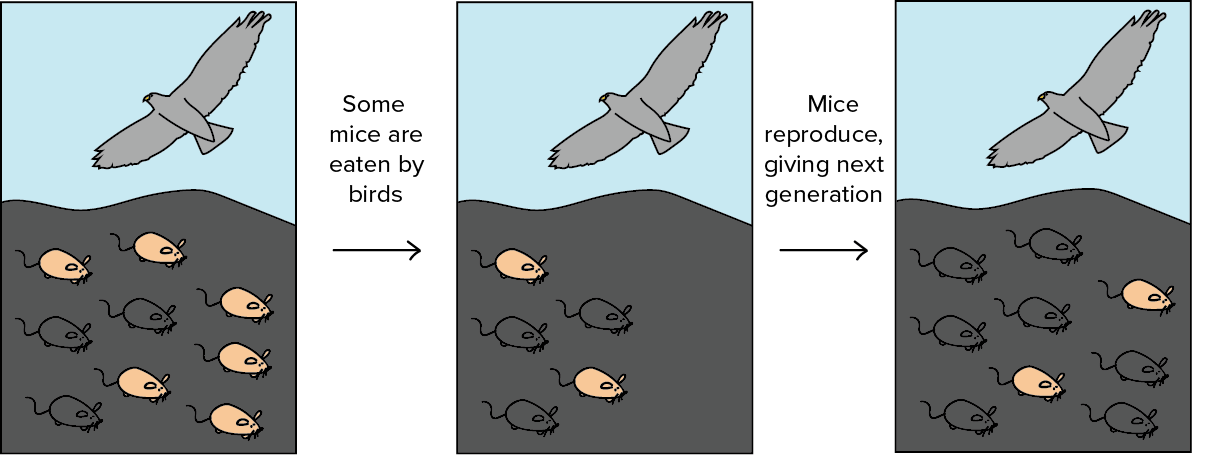
Why is the mouse population changing over time?
1

The light mice can reproduce more successfully than the dark mice

2

The hawks eat more dark mice than light mice because the dark mice taste better

3

The hawks eat more light mice than dark mice because they can see the light mice more easily

4

The hawks eat more dark mice than light mice because they can see the dark mice more easily

15

Multiple Choice

Question image
What process is being shown in this image?
1

Variation

2

Natural Selection

3

Selective Breeding

4

Homeostasis

16

Multiple Choice

Why are advantageous traits more likely to be passed onto offspring?
1

Because they are more likely to survive and reproduce.

2

Because they come from dominant alleles.

3

Because they come from recessive alleles.

4

Because the trait is an acquired phenotype.

17

Multiple Choice

Do organisms "decide" to evolve and change?
1

Yes, they know they need to change to survive 

2

No, they change because of natural selection

18

Multiple Choice

One problem with selective breeding is

1

creating a new species

2

gene variety is lost

3

extinction of a species

19

Multiple Choice

Almost all adaptations started off as?
1

selective breeding

2

physiological

3

structural

4

mutation

20

Multiple Choice

Which is another term for selective breeding?
1

Artificial selection

2

Natural Selection

3

Intelligent selection

21

Multiple Choice

Question image
Evidence shows that the wolf is the ancestor to all of the breeds of dogs shown below. How did this variation arise in a relatively short period of time?
1

A.  Genetic manipulation

2

Natural selection

3

Random chance

4

Selective breeding

22

Multiple Choice

Which is NOT a result of selective breeding?

1

Large seedless watermelons that consumer demand

2

Bright oranges that are all about the same size

3

An insect that matches the color of the environment

4

A dog that has been bred to have short hair

23

Multiple Choice

The purpose of selective breeding is to

1

get bigger animals

2

get smaller animals

3

create animals with desirable traits

4

create animals with bad traits

Natural Selection vs. Selective Breeding Practice

In the next slides you will be answering questions about Natural Selection and Selective Breeding. You may use your notes. If you miss a question, it must be written down to receive credit on your Quizizz. You need an 80% or higher to move on to creating your butterfly.

Some text here about the topic of discussion

Show answer

Auto Play

Slide 1 / 23

SLIDE