LS. 8.2.4 Flow of Energy and Cycling of Matter in Ecosystems
Presentation
•
Science
•
8th Grade
•
Medium
+14
Standards-aligned
Erin Jameson
Used 27+ times
FREE Resource
11 Slides • 28 Questions
1
2
3
4
5
6
Multiple Choice
I am the chef for the ecosystem because I am the only organism that can make my own food.
consumer
producer
decomposer
7
Multiple Choice
Consumers
Carnivores
Omnivores
Animals
8
Multiple Choice
Eats dead plants or animals and breaks down to put nutrients in the soil
Eats plants or other animals for food
Makes its own food
9
Multiple Choice
They make carbon dioxide
They decompose
They make or produce their own food
They are omnivores
10
11
12
Multiple Choice
100%
10%
50%
75%
13
Multiple Choice
A
B
C
D
14
Multiple Choice
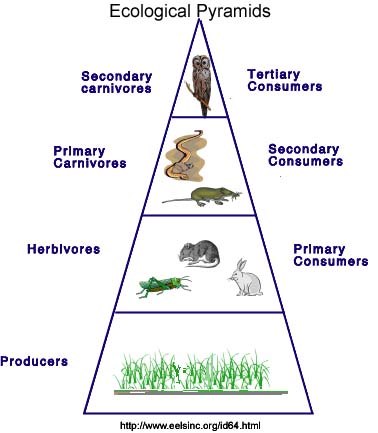
Producers
Carnivores
Herbivores
Top Predator
15
Multiple Choice
Producers
Herbivores
Carnivores
Top Predator
16
Multiple Choice
Owl
Grasshopper
Lilypad
Mouse
17
Multiple Choice
Primary Consumers
Producers
Decomposers
Tertiary Consumers
18
19
20
Multiple Choice
Food Chain or Food Web?
Food Chain
Food Web
21
Multiple Choice
Why are food chains / food webs helpful?
To see what plants eat other animals
To see what animals eat other sea creatures
To see what animals eat other animals / organisms
To see what plants eat other plants
22
Multiple Choice
What does a food web represent? (¿Qué representa una red alimenticia?)
All connections of energy flow throughout all organisms in a habitat. (Todas las conexiones de flujo de energía a través de todos los organismos en un hábitat.)
The specific ways that organisms help each other out. (Las formas específicas en que los organismos se ayudan entre sí.)
A single pathway or energy flow between organisms. (Una sola vía o flujo de energía entre los organismos.)
How carnivores get their food. (Como consiguen su comida los carnívoros.)
23
Multiple Choice
An elephant eats only plants. Which type of consumer is an elephant? (Un elefante come solo plantas. ¿Qué tipo de consumidor es un elefante?)
An herbivore (Un herbívoro)
A carnivore (Un carnívoro)
A producer (Un productor)
A decomposer (Un descomponedor)
24
Multiple Choice
In a food web, which of these is a producer? (En una red alimenticia, ¿cuál de estos es un productor?)
humans (Humanos)
lizards (lagartijos)
spiders (Arañas)
grass (pasto)
25
Multiple Choice
A spider eats insects, like flies and crickets. What type of consumer is a spider? (Una araña come insectos, como moscas y grillos. ¿Qué tipo de consumidor es una araña?)
herbivore (herbívoro)
carnivore (carnívoro)
omnivore (omnívoro)
decomposer (descomponedor)
26
Multiple Choice
Water
Sun
Consumers
Oxygen
27
Multiple Choice
Tertiary Consumers
Secondary Consumers
Producers
28
Multiple Choice
What is the decomposer in the picture above?
grass
fungus/mushrooms
hawk
frog
29
Multiple Choice
The diagram provided shows a marine food chain. In this food chain, the zooplankton are
primary producers.
primary consumers.
secondary consumers.
tertiary consumers.
30
31
Multiple Choice
Which is an abiotic factor that most limits the number of fish living in a pond?
the color of the water
the temperature of the water
the presence of plants
the number of predators
32
Multiple Choice
How do organisms like plants contribute to water cycle?
through condensation
through evaporation
through precipitation
through transpiration
33
Multiple Choice
Two species of fish live in the same pond. Which of the following would increase competition between these two species of fish?
Habitat temperature increases.
Population of birds that eat the fish increases.
Number of food plants the fish eat increases.
Water level in the pond decreases.
34
35
Multiple Choice
Through food chains, the carbon that is in plants moves to the animals that eat them. When an animal eats another animal, carbon is ___________________.
released
transferred
dissolved
gone
36
Multiple Choice
Which process contributes carbon dioxide to the atmosphere?
respiration
photosynthesis
tree farms
37
Multiple Choice
Which process removes carbon dioxide from the atmosphere?
deforestation
tree farms
burning fossil fuels
cellular respiration
38
Multiple Choice
39
Multiple Choice
Respiration is the process by which animals take in _____ and release _____ to make energy.
Show answer
Auto Play
Slide 1 / 39
SLIDE

Similar Resources on Wayground
36 questions
Bohr Diagrams
Presentation
•
8th Grade
38 questions
Properties of Matter
Presentation
•
8th Grade
33 questions
Electromagnetic Waves
Presentation
•
9th Grade
37 questions
Understanding Earth's History Part 1
Presentation
•
8th Grade
32 questions
2022-23 "Radioactivity" 10.1
Presentation
•
8th Grade
35 questions
Chemistry Review with Companion Sheet 23-24
Presentation
•
8th Grade
33 questions
8.6C EXPERIENCE ACID & BASES Lecture Presentations.
Presentation
•
8th Grade
33 questions
Quizizz Recovery: Newton's Laws
Presentation
•
8th Grade
Popular Resources on Wayground
10 questions
5.P.1.3 Distance/Time Graphs
Quiz
•
5th Grade
10 questions
Fire Drill
Quiz
•
2nd - 5th Grade
20 questions
Equivalent Fractions
Quiz
•
3rd Grade
22 questions
School Wide Vocab Group 1 Master
Quiz
•
6th - 8th Grade
20 questions
Main Idea and Details
Quiz
•
5th Grade
20 questions
Context Clues
Quiz
•
6th Grade
20 questions
Inferences
Quiz
•
4th Grade
12 questions
What makes Nebraska's government unique?
Quiz
•
4th - 5th Grade
Discover more resources for Science
8 questions
Amoeba Sister Asexual vs Sexual Reproduction
Interactive video
•
8th Grade
19 questions
Introduction to Properties of Waves
Presentation
•
6th - 8th Grade
16 questions
Interactions within Ecosystems
Presentation
•
6th - 8th Grade
10 questions
Exploring the Layers of the Earth
Interactive video
•
6th - 10th Grade
20 questions
Energy Transformations
Quiz
•
6th - 8th Grade
46 questions
8th Science STAAR Review
Quiz
•
8th Grade
20 questions
Cell Organelles and Functions
Quiz
•
6th - 8th Grade
20 questions
Moon Phases and Eclipses
Quiz
•
6th - 8th Grade