Search Header Logo
Heat Transfer: Convection, Conduction, Radiation & Cel vs Kelvin

Heat Transfer: Convection, Conduction, Radiation & Cel vs Kelvin

Assessment

Presentation

Science

6th - 8th Grade

Medium

NGSS
MS-PS1-4, MS-PS3-4, MS-ESS2-5

+2

Standards-aligned

Created by

Kristi Warf

Used 23+ times

FREE Resource

11 Slides • 21 Questions

1

media

Heat Transfer

Convection, Conduction, Radiation, &
Celsius vs. Kelvin

2

media

How heat
moves

Convection, Conduction,
Radiation, & Celsius vs. Kelvin

Heat travels
from HOT to
COLD!

3

media

Transfer of heat by the flow of a gas
or liquid.

Molecules move in a circular
motion.

Hot air rises and cool air falls.

Convection

4

media

Water boiling on the stove

(HOT water RISES, COLD water
SINKS)

Heater heating a room, or house

(HOT air RISES, COLD air SINKS)

Convection Examples

5

media

Transfer of heat when molecules
bump into each other.

Occurs when there is direct
contact or touching.

Mostly between solids.

Conduction

6

media

Touching a hot stove and getting
burned.

Cheese melting on a hamburger. The
cheese is TOUCHING the hamburger
patty.

A spoon getting hot in a bowl of soup.
The spoon is TOUCHING the hot soup.

Conduction Examples

7

media

Transfer of heat through rays or
waves.

Rays and waves travel in a straight
line.

Rays can travel through a vacuum
(space).

Radiation

8

media

The sun warming the earth.
o
The rays travel in a straight line to the earth

A campfire
o
The rays from the fire warm the front part of
your body

A heat lamp warming food.
o The lamp’s rays travel in a straight line to keep
the food warm.

Radiation Examples

9

Multiple Choice

What happens when a cold drink sits in a hot room?

1

It remains cold

2

It gets warmer

3

It starts boiling

4

It starts to freeze

10

Multiple Choice

When two things are the same temperature:

1

They have the same number of molecules

2

Their molecules stop moving

3

Their molecules move at the same average speed

4

Heat transfer between the two things stops

11

Multiple Choice

When you heat a pot on a stove, the handle gets warm. Which type of heat transfer is responsible?

1

Conduction

2

Radiation

3

Convection

4

All of the above

12

Multiple Choice

Question image

A cat is hanging out several feet from a fire in a fireplace. This causes the kitty cat to get warm. The kitty cat is warm because of...

1

Convection

2

Conduction

3

Radiation

4

The fur sweater he's wearing!

13

Multiple Choice

Question image

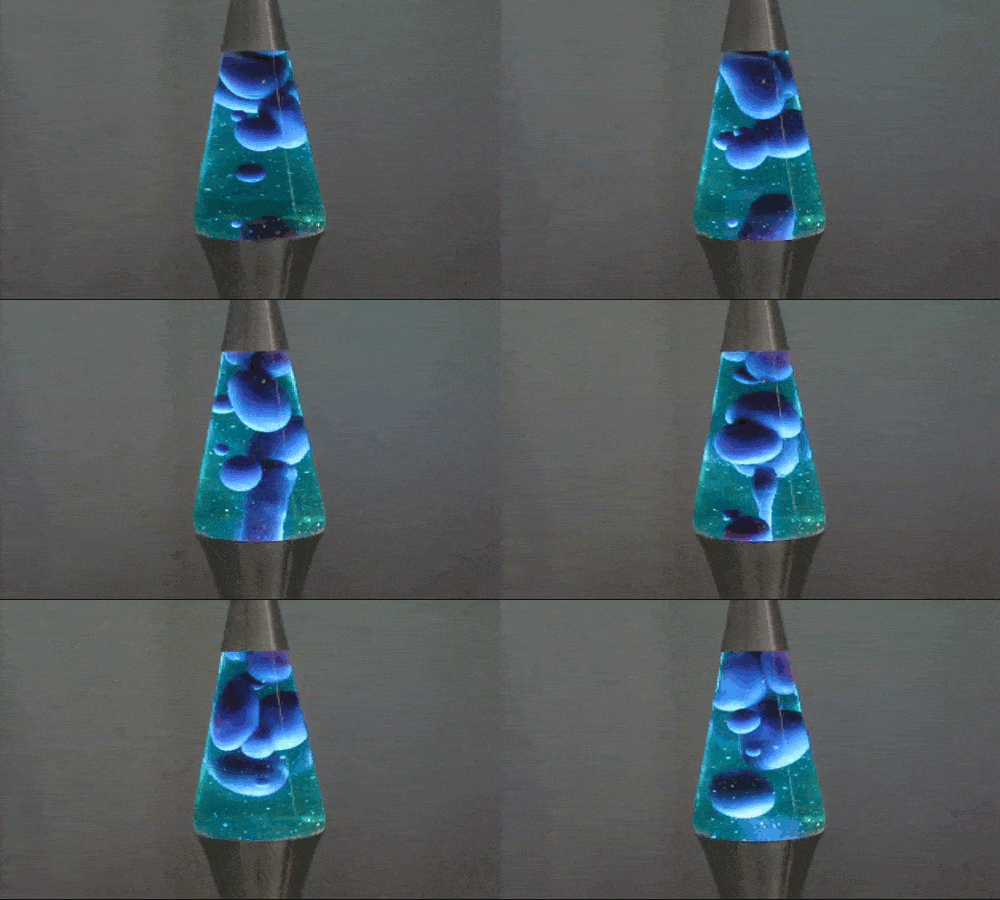
A certain type of decorative lamp contains colored liquids. These liquids form globs that break off and rise to the top of the liquid. The globs rise due to

1

Convection

2

Conduction

3

Radiation

4

Globulation

14

Multiple Choice

Question image

Near the ceiling of a room, the air is warmer. The warmer air is rising because of

1

Convection

2

Conduction

3

Radiation

4

It was told to by this crazy fool!

15

Multiple Choice

Question image

In a swimming pool, the water near the surface is slightly warmer. The temperature of the water near the top rises because of

1

Convection

2

Conduction

3

Radiation

4

Too many dogs being in the pool!

16

Multiple Choice

Question image

A fireman that is at a building that is on fire feels a door and it is hot. Why does his hand feel hot?

1

Convection

2

Conduction

3

Radiation

4

The Human Torch was on the other side!

17

Multiple Choice

Question image

In heat transfer, heat always flows from the _______________ object to the _______________ object.

1

hotter / colder

2

colder / hotter

3

hotter / hotter

4

colder / colder

18

Multiple Choice

Question image

Which of the following statements is true regarding heat energy?

1

The quicker a molecule moves, the colder it is.

2

The slower a molecule moves, the warmer it is.

3

The quicker a molecule moves, the warmer it is.

4

The faster you dance, the quicker you get tired.

19

Multiple Choice

To measure the temperature difference between two cups of water, you would use a _____.
1

measuring cup

2

ruler

3

thermometer

4

balance scale

20

media

Celsius is the modern system of measuring
temperature. It fits in with much of the METRIC
system.

Celsius vs. Kelvin

21

media

Kelvin is an important scale used in most of SCIENCE.

ABSOLUTE ZERO
(has not been reached yet)

Molecules are ALWAYS MOVING, even if they are in a
solid, or frozen state. However: When Absolute Zero is
reached:

-ALL molecules STOP MOVING
-NO more KINETIC ENERGY

Celsius vs. Kelvin

22

media

Celsius vs. Kelvin

23

Multiple Choice

Which temperature scale has no negative temperatures?
1

Celsius

2

Fahrenheit 

3

Joule

4

Kelvin

24

Multiple Choice

Question image
This happens to water at 0 degrees Celsius.
1

Boils

2

Freezes

3

Heats

4

All of them

25

Multiple Choice

Question image
This happens to water at 100 degrees Celsius.
1

Boils

2

Freezes

3

Heats

4

All of them

26

Multiple Choice

Question image
A temperature scale that is used mostly in United States. 
According to it, water freezes at 32 degrees and boils at 212 degrees.
1

Celsius

2

Fahrenheit

3

Kelvin

4

All of them

27

Multiple Choice

Question image
Scientists' favorite temperature scale, because it begins at the absolute coldest anything can get. 
1

Celsius

2

Fahrenheit

3

Kelvin

4

All of them

28

Multiple Choice

Question image

The absolute coldest anything can get.

In Celsius it's -273.15 degrees. Or 0 degrees Kelvin.

1

Absolute cold

2

Kelvin

3

Absolute zero

4

I don't know

29

Multiple Choice

Question image
Select the temperature in °F
1

90°F

2

100°F

3

40°F

4

30°F

30

Multiple Choice

Question image
The faster molecules move, 
1

the higher the temperature

2

the less temperature

3

the same temperature

4

I don't know

31

Multiple Choice

Question image
Look at the activity. Select the temperature it would most likely be in °F
1

20°F

2

30°F

3

60°F

4

80°F

32

Multiple Choice

Temperature is a measure of the average _____________ energy of the particles of a substance.

1

potential

2

kinetic

3

gravitational

4

heat

media

Heat Transfer

Convection, Conduction, Radiation, &
Celsius vs. Kelvin

Show answer

Auto Play

Slide 1 / 32

SLIDE