
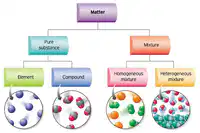
Composition of Matter

Presentation
•
Chemistry
•
10th Grade
•
Practice Problem
•
Hard

Lorissa Pena
Used 25+ times
FREE Resource
14 Slides • 0 Questions
1

COMPOSITION
OF MATTER
2

A Puresubstance is a substance that cannot
be broken down into simpler parts and still
retain their properties. Pure substances
CANNOT be separated PHYSICALLY.
Pure Substances are one of two types: either
ELEMENTS or COMPOUNDS
3

Elements are pure substances in which all
atoms are the exact same.
Separated only by NUCLEAR FISSION
Found on the periodic table of elements
Ex – oxygen, gold, zinc
4

Compounds are substances with 2 or more elements
chemically combined (bonded) in a fixed proportion.
Ex – Water – H2O always has 2 molecules of
hydrogen and 1 molecule of oxygen
Ex – Table Salt – NaCl has one sodium to one
chlorine
Separated by CHEMICAL REACTIONS
5

Examples of Elements Examples of Compounds
• Helium
• Silver
• Gold
• Carbon
• Platinum
• Chlorine
• Hydrogen
• Oxygen
• Aluminum
• Sodium
• NaCl (table salt)
• H2O (water)
• CaCO3 (chalk)
• SiO2 (glass)
• H2SO4 (battery acid)
• CO2 (carbon dioxide)
• NaClO (bleach)
• C6H12O6 (glucose)
• HCl (stomach acid)
• NaHCO3 (baking soda)
6

A mixture contains 2 or more substances that CAN
be physically separated 🡪 heating, distilling, cooling,
sorting, filtering.
2 Main types:
Homogeneous and
Heterogeneous
7

Types of Mixtures:
Homogeneous mixture – a mixture of different materials
that looks the same all the way through.
•Very small particles,
•No “chunks”
Ex - Apple juice, salt water, tomato soup, iced tea
8

Solutions are homogeneous mixtures in
which one substance is dissolved into
another, a solute is dissolved in a
solvent.
Ex: In saltwater, the salt is the solute
and the water is the solvent.
9

The SOLUTE is the substance in the
SMALLERamount.
The SOLVENT is the substance in the
LARGERamount.
The mix of the two = the Solution
Water
Hot
Cocoa
Mix
Hot
Chocolate
SOLUTION:
10

A solute dissolves faster when
stirred (creates friction) or heated.
•How do you increase solubility?
🡪How do you mix that solution
faster?
11

Colloid – a homogeneous mixture
with particles that are VERY
LARGE but never settle
ex – smoke and Milk
12

Tyndall Effect – when light hits the particles in a
colloid , it scatters.
You can see the rays of light coming through a
window because of the Tyndall effect.
13

Heterogeneous mixture – A mixture of
different materials that does NOT look the same
all the way through.
• Very Large Particles
• Has chunks in it
Ex – vegetable soup
14

Suspension – a heterogeneous mixture
containing liquid that settles into parts
based on densities
ex – Italian Salad dressing
COMPOSITION
OF MATTER
Show answer
Auto Play
Slide 1 / 14
SLIDE
Similar Resources on Wayground

10 questions
Covalent Nomenclature
Presentation
•
10th Grade
14 questions
Balancing Chemical Equations
Presentation
•
10th Grade
14 questions
Electron Math
Presentation
•
9th - 12th Grade
13 questions
Acids/Bases
Presentation
•
9th - 10th Grade
10 questions
Intro to the Periodic Table Part 2
Presentation
•
10th Grade
9 questions
Appositives and Appositives Phrases
Presentation
•
10th Grade
12 questions
Complex Numbers
Presentation
•
10th Grade
12 questions
Descriptive Text
Presentation
•
10th Grade
Popular Resources on Wayground
10 questions
Safety Day 2026 – Student Review

Quiz
•
9th Grade
21 questions
Continents and Oceans
Quiz
•
6th Grade
20 questions
Parts of Speech
Quiz
•
5th Grade
16 questions
Subject & Predicate
Quiz
•
5th Grade
25 questions
Multiplication Facts
Quiz
•
5th Grade
12 questions
Map Skills
Quiz
•
3rd Grade
22 questions
Continents and Oceans
Quiz
•
5th Grade
15 questions
Rounding Decimals
Quiz
•
5th Grade
Discover more resources for Chemistry
20 questions
electron configurations and orbital notation
Quiz
•
9th - 12th Grade
25 questions
Writing and Naming Binary Ionic compounds
Quiz
•
10th Grade
20 questions
COUNTING ATOMS
Quiz
•
10th Grade
20 questions
Physical or Chemical Change/Phases
Quiz
•
8th Grade - University
15 questions
Periodicity Module Exam Practice Quiz
Quiz
•
9th - 12th Grade
20 questions
Naming Ionic Compounds
Quiz
•
10th Grade
45 questions
Chem Unit 3 Review
Quiz
•
10th Grade
16 questions
History of the Atomic Theory
Quiz
•
10th Grade