
10.2 "Conflicts Over Land"

Presentation
•
History
•
8th Grade
•
Practice Problem
•
Medium

Kelley Murphy Kelley
Used 34+ times
FREE Resource
18 Slides • 13 Questions
1

🙢
The Removal of Native Americans
Chapter 10, Section 2
2

🙢
🙢 Discuss why and how Native Americans
were relocated from eastern states to western
states.
🙢 Explain why some Native Americans resisted
relocation and the outcomes of their
resistance.
Lesson Goals:
Looking Back, Looking Ahead
In Section 1, you learned about some of the actions Andrew
Jackson took as president. In Section 2, you will learn about
his policies toward Native Americans.
3


Moving Native Americans
The Cherokee held their land long before
European settlers arrived. Through treaties
with the United States government, the
Cherokee became a separate nation within
Georgia.
By the early 1800s, the Cherokee had
their own schools, their own newspaper,
and their own written constitution.
Sequoya’s invention of a Cherokee
alphabet enabled many of the
Cherokee to read and write in their
own language.
4
Click the link below to view the video and the video's transcript:

5
6
Multiple Choice

The Cherokee alphabet is heavily influenced by the English language.
true
false
7
Multiple Choice
The process of creating a written Cherokee language took Sequoya about ___ years.
6
8
10
12
8
Drag and Drop
9
Fill in the Blanks
Through the 1830s the U.S. government brutally removed the Cherokee and other indigenous groups from their lands east of the Mississippi, forcing them westward in a journey known as the
Type answer...
10


The Cherokee farmed some of
Georgia’s richest land, and in 1829
gold was discovered there. White
Americans began trespassing on
Cherokee territory in pursuit of
riches.
Moving Native Americans
MAIN IDEA: As settlements spread westward, many Native
Americans were forced off their lands.
11

12

What Was the Indian Removal Act?
In 1830 Congress passed the Indian Removal Act. It allowed the federal
government to pay Native Americans to move west. Jackson then sent officials to
negotiate treaties with Native Americans of the Southeast. In 1834 Congress
created the Indian Territory, an area in present-day Oklahoma, for these Native
Americans.
13
Hotspot
Click on modern-day state that was considered the "Indian Territory" in the 1830s.
14


The Cherokee Nation
🙢 The Cherokee Nation, however, refused to give up
its land. In treaties of the 1790s, the federal
government had recognized the Cherokee people as
a separate nation with their own laws. Georgia,
however, refused to recognize Cherokee laws.
🙢 The Cherokee sued the state and eventually took
their case to the Supreme Court. In Worcester v.
Georgia (1832), Chief Justice John Marshall ruled that
Georgia had no right to interfere with the Cherokee.
The Native Americans, he said, were protected by
the federal government and the Constitution.
15
Click the link below to view the video:
16

The Cherokee Nation
President Jackson had supported Georgia’s efforts to removethe
Cherokee. He vowed to ignore the Supreme Court’s ruling.
“John Marshall has
made his
decision…. Now let
him enforce it.”
17

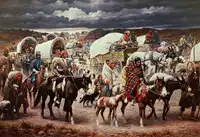
What Was the Trail of Tears?
In 1835 the federal government persuaded a few Cherokee to
sign a treaty giving up their people’s land. Yet most of the
Cherokee refused to honor the treaty. They wrote a protest letter
to the government and people of the United States pleading for
understanding. It did not soften the resolve of President Jackson
or the area’s white settlers. In 1838 federal troops under General
Winfield Scott came to remove the Cherokee from their homes
and lead them west.
18

19

20


The Seminole
The Seminole people of Florida were the only Native Americans who
successfully resisted their removal.
Although they were pressured in
the early 1830s to sign treaties
giving up their land, the Seminole
chief, Osceola, and some of
his people refused to leave Florida.
The Seminole decided to go to war
against the United States instead.
In 1835 the Seminole joined forces with a group of
African Americans who had run away to escape
slavery. Together they attacked white settlements
along the Florida coast. They used guerrilla tactics,
making surprise attacks and then retreating back into
the forests and swamps.
21
Multiple Choice
Who was the only native american group to successfully resist removal from their homeland?
Cherokee
Shawnee
Seminole
Comanche
22

23

🙢
🙢 Native Americans’ requests to remain on
their lands were refused, and they were often
forcibly removed.
🙢 Native Americans often resisted, waging war
against the United States in an attempt to
keep their land.
10.2 Reading Summary
Reviewing the Main Ideas
24
Conflicts Over Land
Use the preceding slides and/or pgs. 372 - 378 to help you answer the following questions.

25
Fill in the Blanks
In 1830 President Andrew
Type answer...
26
Fill in the Blanks
In 1834 Congress set aside an area for Native Americans, most of it in what is today the state of
Type answer...
27
Fill in the Blanks
President Jackson ignored the Supreme Court’s decision in the case of Worcester v.
Type answer...
28
Fill in the Blanks
The “Trail Where They
Type answer...
29
Fill in the Blanks
In 1835 the
Type answer...
30
Multiple Choice
Which act allowed the federal government to pay Native Americans to move west?
Federal Act
Indian Removal Act
Native American Act
Settlers Act
31
Multiple Choice

The Cherokee, Creek, Seminole, Chickasaw, and Choctaw peoples were collectively known as
the “Five Civilized Tribes.”
the “Five Warrior Tribes.”
the “Native American Nation.”
the “Native American People.”
🙢
The Removal of Native Americans
Chapter 10, Section 2
Show answer
Auto Play
Slide 1 / 31
SLIDE
Similar Resources on Wayground

24 questions
Civil War Lesson 1
Presentation
•
7th Grade
26 questions
Indian Removal Cherokee
Presentation
•
8th Grade
22 questions
Lesson 5 & 6
Presentation
•
8th Grade
27 questions
Chapter 11: Lesson 1
Presentation
•
8th Grade
21 questions
NEW SOUTH PART 1
Presentation
•
8th Grade
22 questions
Assignment #015 Three Fifths Compromise
Presentation
•
8th Grade
23 questions
Liberty or Death: Patrick Henry, the Continental Army, and Bunker Hill
Presentation
•
8th Grade
24 questions
Empresarios
Presentation
•
7th Grade
Popular Resources on Wayground
10 questions
How much do you know about our Portrait of an Eagle?

Quiz
•
10th Grade
10 questions
Fast Food Slogans
Quiz
•
6th - 8th Grade
21 questions
Continents and Oceans
Quiz
•
6th Grade
20 questions
Parts of Speech
Quiz
•
5th Grade
16 questions
Subject & Predicate
Quiz
•
5th Grade
25 questions
Multiplication Facts
Quiz
•
5th Grade
12 questions
Map Skills
Quiz
•
3rd Grade
22 questions
Continents and Oceans
Quiz
•
5th Grade
Discover more resources for History
10 questions
Exploring the Journey of Early Humans

Interactive video
•
6th - 10th Grade
21 questions
13 colonies map review
Quiz
•
8th Grade
10 questions
Exploring Jamestown: John Smith and Pocahontas
Interactive video
•
6th - 10th Grade
20 questions
The Early Colonies
Quiz
•
7th - 11th Grade
10 questions
Recap on Mesopotamia: Key Concepts and Facts
Interactive video
•
6th - 10th Grade
16 questions
Government Unit 2
Quiz
•
7th - 11th Grade
34 questions
Judicial Branch and Juvenile Justice
Quiz
•
8th Grade
18 questions
Causes of the American Revolution Review
Quiz
•
8th Grade