
Atoms and Elements review

Presentation
•
Science
•
6th - 8th Grade
•
Practice Problem
•
Hard

Stephanie Barahona
Used 1+ times
FREE Resource
12 Slides • 0 Questions
1

Click here for the Spanish Version
2
Click here for the Spanish Version
3

Here on Earth, we have tall mountains, deep seas, and miles upon miles of all
sorts of land. Over seven billion human beings and an untold number of animals
inhabit Earth. On the smallest scale, we are made up of countless tiny atoms.
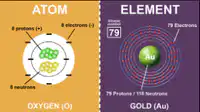
Atoms are small particles that are the building blocks of an element. Too small to
see, those atoms combine in an infinite number of ways to make us who and what
we are. Likewise, they make up all the matter around us, from mountains and seas
to planets and stars. All of these things are composed of variations of the same
small set of materials we know as elements. Elements are substances that have
only one type of atom. They cannot be broken down into a simpler form. There
are about 118 elements known on earth.
Atoms and Elements
4


Elements and the Periodic Table
5


ATOMIC NUMBER
Indicates the number of
protons in an element.
If the element is neutral,
it will also be the number
of electrons for that
element.
ATOMIC MASS OR
MASS NUMBER
Shows how many particles
are located inside the
nucleus. It indicates all of
the protons and neutrons.
Information inside of the box:
6


Information inside of the box:
Element Symbol: It
represents the name of
the element. Some of
them do not make sense
because they are based
on another language
called Latin.
Lead is called PLUMBUM in Latin
7


Information inside of the box:
How many protons are in
Lead?
How many electrons are
in Lead?
How many protons and
neutrons are in Lead?
8


How do you find the number of neutrons by
using the information inside the box?
You already know the
number protons and
neutrons are in Lead?
You also already know the
number of only the
protons Lead.
9


How do you find the number of neutrons by
using the information inside the box?
Round the atomic mass to
the nearest whole number
Subtract the number of
protons.
207
-82
There are 125 neutrons in lead
10


An atom is made up of subatomic particles. The nucleus is located in the center
of the atom. It is made up of two particles, protons and neutrons. Protons have a
positive charge and neutrons are neutral. That means they have no charge
whatsoever. Outside of the nucleus, there are negatively charged particles
called electrons. Electrons are super small compared to protons and neutrons.
Electrons are attracted to the positively charged nucleus.
11


12

Similar to positive and negative charges of a magnet, positive and negative charges
are attracted to each other.
Click Here to see an Animation
Click here for the Spanish Version
Show answer
Auto Play
Slide 1 / 12
SLIDE
Similar Resources on Wayground

10 questions
El verbo SER
Presentation
•
6th - 8th Grade
11 questions
Nervous System Review
Presentation
•
6th - 8th Grade
9 questions
Exothermic & Endothermic Reactions
Presentation
•
5th - 8th Grade
10 questions
Static Electricity
Presentation
•
7th - 8th Grade
12 questions
Scientific Method
Presentation
•
6th - 8th Grade
11 questions
Calculating & Graphing Speed
Presentation
•
6th - 7th Grade
8 questions
Natural and Artificial Selection
Presentation
•
6th - 8th Grade
10 questions
Career Quest Introduction
Presentation
•
6th - 8th Grade
Popular Resources on Wayground
10 questions
Safety Day 2026 – Student Review

Quiz
•
9th Grade
21 questions
Continents and Oceans
Quiz
•
6th Grade
20 questions
Parts of Speech
Quiz
•
5th Grade
16 questions
Subject & Predicate
Quiz
•
5th Grade
25 questions
Multiplication Facts
Quiz
•
5th Grade
12 questions
Map Skills
Quiz
•
3rd Grade
22 questions
Continents and Oceans
Quiz
•
5th Grade
15 questions
Rounding Decimals
Quiz
•
5th Grade
Discover more resources for Science
20 questions
Newton's Laws of Motion
Quiz
•
8th Grade
20 questions
Elements, compounds, and mixtures
Quiz
•
6th Grade
10 questions
6.6D - Relative Density Review
Quiz
•
6th Grade
15 questions
potential and kinetic energy
Quiz
•
8th Grade
21 questions
Newton's Laws of Motion
Quiz
•
8th Grade
20 questions
Elements, Compounds and Mixtures
Quiz
•
8th Grade
10 questions
Exploring Chemical and Physical Changes

Interactive video
•
6th - 10th Grade
20 questions
CONDUCTION,CONVECTION AND RADIATION
Quiz
•
6th Grade