

Understanding Rhetoric Review

Presentation
•
English
•
6th - 8th Grade
•
Practice Problem
•
Medium
+14
Standards-aligned

Katrina Colvin
Used 18+ times
FREE Resource
8 Slides • 11 Questions
1

Understanding Rhetoric
Review
Colvin 6th - 8th
2

Vocabulary
Appeal: a serious or urgent request
Figure of Speech: a word or phrase used in a nonliteral sense
Semantics: how words and phrases are interpreted
Credible: able to be believed; convincing
Logic: a way of thinking that's is reasonable and based on good judgment
Reason: the ability to think, understand, and form judgments by applying logic
3


What is “Rhetoric”?
Rhetoric is the art or skill of
effective speaking or writing,
especially the beautiful and efficient
use of figures of speech.
4

Rhetorical questions are statements made in the
form of questions with no expectation of an answer.
Verbal Irony is when statements mean the opposite
of what is said. Sarcasm is verbal irony that is
mocking or derogatory.
Rhetorical
Questions, Verbal
Irony & Sarcasm
5

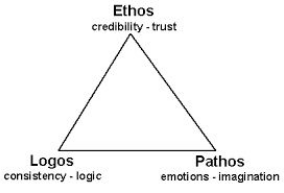
Aristotle’s Rhetorical Triangle
Thousands of years ago, Aristotle
provided us with three ways to appeal
to an audience called: logos, pathos, and
ethos.
The triangle–Aristotle’s Rhetorical
Triangle–shows the three ways to make
persuasive appeals:
1.Ethos: credibility, ethics, or morals
2.
Logos: logic or reason
3.Pathos: emotion
6

Rhetorical Devices
Writers use rhetorical devices to help
them persuade their audience. A
rhetorical device is a figure of speech
intended to have an effect on its
audience.
●
Since rhetoric is persuasive, that
effect must persuade the reader
to the writer’s perspective.
7

Common Rhetorical Devices
Write these down!
Antithesis
A contrast of ideas by
means of parallel
arrangements of words
or phrases
Asyndeton
Omitting conjunctions
that ordinarily join
words or clauses
Chiasmus
words, phrases, or
concepts are repeated
in reverse order, in the
same or a modified form
Synecdoche
When a part is put for
the whole
Metonymy
the use of a linked term
to stand in for an object
or concept
Zeugma
a word applies to two
others in different
senses or to two others
of which it semantically
suits only one
8

Examples
Antithesis: “Go big or go home.”
●“Big” and “home” are contrasting each other.
○Going big would be putting everything on the line while going home would be giving up
Asyndeton: “They observe, they take up, they complete it.”
●Notice how “they” is being placed in between each action.
Chiasmus: ““Bad men live that they may eat and drink, whereas good men eat and drink that they may live.”
●By reversing “eat and drink” and “live”, the author distinguishes bad men and good men
Synecdoche: ”I want a new set of wheels.”
●Wheels are just part of a car but in this sentence, “wheels” is being used to represent the whole car
Metonymy: “The President wants to put boots on the ground to stop this conflict.”
●“Boots on the ground” represents soldiers.
Zeugma: “John lost his coat and his temper”
●Here, “lost” refers to John’s coat and his temper
These rhetorical devices are new so here are some examples.
9
Multiple Choice
"Jerome made an __________ to his principal to not cancel homecoming."
appeal
logic
rhetorical question
synecdoche
10
Multiple Choice
"Amanda said that the prosecutor's argument was not based on ____________."
semantics
credible
reason
antithesis
11
Hotspot
Which part of the triangle represents an emotional appeal? Click the correct response.
12
Multiple Choice
Verbal Irony and Sarcasm are the exact same.
True
False
13
Multiple Choice
"We came, we saw, we conquered." This is an example of...
Metonymy
Synecdoche
Asyndeton
Zeugma
14
Match
Ethos
Pathos
Logos
Credibility appeal
Emotional appeal
Logical appeal
Credibility appeal
Emotional appeal
Logical appeal
15
Multiple Choice
"Carla lost her car keys and her mind last night." This is an example of...
Zeugma
Metonymy
Rhetorical Question
Chiasmus
16
Hotspot
Which of these represents a credibility appeal? Click the correct answer.
17
Multiple Choice
"Why does it have to rain on today of all days?!" asked the bride. This is a...
emotional appeal
rhetorical question
sarcasm
synecdoche
18
Hotspot
Which of these represents a reasonable response? Click the correct answer.
19
Multiple Choice
Verbal irony is when you say...
exactly what you mean
the opposite of what you mean
statements that aren't taken literally
lyrics in a rhythm
Understanding Rhetoric
Review
Colvin 6th - 8th
Show answer
Auto Play
Slide 1 / 19
SLIDE
Similar Resources on Wayground

16 questions
ELPAC Reading Practice #3: Student Essay
Presentation
•
6th - 8th Grade
16 questions
What is a Memoir?
Presentation
•
6th - 8th Grade
14 questions
Greek and Latin Roots
Presentation
•
5th - 8th Grade
13 questions
Making Inferences & Predictions
Presentation
•
6th - 8th Grade
15 questions
ELPAC Practice Test Listening
Presentation
•
6th - 8th Grade
13 questions
Thermal Energy
Presentation
•
6th - 8th Grade
15 questions
Paraphrasing
Presentation
•
6th - 8th Grade
14 questions
Email Etiquette
Presentation
•
6th - 8th Grade
Popular Resources on Wayground
10 questions
How much do you know about our Portrait of an Eagle?

Quiz
•
10th Grade
10 questions
Fast Food Slogans
Quiz
•
6th - 8th Grade
21 questions
Continents and Oceans
Quiz
•
6th Grade
20 questions
Parts of Speech
Quiz
•
5th Grade
16 questions
Subject & Predicate
Quiz
•
5th Grade
25 questions
Multiplication Facts
Quiz
•
5th Grade
12 questions
Map Skills
Quiz
•
3rd Grade
22 questions
Continents and Oceans
Quiz
•
5th Grade
Discover more resources for English
20 questions
Context Clues
Quiz
•
6th Grade
20 questions
Types of sentences
Quiz
•
6th Grade
25 questions
Making Inferences
Quiz
•
6th - 8th Grade
20 questions
Figurative Language Review
Quiz
•
6th Grade
15 questions
Plot Elements
Quiz
•
6th Grade
20 questions
Figurative Language Review
Quiz
•
8th Grade
12 questions
Chemical Reactions

Interactive video
•
7th Grade
18 questions
Main Idea
Quiz
•
4th - 6th Grade