

Evolution -

Presentation
•
Biology
•
9th - 12th Grade
•
Medium
+5
Standards-aligned

Abigale Clair
Used 32+ times
FREE Resource
15 Slides • 30 Questions
1

EvoLUtiON
2


First studied to be a Dr then a
clergyman...he was uninterested
in these subjects. He was more
interested in plants & animals
Who WAs DarWIn???
TraVEleD fOR 5 yeARs oN tHe hMs
BeAgLe
DarWIn ColLEcTed SpeCImeNs
wHilE StuDyINg oN tHe
gaLApaGOs iSlANdS
SpeCImeNs
GalAPagOS fiNcHEs
3


Who WAs DarWIn???
VerY cuRIoUs
Man!
Published On The Origin Of
Species in 1859
Kept secret
notebooks of
his ideas
Found remains of a giant
armoured animal, a
glyptodon, which he
realized looked similar to
the smaller armadillos he
saw
Fascinated with
barnacles
He studied
them for 8
years!
4
Open Ended

Explain who Darwin was and his significance to evolution.
5


What is it?
Some organisms have
favorable traits that are
well-suited to their
immediate environment.
Organisms with this
advantage are more likely
to thrive, reproduce, and
pass their traits on to future
generations than
organisms without such
traits.
MecHAniSm- NAtuRAl SelECtiON
Mutations are a major source of
genetic diversity
Genetic Diversity makes
natural selection possible!
6
Drag and Drop

7


AdaPtATiOnS
OcCurS OveR A LonG tiME
●Gradual
●Favorable traits increase and
less favorable decrease
●Natural selection moves the
species in a new direction
Favorable traits that
increase an organism's
chance for survival in a
particular environment
8
Dropdown
9


DarWIn’S tHeOrY of NAtuRAl SelECtiON
VarIaTIon
01
ComPEtiTIon
02
inHEriTAnCe
03
Individuals produce
offspring that resemble
their parents
Mutations create
variation. Some may have
beneficial variations
Those more fit to succeed
will survive and
reproduce
10
Multiple Select

have no effect
be beneficial
be harmful
11


Some individuals are
better able to secure
a mate than others
SexUaL
seLEcTiOn
12
Multiple Select
An example of sexual selection could be...
A peacocks large colorful tail.
Fruit flies performing dances for a mate
A bird singing a song
A giraffe's long neck
13


A small population
with little genetic
variation becomes
isolated.
Sharp reduction in a
gene in a population
due to a major event
BotTlE NecK
Change in allele
frequency within a
population due to
CHANCE
MecHAniSmS- geNEtiC dRifT
No selection
is involved
Ex: a large
# of
people
with hazel
eyes die
during a
flood.
Founder effect
14
Multiple Choice
Genetic drift is driven by chance, not natural selection
true
false
15
Multiple Choice
gene pool
founder effect
bottleneck
mutation
16
Multiple Choice
gene flow
bottleneck
mutation
founders
17


MecHAniSmS- geNE fLow
Transfer of genetic information from one breeding population to another.
CAUSES:
●Natural events (storm blows
pollen from one population of
plants to another)
●Immigration (movement INTO a
population or ecosystem)
●Emmigration (movement EXITING
a population or ecosystem)
18
Multiple Choice
A forest fire ignites and kills many members of a population of rattlesnakes. This is an example of:
gene flow
genetic drift
mutation
19
Match
Mutation
Gene Flow
Genetic Drift
Bottle Neck
Founders Effect
Change in DNA sequence
Increases genetic variation
Usually decreases genetic variation
Population gets smaller (Natural Disaster)
Starting a new population
Change in DNA sequence
Increases genetic variation
Usually decreases genetic variation
Population gets smaller (Natural Disaster)
Starting a new population
20
Multiple Choice

A population of flowers on one side of a river transports pollen to flowers on the other side of the river
Gene Flow
Genetic Drift
21
Multiple Choice
What is genetic drift in 1 word:
random
calculated
especial
darwin
22
Multiple Choice
when a large population is drastically reduced in size, causing a loss of genetic diversity that can have negative long-term effects.
Founder effect
Bottlebottom effect
Bottleneck effect
Founder Father effect
23


MecHAniSmS of EVolUTiOn
24
Multiple Choice

Select the best answer based on the image.
Gene Flow
Genetic Drift
25
Multiple Choice
A change in a gene
replication
translation
mutation
transcription
26
Multiple Choice
Mutations are important because they bring about
death of the organism in which they develop
genetic variation needed for a population to evolve
benefits for the individual, not for the population
changes in genotype, but not phenotype
27


NatURal SEleCtIoN cAN leAD to...
Speciation: the emergence of a
new species
Occurs when: members of a
population can no longer
successfully reproduce
28


Reproductive Isolation: members of
a population that live in the same
area become unable to interbreed
Geographic Isolation: portion of a population
becomes physically separated by a geographical
barrier
HOw???
29
Multiple Select
SELECT ALL THAT APPLY: Which of the following must be true in order for organisms to be considered the same species?
They must be able to mate
They must be able to produce fertile offspring
They must have structural similaries
They must have the same bone structure
30
Multiple Choice

Differentiation
Geographic Isolation
Adaptation
Separation
31
Multiple Choice
The formation of a new species is called
Natural selection
Struggle for existence
Speciation
Darwinism
32
Multiple Choice
The emergence of new rivers or streams is a type of ____________ isolation.
Temporal
Reproductive
Behavioral
Geographic
33
Multiple Choice
There are two main ways that speciation happens naturally. Both processes create new species by reproductively isolating populations of the same species from each other. What are these two types of isolation?
geographical and reproductive
geographical and complex
reproductive and complex
locational and geographical
34


35


diREcTiOnaL
StaBIliZInG
Well adapted; favors
intermediate phenotype
diSrUPtiVE
Favors 2 extremes; may
lead to speciation
Favors extremes; may be
environmental changes
PatTErNs oF sELecTIon
36
Multiple Choice
Panthers with teeth that are too short have difficulty capturing prey, while panthers with teeth that are too long have difficulty chewing their food. What type of selection is this?
disruptive
stabilizing
directional
37
Multiple Choice
In a lake in South Africa, guppies are eaten by the pike fish, and the larger the guppy, the more difficulty it has escaping its pike fish predator. What type of selection is this?
stabilizing
directional
disruptive
38
Multiple Choice
The rocks at the bottom of a stream are either black or white. The snails that live on these rocks range in color from white, to gray, to black. The fish in the stream love to munch on these snails. The fish cannot spot the black and white snails, but can easily spot the gray snails. This is an example of:
Distorted
Stabilizing
Disruptive
Directional
39


HarDy WeInBerG EquILibRIum
If this conditions are not met,
the population is considered to
be evolving
40
Multiple Choice
Which of these is a condition that MUST be met for Hardy-Weinberg equilibrium?
extremely small population size
no natural selection
gene flow
nonrandom mating
41
Multiple Choice
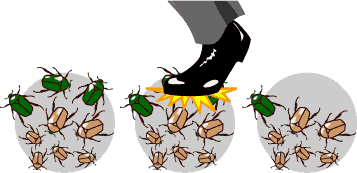
Someone steps on some bugs and randomly removes their alleles from the population. This is an example of
gene flow
genetic drift
speciation
allele frequency
42
Multiple Choice
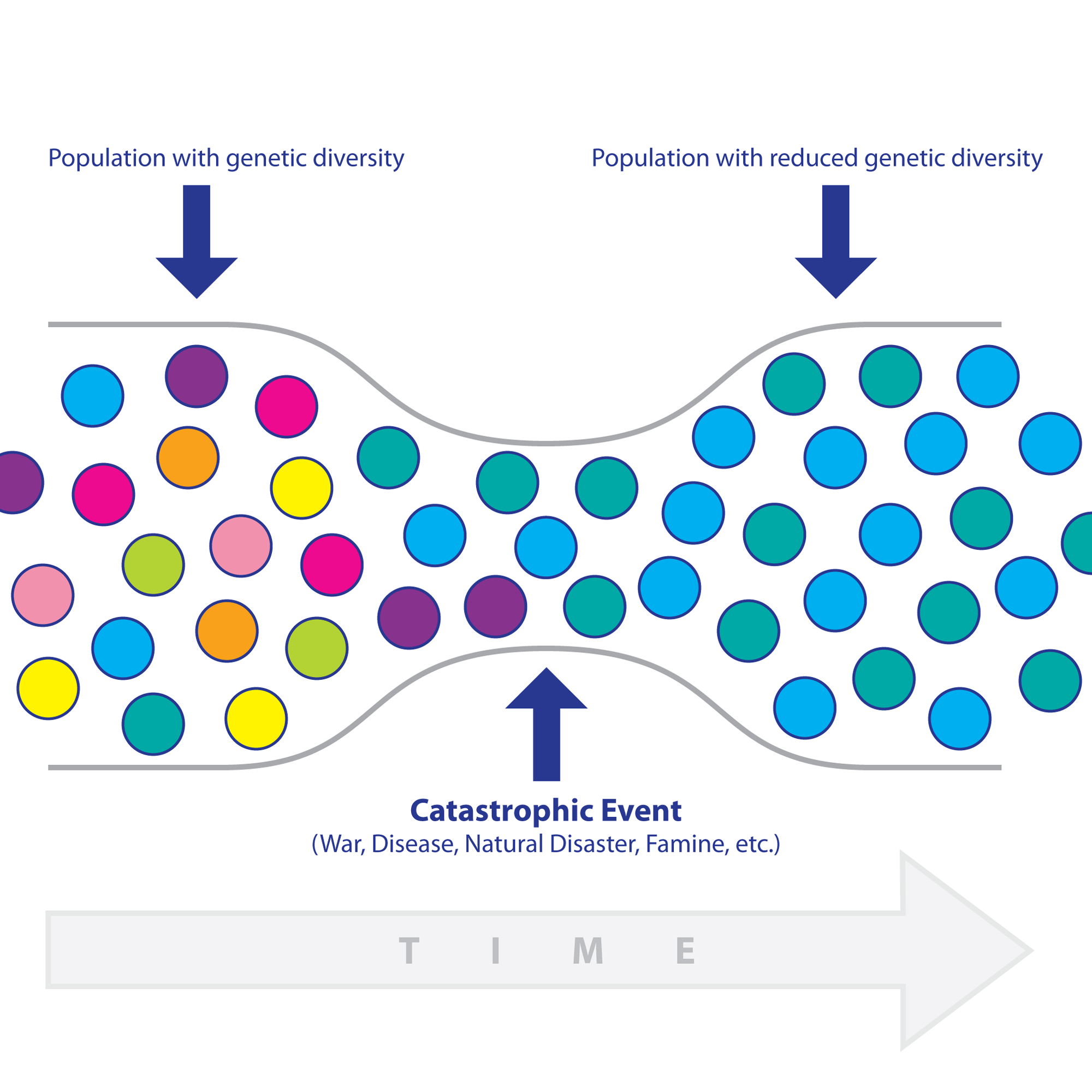
A drastic reduction in the size of a population that can change allele frequencies is called
the bottleneck effect
the founder effect
the gene flow effect
the Thanos effect
43
Multiple Choice
Which is NOT an assumption of Hardy-Weinberg equilibrium?
natural selection
large populations
no mutations
no migration
random mating
44
Multiple Choice
If a population of lizards is isolated on an island, with no new immigrants over many years, any new genetic variations are most likely to come from
recessive alleles
natural selection
mutations
speciation
45
Multiple Choice
If all 5 Hardy-Weinberg assumptions are true, a population is said to be in genetic equilibrium. This means
it is evolving
it is NOT evolving
EvoLUtiON
Show answer
Auto Play
Slide 1 / 45
SLIDE
Similar Resources on Wayground

42 questions
Credit Score
Presentation
•
9th - 12th Grade
40 questions
Skeletal System
Presentation
•
9th - 12th Grade
41 questions
Unit 1 Review
Presentation
•
9th - 12th Grade
41 questions
Meiosis
Presentation
•
9th - 12th Grade
43 questions
23_24 | EOC Review | Cell Cycle & Cancer| Mitosis| Meiosis
Presentation
•
9th - 12th Grade
38 questions
Meiosis Lesson
Presentation
•
9th - 12th Grade
39 questions
Commas
Presentation
•
9th - 12th Grade
38 questions
Thermodynamics
Presentation
•
9th - 12th Grade
Popular Resources on Wayground
10 questions
How much do you know about our Portrait of an Eagle?

Quiz
•
10th Grade
10 questions
Fast Food Slogans
Quiz
•
6th - 8th Grade
21 questions
Continents and Oceans
Quiz
•
6th Grade
20 questions
Parts of Speech
Quiz
•
5th Grade
16 questions
Subject & Predicate
Quiz
•
5th Grade
25 questions
Multiplication Facts
Quiz
•
5th Grade
12 questions
Map Skills
Quiz
•
3rd Grade
22 questions
Continents and Oceans
Quiz
•
5th Grade
Discover more resources for Biology
20 questions
Characteristics of Life
Quiz
•
9th - 10th Grade
10 questions
Exploring the 4 Major Macromolecules and Their Functions

Interactive video
•
9th - 12th Grade
20 questions
Cell organelles and functions
Quiz
•
10th Grade
20 questions
Cell Transport
Quiz
•
9th - 12th Grade
25 questions
photosynthesis and cellular respiration
Quiz
•
9th Grade
20 questions
Macromolecules
Quiz
•
10th Grade
16 questions
Population Ecology
Quiz
•
9th - 12th Grade
20 questions
Cell Organelles
Quiz
•
9th Grade