
Rise of Greek Civilization

Presentation
•
Social Studies
•
6th - 8th Grade
•
Practice Problem
•
Medium

Janae Steen
Used 24+ times
FREE Resource
14 Slides • 6 Questions
1
Rise of Greek Civilization
2
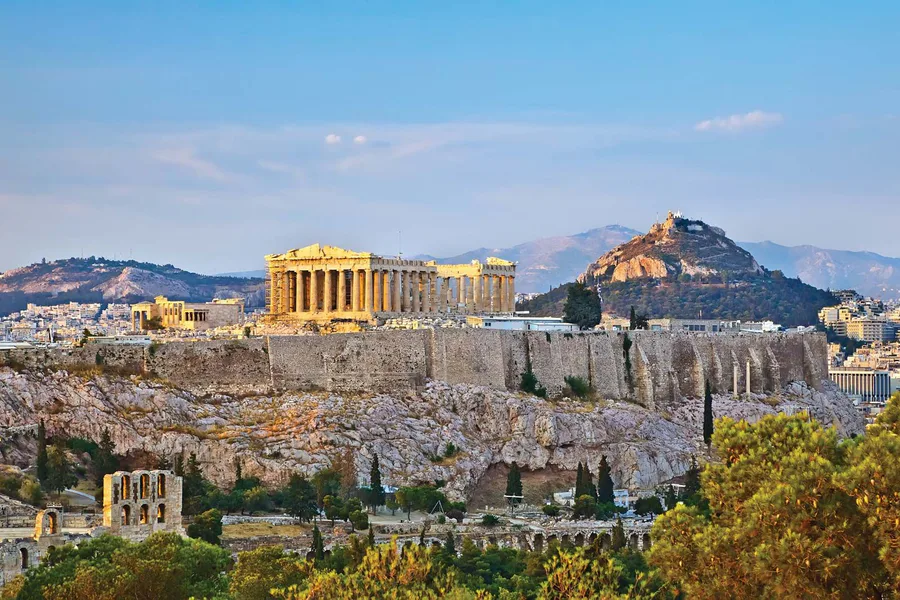
The early Greeks developed important settlements, trade routes, and political ideas in the Mediterranean region.
It Matters Because
How does geography influence the way people live?
Essential Question
Lesson Introduction
3
Terms to Know
peninsula
bard
colony
polis
agora
phalanx
4


Greece was the first civilization to develop in Europe. People first settled in river valleys that had rich soil. If you flew over Greece today, you would see rugged landscapes and beautiful seas.
Mountains
Greece is a peninsula. This means that it is surrounded by water on three sides. Among the many islands that make up Greece, ancient people traded. Many fished for a living. On the plains between the mountains, farmers raised crops and sheep and goats.
Seas
5
Open Ended
How did seas influence the way many ancient Greeks lived?
6
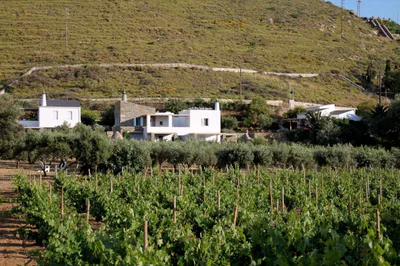
Many settled in farming communities, on narrow, fertile plains. In the area's mild climate, farmers grew crops, such as wheat, barley, olives, and grapes.
Farming Communities
Even though may communities were near the sea, some lived far from the coast. These communities were separated by rugged mountains and deep valleys. As a result, many parts of Ancient Greece became fiercely independent.
Inland Communities
7
Another civilization called Crete developed off the coast of southern Greece. About 1900, a British archaeologist named Arthur Evans found items from this civilization on Knossos.
The palace has many rooms that stored food.
Other rooms were workshops where people made jewelry and vases.
An ancient people called the Minoans built the palace.
Trade was very important economically for the Minoans. They traded pottery and vases for ivory and metals in Egypt and Syria. Sometime around 1450 B.C., the Minoan civilization ended. Historians hypothesize that people from the mainland, known as Mycenaeans, invaded Crete.
Island Civilization

8
Open Ended
How did the civilization of the Minoans develop?
9
The Mycenaeans lived in Greece from about 2000 B.C. to 1100 B.C in a place called Mycenae.
In this civilization, each king lived in a palace built on a hill. Nobles lived outside the walls on large farms called estates. Enslaved people and other workers lived in villages on the estates. The palaces were centers of government. Workshops were housed there too. People made clothes and jars for wine and olive oil. Other workers made metal swords.
Government officials recorded the wealth of residents. They also collected wheat, livestock, and honey as taxes.
Mainland Civilization
Mycenaean Kingdom
10
Multiple Choice
Why were the Mycenaean palaces important palaces?
They were symbols of wealth and power
They were places of religious worship
They were centers of government
They were built to protect the people
11
Minoan traders from Crete visited the Greek mainland. This led to the Mycenaeans adopting many features of Minoan culture.
building ships
working with bronze
using the sun and stars to navigate the sea
worshipping the Earth Mother as chief god
By the mid-1400s B.C., the Mycenaeans had conquered the Minoans and ruled the Aegean Sea. This brought them much new welath that they used to strengthen their military.
Mainland Civilization
Traders and Warriors
12
Multiple Select
What two things did the Mycenaeans learn from the Minoans?
Bronze-working
Worshipping Zeus
Building schools
Use of astronomy
13
By 750 B.C., many descendants of the people who ran away returned to the Greek mainland. They brought back new ideas, crafts, skills. These people called themselves Hellenes, or Greeks. Greeks traded surplus food with the Egyptians and Phoenicians. As trade increased, a new need for writing developed.
The Hellenes
Internal conflict and earthquakes destroyed the fortresses of Mycenaean palaces and led to the decline of their kingdoms. A group known as the Dorians then invaded the land. For 300 years, trade slowed down, artisans produced less valuables, and most were very poor. Many people fled the land.
A Dark Age
Mainland Civilization
14
Fill in the Blanks
What word means "the system that includes, making, buying, and selling goods?"
Type answer...
15
The Greek alphabet had 24 letters that represented different sounds. It greatly simplified reading and writing in the Greek language. Record keeping became easier. Soon, people wrote down tales that had previously been told by bards, or storytellers.
Alphabet
Written Language

16
The population increased in Greece when the Dark Age ended and by 700 B.C., farmers could not grow enough food for everyone. As a result, Greek communities started to send people away to form colonies on the Mediterranean and Black Sea coasts.
The colonies shipped grains, metals, timber, and enslaved people to "parent" cities in Greece. In return, the cities shipped wine, olive oil, and pottery to the colonies.
Greeks started to make coins from metals to make trading easier. A coin is small and can be traded for many different types of goods. This made it convenient to carry and use. Trade increased and made the colonies wealthier.
Colonies and Trade
17


The polis, or city-state, was the basic political unit in early Greece. At the center of each polis was a fort built on a hilltop. This fort was called an acropolis. The open area outside of the acropolis was called the agora. This space was used as a marketplace and people gathered to debate issues, pass laws, and choose officials.
Each polis was governed by its own citizens. The Greeks developed the modern idea of citizenship. Only men born in the polis were considered citizens. As a result, only they could vote, hold public office, and defend themselves in court.
The Greek City-State
Citizens fought to defend their city-state. These citizen soldier were called hoplites. They fought on foot. Each was armed with a round shield, a short sword, and a spear. They would march shoulder to shoulder in battle. This formation was called a phalanx.
The polis gave Greek citizens a sense of belonging. However, strong loyalty to their individual city-states also divided Greece. This lack of unity weakened Greece.
18
Open Ended
What were the rights and responsibilities of Greek citizens?
19
Lesson Review
Identifying Complete the sentences below with the correct word.
Settlements in a new territory that have close ties to their homeland are called __________.
___________ increased with the development of colonies.
Colonies __________ Greek culture throughout the Mediterranean area.
Greeks began to make coins from __________.
Trade was __________ by the development of coinage.
20
Lesson Review
Assessing Read each of the following statements and decide whether it is true or false
1. As the Dark Age ended, land-owning nobles overthrew the kings of Greece. T F
2. Because of the rugged landscape, each city-state was like a small independent country. T F
3. Mountains and seas brought the Greek city-states together. T F
4. Citizens of city-states put the needs of the city-states above their own. T F
5. A citizen’s strong loyalty to his city-state enabled Greeks to unify. T F
6. The lack of unity among Greek city-states made Greece easier to conquer.
Rise of Greek Civilization
Show answer
Auto Play
Slide 1 / 20
SLIDE
Similar Resources on Wayground

16 questions
Louisiana Purchase
Presentation
•
6th - 8th Grade
18 questions
Cold War: Lesson 1
Presentation
•
6th - 8th Grade
13 questions
5 Themes of Geography
Presentation
•
7th - 8th Grade
15 questions
Reliable Source or Fake News
Presentation
•
6th - 8th Grade
19 questions
Ancient Greek philosophers
Presentation
•
6th - 8th Grade
11 questions
Lanforms of Latin America
Presentation
•
6th - 8th Grade
11 questions
Treaty of Versailles
Presentation
•
6th - 8th Grade
15 questions
Southern Society
Presentation
•
6th - 8th Grade
Popular Resources on Wayground
10 questions
Impact of 9/11 and the War on Terror

Interactive video
•
10th - 12th Grade
21 questions
Continents and Oceans

Quiz
•
6th Grade
5 questions
9/11
Interactive video
•
9th Grade
20 questions
Parts of Speech
Quiz
•
5th Grade
16 questions
Subject & Predicate
Quiz
•
5th Grade
10 questions
Riddles Riddles fun Riddles
Quiz
•
6th - 12th Grade
21 questions
Lab Safety
Quiz
•
10th Grade
6 questions
PRIDE in the Hallways and Bathrooms
Presentation
•
12th Grade
Discover more resources for Social Studies
15 questions
6th Grade Europe's Environmental Issues/Impact of Geography
Quiz
•
6th Grade
10 questions
9/11
Quiz
•
5th - 7th Grade
6 questions
Branches of Hope: The 9/11 Survivor Tree
Interactive video
•
6th Grade
10 questions
Exploring the Age of Exploration: Key Events and Figures
Interactive video
•
6th - 10th Grade
20 questions
Primary and Secondary Sources
Quiz
•
7th Grade
13 questions
Primary and Secondary Sources
Quiz
•
6th Grade
7 questions
Otto's Tale Today is September 11th
Interactive video
•
6th Grade
21 questions
ss.7.cg.1.1- Ancient Influences
Quiz
•
7th Grade