
APPsych Mod 55

Presentation
•
Social Studies
•
9th - 12th Grade
•
Practice Problem
•
Medium

Robert Bruns
Used 3+ times
FREE Resource
22 Slides • 24 Questions
1

Unit X: Personality
Mr. Bruns
AP Psychology
2

Unit X: Personality
Module 55
Freud’s Psychoanalytic
Perspective
3

4

Freud’s View of the
Unconscious Mind
55-1
5

Personality
An individual’s characteristic pattern of
thinking, feeling, and acting.
Each dwarf has a distinct personality.
55-1
6

Psychoanalytic Perspective
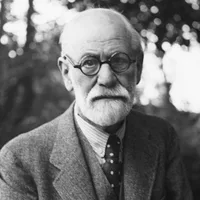
• In his medical practice,
Sigmund Freud encountered
patients suffering from
nervous disorders.
• Their complaints could not be
explained in terms of purely
physical causes.
• In his quest for answers, he
“discovered” the unconscious.
55-1
7

Exploring the Unconscious
• Freud said the unconscious mind is a reservoir of
mostly unacceptable thoughts, wishes, feelings, and
memories.
• He used psychoanalysis to retrieve and release
painful, embarrassing
unconscious memories
through free association
and dream analysis.
55-1
8
Multiple Choice
An individual's characteristic pattern of thinking, feeling, and acting is his or her
self-esteem.
personality.
reality principle.
hierarchy of needs.
9
Multiple Choice
By professional training, Sigmund Freud was a
philosopher.
sociologist.
physician.
literary scholar.
10
Multiple Choice
Freud became interested in unconscious personality dynamics when he noticed that certain patients' symptoms
reflected an internal locus of control.
illustrated a reciprocal determinism.
made no neurological sense.
were passed down genetically.
11
Multiple Choice
Freud believed that certain troubling symptoms could be traced to painful unconscious memories. This led him to suspect that these symptoms resulted from
an internal locus of control.
psychological processes.
an inferiority complex.
genetic defects.
12
Multiple Choice
Prior to his use of free association, Freud had encouraged patients to retrieve their forgotten memories by means of
hypnosis.
projective tests.
psychoactive drugs.
fixation.
13

Personality Structure
55-2
14

Freud’s Model of the Mind
•
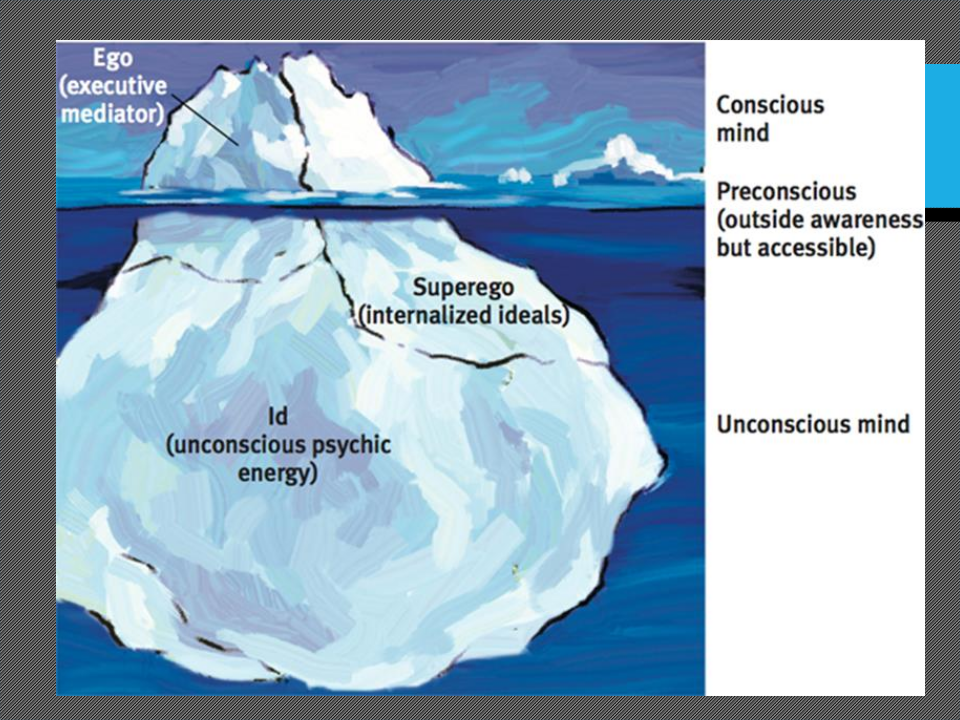
The mind is like an iceberg.
•
It is mostly hidden, and below
the surface lies the
unconscious mind.
•
The preconscious stores
temporary memories.
Figure 55.1 p. 557
55-2
15

Freud’s View of Personality
Personality develops as a result of our efforts to
resolve conflicts between our biological impulses
and social restraints.
Figure 55.1 p. 557
55-2
16

Id, Ego and Superego
The id unconsciously strives to satisfy basic
sexual and aggressive drives, operating on the
pleasure principle, demanding immediate
gratification.
The ego functions as the “executive” and
mediates the demands of the id and superego.
The superego provides standards for judgment
(the conscience) and for future aspirations.
55-2
17
18

19
Multiple Choice
A psychotherapist instructs Dane to relax, close his eyes, and state aloud whatever thoughts come to mind no matter how trivial or absurd. The therapist is using a technique known as
fixation.
free association.
factor analysis.
hypnosis.
20
Multiple Choice
According to Freud, the unconscious is
the thoughts, wishes, feelings, and memories of which we are largely unaware.
a set of universal concepts acquired by all humans from our common past.
a reservoir of deeply repressed memories that does not affect behavior.
the personality structure that abides by the reality principle.
21
Multiple Choice
Forgotten memories that we can easily recall were said by Freud to be
fixated.
displaced.
unconscious.
preconscious.
22
Multiple Choice
Freud emphasized that the id operates on the ________ principle.
pleasure
identity
ego
collectivism
23
Multiple Choice
Freud suggested that in a healthy person the
id is stronger than the ego and superego.
ego is stronger than the id and superego.
superego is stronger than the id and ego.
id, ego, and superego are equally strong.
24
Multiple Choice
According to Freud, the part of personality that represents our sense of right and wrong and our ideal standards is the
ego.
id
superego
collective unconscious.
25

Personality Development
55-3
26
Personality Development
• Freud believed that personality formed during
the first few years of life, which is divided into
psychosexual stages.
• During these stages the id’s
pleasure-seeking energies focus on
pleasure sensitive body areas called
erogenous zones.
55-3
27

Psychosexual Stages
Freud divided the development of personality
into five psychosexual stages:
55-3
28

Oedipus Complex
• A boy’s sexual desire for
his mother and feelings of
jealousy and hatred for
the rival father.
• A girl’s desire for her
father is called the Electra
complex.
55-3
29

Identification
• According to Freud, children cope with
threatening feelings by repressing them and
by identifying with the rival parent.
• Through this process of
identification, their superego
gains strength that incorporates
their parents’ values.
55-3
30
Multiple Choice
Freud suggested that pleasure-seeking energies focus on distinct erogenous zones as we progress through various
defense mechanisms.
psychosexual stages.
free associations.
identifications.
31
Multiple Choice
Freud suggested that the id's pleasure-seeking energies focus on distinct pleasure-sensitive areas of the body known as
psychosexual stages.
the Big Five.
erogenous zones.
fixations.
32
Multiple Choice
According to Freud, the most important erogenous zone during earliest infancy consists of the
eyes.
mouth.
bowels.
urethra.
33
Multiple Choice
The Oedipus complex is the term used by Freud to describe
the erogenous zones that are the focus of the latency stage.
the passive dependence of someone who is orally fixated.
children's efforts to overcome feelings of inferiority.
boys' feelings of guilt and fear of punishment over their sexual desire for their mother.
34
Multiple Choice
Some psychoanalysts in Freud's era believed that girls experienced unconscious sexual desires for their father during the phallic stage. These feelings, they thought, reflected
self-actualization.
an Electra complex.
the spotlight effect.
unconditional positive regard.
35

Defense Mechanisms
55-4
36

Defense Mechanisms
55-4
37
Multiple Choice
Which theory would most likely predict that boys raised without a father figure will have difficulty developing a strongly masculine gender identity?
Gordon Allport's trait theory
Abraham Maslow's humanistic theory
Albert Bandura's social-cognitive theory
Sigmund Freud's psychoanalytic theory
38
Multiple Choice
Psychoanalytic theory suggests that the ego disguises threatening impulses and reduces anxiety by means of
free association.
self-actualization.
unconditional positive regard.
defense mechanisms.
39
Multiple Choice
According to Freud, the defense mechanism that underlies all others is
repression.
displacement.
projection.
reaction formation.
40
Multiple Choice
The defense mechanism in which self-justifying explanations replace the real, unconscious reasons for actions is
projection.
reaction formation.
rationalization.
displacement.
41
Multiple Choice
Projection refers to the process by which people
consciously express feelings that are the opposite of underlying unconscious impulses.
disguise unacceptable, unconscious impulses by attributing them to others.
retreat to behavior patterns characteristic of an earlier stage of development.
repress unacceptable impulses into the unconscious mind.
42
Multiple Choice
Children who release unexpressed anger toward their parents by kicking the family pet illustrate the defense mechanism of
projection.
displacement.
regression.
reaction formation.
43
Multiple Choice
Frank refuses to believe that he is addicted to drugs despite overwhelming evidence to the contrary. He is most clearly demonstrating the defense mechanism of
displacement.
regression.
projection.
denial.
44
Multiple Choice
Parents who disguise hostility toward their children by becoming overly protective of them are very likely using the defense mechanism of
reaction formation.
rationalization.
regression.
projection.
45

Evaluating the
Psychoanalytic Perspective
55-5
46

Modern Research & Freud’s Ideas
• Freud offered after-the-fact explanations, which cannot
be tested scientifically
• Many of his ideas have been disputed by modern
research:
Development is not fixed in childhood
Gender identity can develop without a same-sex
parent present
Dreams do not exist to disguise wishes
Suppressed sexuality does not lead to psychological
disorders
Stressful situations lead to enhanced memories, not
repressed ones
55-5
Unit X: Personality
Mr. Bruns
AP Psychology
Show answer
Auto Play
Slide 1 / 46
SLIDE
Similar Resources on Wayground

40 questions
Concordância verbal
Presentation
•
KG
39 questions
Evolution Terms part 2
Presentation
•
9th - 12th Grade
43 questions
Graphs and Graphing
Presentation
•
9th - 12th Grade
43 questions
Day 2 2026 Semester 2
Presentation
•
9th - 12th Grade
42 questions
Canada Map 1
Presentation
•
9th - 12th Grade
42 questions
Fossil Fuels
Presentation
•
9th - 12th Grade
37 questions
Colonialism
Presentation
•
9th - 12th Grade
42 questions
Pickleball Basics
Presentation
•
9th - 12th Grade
Popular Resources on Wayground
10 questions
How much do you know about our Portrait of an Eagle?

Quiz
•
10th Grade
10 questions
Fast Food Slogans
Quiz
•
6th - 8th Grade
21 questions
Continents and Oceans
Quiz
•
6th Grade
20 questions
Parts of Speech
Quiz
•
5th Grade
16 questions
Subject & Predicate
Quiz
•
5th Grade
25 questions
Multiplication Facts
Quiz
•
5th Grade
12 questions
Map Skills
Quiz
•
3rd Grade
22 questions
Continents and Oceans
Quiz
•
5th Grade
Discover more resources for Social Studies
10 questions
Exploring the Age of Exploration: Key Events and Figures

Interactive video
•
6th - 10th Grade
17 questions
1.3 Review
Presentation
•
11th Grade
10 questions
Exploring the 13 Colonies Regions
Interactive video
•
6th - 10th Grade
8 questions
Smith Unit 5 Quick Check #1 Big Business, Monopolies &Technology
Quiz
•
11th Grade
46 questions
Unit 1 Test REVIEW Ancient Greece and Rome
Quiz
•
9th - 12th Grade
10 questions
Exploring Ancient Mesopotamia Through Song
Interactive video
•
6th - 10th Grade
27 questions
Supply & Demand Test Review
Quiz
•
12th Grade
36 questions
Unit 5 Key Terms
Quiz
•
11th Grade - University