Petroski - Earth Science LEAP Review
Presentation
•
Science
•
8th Grade
•
Medium
+16
Standards-aligned

Amber Petroski
Used 11+ times
FREE Resource
24 Slides • 73 Questions
1

Earth Science LEAP Review
2
Geology
Plate Motion
Rock Transformations
This review activity will focus on:
3
Part 1: Convection in the Mantle
4
Fluid means movable molecules (liquids or gas)
Caused by differences in temperature and density.
Convection is the transfer of heat by movement of a heated fluid.
5
Hot fluid is less dense, so it rises
Cool fluid is more dense, so it falls
6
Convection currents flow in the Mantle of the Earth
The heat source is from the core of the Earth and the Mantle itself.
These convection currents have been acting like a conveyor belt, moving the lithosphere above for billions of years.
these currents are the engines that move the the plates of the Earth's surface.
7
Hotspot
Click on the location on the diagram to indicate where the step in the convection process is occurring:
Density of the mantle materials is less than the material above it, so the material begins to rise.
8
Hotspot
Click on the location on the diagram to indicate where the step in the convection process is occurring:
The force gravity is causing denser material to fall
9
Hotspot
Click on the location on the diagram to indicate where the step in the convection process is occurring:
Core heat causes causes temperatures to rise, therefore decreasing the density of the material.
10
Hotspot
Click on the location on the diagram to indicate where the step in the convection process is occurring:
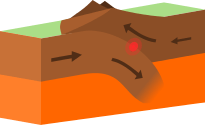
Rising material hits the rigid lithosphere and cannot go any further.
11
Multiple Choice
What causes convection currents?
The heat of the Earth's exterior
Energy from the Sun
The rotation of the Earth
The heat from the Earth's core
12
Multiple Choice
What do convection currents do to the plates of the Earth?
Increase the temperature
Cause movement
Cause them to sink
Generate magnetic fields
13
Part 2: The Theory of Continental Drift
14
Alfred Wegener theorized that the continents were all joined together at one time and have drifted apart.
His Theory was rejected.
The Theory of Continental Drift
15
16
Fossil Evidence
Continental Fit
Sea Floor Spreading
Landforms and Rock Layers
Wegener had 4 pieces of evidence for continental drift
17
Fossils are found on separate continents with vast oceans between them.
Fossil Evidence
The continents with their shelves seem to fit together like a puzzle
Continental Fit
The sea floor spreads apart at a divergent boundary
Sea Floor Spreading
Landforms match from continent to continent with same aged rocks.
Landforms/Rocks
18
Multiple Choice
Alfred Wegener thought which 2 continents looked like puzzle pieces that could fit together?
Antarctica and Asia
South America and Africa
South America and Australia
Africa and Pangaea
19
Multiple Choice
What geologic feature was evidence to support the theory that the continents used to be joined?
Same rocks were found on different continents
Glacial grooves were found on different continents
Fossilized evidence of the same organism found on different continents
Africa and South America look like puzzle pieces that fit together
20
Multiple Choice
What cold environment feature was evidence to support the theory that the continents used to be joined?
Same rocks were found on different continents
Glacial grooves were found on different continents
Fossilized evidence of the same organism found on different continents
Africa and South America look like puzzle pieces that fit together
21
Multiple Choice
What evidence of an ancient organism was used to support the theory that the continents used to be joined?
Same rocks were found on different continents
Glacial grooves were found on different continents
Fossilized evidence of the same organism found on different continents
Africa and South America look like puzzle pieces that fit together
22
Multiple Choice
What was Pangaea?
It was a supercontinent, made of all of the landmasses on Earth.
It was 2 separate landmasses, one on the Northern Hemisphere and one on the Southern Hemisphere.
It was a supercontinent made of 3 landmasses
It was the name of an ancient organism
23
Multiple Choice
What was Alfred Wegenerś Continental Drift theory?
The continents used to be joined together to form a supercontinent.
The continents have since drifted apart to their current location
Pangaea was formed around 250 million years ago
All of the above
24
Multiple Choice
Tectonic plates
Puzzles
Earthquakes
25
Multiple Choice
What is the force that moves the continents?
Conduction
Convection
Radiation
Conveyor belts
26
Multiple Choice
Originally the Continental drift theory was not well received by other scientist. Why?
There was a competing theory at the time that was more believable.
There was no data showing the continents ever moved.
The scientists did not know the force responsible for moving the continents.
The scientist presenting the data was unreliable.
27
Reorder
Order the pictures of Pangaea from oldest to present day.
28
Match
Glacier grooves match up on neighboring continents
Plant and animal evidence found on continents seperated by oceans
Hardened magma of the same chemistry and age
Continents seem to fit together like puzzle pieces
Climate Clues
Fossil clues
Rock clues
Continental shape clues
Climate Clues
Fossil clues
Rock clues
Continental shape clues
29
Part 3: The Theory of Sea Floor Spreading
30
The Sea floor spreads apart on both sides of the mid-ocean ridge.
The ocean floor moves like a conveyor belt, carrying the continents with it.
Mid-Ocean Ridge
31
Pillow shaped rocks form when molten lava erupts and dries quickly on the ocean floor.
Molten Materials
Rocks lie in patterns showing a record of reversals of the Earth's magnetic fields over long periods of time.
Magnetic Stripes
The farther away from the mid-ocean ridge you get, the older the rocks are on the ocean floor.
Drilling Samples
32
The sideways and downward movement of a tectonic plate into the mantle
Eventually, the Earth's crust sinks into deep water trenches.
Subduction occurs to recycle the earths plates back into the mantle to be melted.
Subduction
33
34
Multiple Select
Mid-ocean ridges are the sites of intense _________ activity.
emotional
volcanic
earthquake
mathematical
35
Multiple Select
As the melted rock cools and hardens,
it forms new ________.
volcanoes
hope
core
crust
36
Multiple Select
___________ is the process by which
new oceanic lithosphere (sea floor) forms as magma rises to Earth’s surface and solidifies at a mid-ocean ridge.
Continental drift
Sea-floor spreading
Plate tectonics
Mid-ocean range
37
Multiple Choice
Tectonic plates
Trenches
Divergent boundary
Continental shelves
38
Multiple Choice
Tectonic plates
Trenches
Divergent boundary
Continental shelves
39
Multiple Choice
earthquakes
subduction zones
fossils
volcanoes
40
Multiple Choice
Closest to the mid-ocean ridge
Farthest from the mid-ocean ridge
41
Multiple Choice
True
False
42
Multiple Choice
Parts of the crust fall into the mantle
Parts of the crust fall into the core
Parts of the crust fall into space
None of these
43
Multiple Choice
scientist found animals at the bottom of the sea
mountain rocks crashed into the ocean
scientist found pillow shaped rocks like pillows
44
Multiple Choice
divergent boundaries
subduction
new crust is formed
mountain ranges
45
Multiple Choice
Continent's edge
Deep-ocean trench
Mid-ocean ridge
46
Multiple Choice
Look at this image, which shows changes at mid-ocean ridges. The highlighted section shows how one location of the sea floor moves over time. Which process is demonstrated in this image?
Continental drift
earthquakes
plate collisions
sea-floor spreading
47
Multiple Choice
mid-ocean ridge
deep-ocean trench
asthenosphere
48
Part 4: The Theory of Plate Tectonics
49
This theory is a combination of continental drift and sea floor spreading
50
Plates move TOWARD each other.
There are three kinds:
Ocean to Ocean
Ocean to Continent
Continent to Continent
Convergent
Plates move AWAY from each other
Divergent
Plates SLIDE PAST each other
Transform
51
If under the ocean = Mid-Ocean Ridges
Includes volcanic mountain ranges
If on land = Rift Valleys
Includes volcanoes
Landforms at Divergent Boundaries
52
Fault lines are the most common.
Hills may form from displaced rock.
Landforms at Transform Boundaries
53
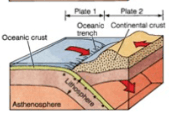
Trench
Volcanic Arc Islands
Subduction Zone
Ocean - Ocean Convergent
Trench
Volcanic Mountain Ranges
Subduction Zone
Ocean - Continent Convergent
Mountain Ranges
Continent - Continent Convergent
54
Multiple Choice
The earth's outer shell is divided into slabs of rock called ______ .
continental plates
crustal plates
trench plates
tectonic plates
55
Multiple Choice
What is the driving force behind the movement of the plates?
56
Match
divergent
convergent
transform
divergent
convergent
transform
57
Multiple Choice
At which plate boundary is new crust formed?
divergent
convergent
continental
transform
58
Multiple Choice
What type of crusts are involved with one plate subducting beneath another?
continental and continental
Oceanic and continental
oceanic and divergent
continental and convergent
59
Multiple Select
What types of landforms are formed at convergent boundaries?
PICK TWO
volcanoes
new crust
Trenches
rift valley
60
Multiple Choice
What is the WHOLE AREA called where the oceanic crust goes beneath the continental crust?
subtraction zone
section zone
secondary zone
subduction zone
61
Multiple Choice
True or False: The continental plates move so quickly that we can feel them.
True
False
62
Multiple Choice
Volcanoes
mountains
trenches
earthquakes
63
Multiple Choice
Convergent
Divergent
Transform
Spreading
64
Multiple Choice
Which layer of Earth flows slowly and causes the crust to move?
Crust
Mantle
Inner Core
Outer core
65
Multiple Choice
When the earth causes an upward thrust in the epicenter.
When the earth moves up and down along the ocean floor.
When tectonic plates slide against each other causing the earth to move.
None of the above
66
Multiple Choice
Subduction means.....
one plate goes under another plate
two plates slide past each other
two plate collide and form folded mountains
67
Multiple Choice
Sea-floor spreading explains how.....
new crust is created at a divergent boundary
volcanoes are formed on continents
deep sea trenches are formed
68
Multiple Choice
An opening on the Earth's crust through which hot molten rock flows out from deep inside the Earth.
Volcano
Fault line
Fold
Crater
69
Multiple Choice
Energy from the Sun
Magnetic Pole Reversal
Convection currents in the mantle
Faults in Mountain Ranges
70
Multiple Choice
Plate
Divergent
Convergent
Transform
71
Multiple Choice
Rift Valley
Mid-Ocean Ridge
Island Arc
Flat land
72
Multiple Choice
Volcano
Mountain
Rift
Island Arc
73
Multiple Choice
Where are the youngest rocks on Earth found?
Along mid-ocean ridges
Along transform boundaries
On the edges of the continents
Near ocean trenches
74
Part 5:
Rock Transformation
75
Rock created from cooled lava or magma either inside of the Earth's crust or on the surface
Igneous
Rock created from the compaction and cementation of sediments
Sedimentary
Rocks that have been created from the transformation of other rock types through extreme heat and pressure
Metamorphic
76
Multiple Choice
During which process does layer upon layer of sediment build up, exerting pressure on the layers below?
Erosion
Compaction
Conglomerate
77
Multiple Choice
Metamorphic rock transforms to sediment by ______?
melting and cooling
cementation and compaction
Weathering and erosion
heat and pressure
78
Multiple Choice
Heat and ____________ can change sedimentary rock into metamorphic rock.
Pressure
Melting
Cooling
79
Multiple Choice
Igneous rocks form from the __________ of magma or lava.
Pressure
Cooling
Heat
80
Multiple Choice
_________ is the process which causes magma to form.
Pressure
Melting
Cooling
81
Multiple Choice
Which type of rock often contains fossils and how do you think this occurs?
Sedimentary rocks
Metamorphic
Igneous
82
Multiple Choice
What Are The Three Main Types Of Rocks?
Igneous, Depository, Metamorphic
Depository, Igneous, Sedimentary
Metamorphic, Igneous, Depository
Igneous, Metamorphic, Sedimentary
83
Multiple Choice
Rocks can turn into any other rocks?
True
False
84
Multiple Choice
The rocks cycle follows a specific order?
True
False
85
Multiple Choice
These Rocks are formed from Magma and Lava
Metamorphic
Igneous
Sedimentary
86
Multiple Choice
This rock started as molten magma but transformed after a volcano erupted. What type of rock is this?
Sedimentary
Igneous
Metamorphic
87
Multiple Choice
This rock was another type of rock that was heated and compressed over time. What type of rock is this?
Sedimentary
Igneous
Metamorphic
88
Multiple Choice
Molten rock below the Earth's surface is called...
Magma
Lava
Goo
Really hot goo
89
Multiple Choice
The process when rocks break into smaller pieces due to exposure to natural elements is called
erosion
weathering
sediments
90
Dropdown
91
Multiple Choice
cementation
process which wind , water, ice and heat BREAK DOWN rock into sediment
process which wind, water, ice and heat TRANSPORT soil and sediment from one location to another
process in which rock and sediment is laid down
process that glues compacted sediment to form sedimentary rock
92
Multiple Choice
weathering
process which wind , water, ice and heat BREAK DOWN rock into sediment
process which wind, water, ice and heat TRANSPORT soil and sediment from one location to another
process in which rock and sediment is laid down
process that glues compacted sediment to form sedimentary rock
93
Multiple Choice
erosion
process which wind , water, ice and heat BREAK DOWN rock into sediment
process which wind, water, ice and heat TRANSPORT soil and sediment from one location to another
process in which rock and sediment is laid down
process that glues compacted sediment to form sedimentary rock
94
Multiple Choice
deposition
process which wind , water, ice and heat BREAK DOWN rock into sediment
process which wind, water, ice and heat TRANSPORT soil and sediment from one location to another
process in which rock and sediment is laid down
process that glues compacted sediment to form sedimentary rock
95
Hotspot
Click on the box that indicates where IGNEOUS Rock would be placed on the rock cycle.
96
Hotspot
Click on the box that indicates where METAMORPHIC Rock would be placed on the rock cycle.
97
Hotspot
Click on the box that indicates where SEDIMENTARY Rock would be placed on the rock cycle.
Earth Science LEAP Review
Show answer
Auto Play
Slide 1 / 97
SLIDE

Similar Resources on Wayground
95 questions
Previous Knowledge On Charts
Lesson
•
8th Grade
95 questions
US History Ch. 16 the Gilded Age
Lesson
•
9th Grade
88 questions
F3 (G) Special Relationships L47
Lesson
•
8th Grade
92 questions
8.9.2-Earth's Motion
Lesson
•
9th Grade
92 questions
8th Grade Math EOG Review
Lesson
•
8th Grade
91 questions
Periodic table -goal is 4-8 secs per ?
Lesson
•
8th Grade
93 questions
Biology MP2 9 Weeks Test Review
Lesson
•
9th Grade
Popular Resources on Wayground
10 questions
5.P.1.3 Distance/Time Graphs
Quiz
•
5th Grade
10 questions
Fire Drill
Quiz
•
2nd - 5th Grade
20 questions
Equivalent Fractions
Quiz
•
3rd Grade
15 questions
Hargrett House Quiz: Community & Service
Quiz
•
5th Grade
20 questions
Main Idea and Details
Quiz
•
5th Grade
20 questions
Context Clues
Quiz
•
6th Grade
20 questions
Inferences
Quiz
•
4th Grade
15 questions
Equivalent Fractions
Quiz
•
4th Grade
Discover more resources for Science
20 questions
Recognizing Violence and Being an Upstander
Quiz
•
8th Grade
19 questions
Introduction to Properties of Waves
Lesson
•
6th - 8th Grade
16 questions
Interactions within Ecosystems
Lesson
•
6th - 8th Grade
10 questions
Exploring the Layers of the Earth
Interactive video
•
6th - 10th Grade
20 questions
Newton's Laws of Motion
Quiz
•
8th Grade
46 questions
8th Science STAAR Review
Quiz
•
8th Grade
10 questions
Exploring the Dynamics of Ocean Currents
Interactive video
•
6th - 10th Grade
23 questions
Newton's 3 Laws of Motion
Quiz
•
8th Grade