Search Header Logo
04/12-13

04/12-13

Assessment

Presentation

Science

9th Grade

Practice Problem

Easy

NGSS
HS-LS3-2, HS-LS3-3, HS-LS1-4

+2

Standards-aligned

Created by

Emily Ortiz

Used 4+ times

FREE Resource

11 Slides • 16 Questions

1

media
media

2

media
media

R2:
Independent
Practice

5 min

The Golden 4:

1.Sketch with mini brain dump - label
sketch

2.strikethrough of incorrect answers

3.Scientific words & power words

4.Scientific GIST 5-8 words of question
and answer choices

3

Multiple Choice

A laboratory assistant was told to watch the mitosis of a eukaryotic cell under the microscope and inform the lead scientist when the cell enters prophase. What should the assistant expect to look for to indicate that the cell is in prophase? 

1

The chromosomes gather at opposite ends of the cell and uncoil, and then two new nuclear envelopes form around this genetic material. 

2

The sister chromatids separate into individual chromosomes and are moved apart. 

3

The chromosomes line up across the center of the cell, and each chromosome is connected to a spindle fiber. 

4

The chromatin condenses into chromosomes, the nuclear envelope breaks down, and a spindle begins to form.

4

Multiple Choice

Question image

A photomicrograph of onion root tip cells during mitosis is shown

Which phase of mitosis is occurring in the cell indicated by the arrow?

Enter your answer in the box. 

1

anaphase

2

telophase

3

metaphase

4

prophase

5

media

1.Lay the deck face down on the desk

2.

One student takes the top card and gives
clues to help the other students guess the
target word in the black box on the top of the
card.

3.

In giving clues, the student may not use the
two taboo words listed below the target
word.

Genetics Taboo (10

min)

6

media
media

Mitosis vs Meiosis

Mitosis

Meiosis

List some key differences between mitosis and meiosis in the table below.

7

Open Ended

Question image

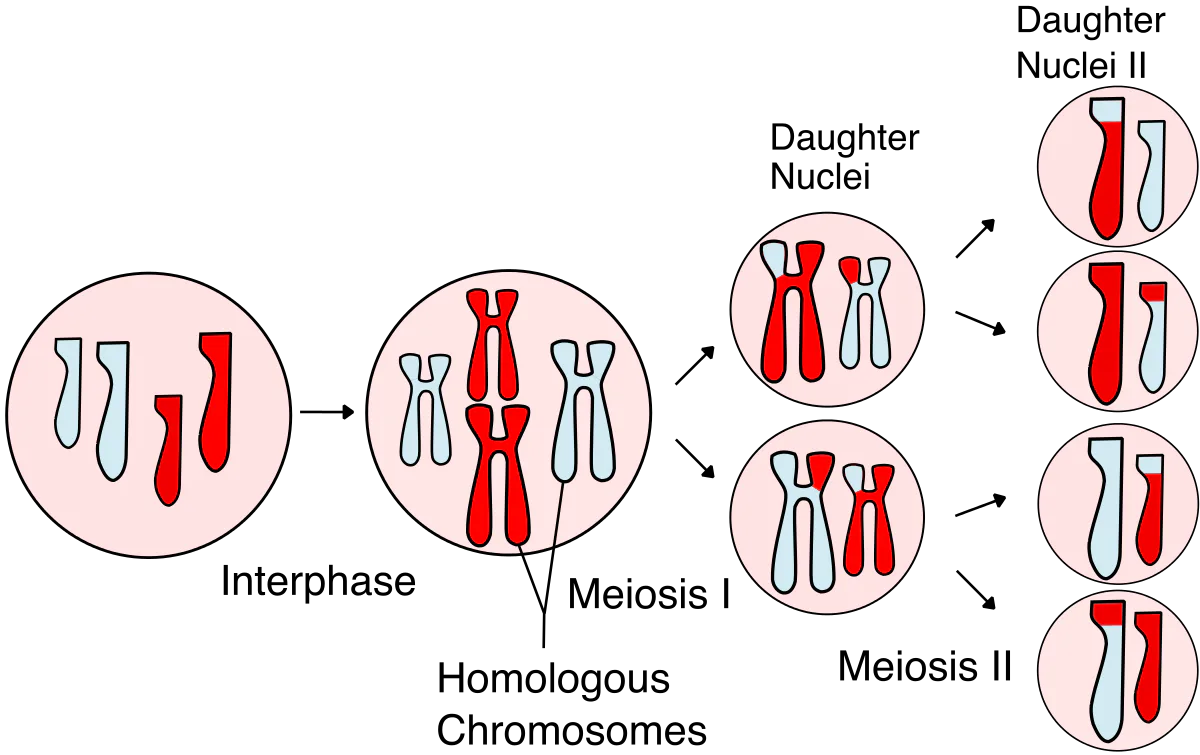
How does meiosis result in genetic diversity within organisms?

8

media

Complete questions 1-5. Remember
the Golden 4:
1.

Sketch with mini brain dump -
label sketch

2.

strikethrough of incorrect
answers

3.

Scientific words & power words

4.

Scientific GIST 5-8 words of
question and answer choices

Independent
Practice Pt 1

Vocab Box

Phenotype: Physical trait (what you can
see)
Genotype: Genes or alleles (the letter
combinations in a Punnett square
Homozygous: same alleles (AA, aa, BB,
bb)
Heterozygous: different alleles (Aa, Bb)
Dominant: if present, alleles that will be
expressed over recessive alleles; capital
letters
Recessive: alleles that are expressed only
if they are present in the absence of a
dominant allele; lowercase letters

9

Q1: Complete the Punnett square in your journal

In the following examples, the trait of black colored fur on a rat is studied. Black fur (B) is dominant over brown fur (b). For each example, predict the distribution of phenotype and genotype in the offspring for the parents described.

A homozygous dominant male is crossed with a homozygous recessive female.

10

Open Ended

What is the distribution (ratio) of genotypes in the offspring?

11

Open Ended

What is the probability of rats inheriting black colored fur in the offspring?

12

Q2: Complete the Punnett square in your journal

In the following examples, the trait of black colored fur on a rat is studied. Black fur (B) is dominant over brown fur (b). For each example, predict the distribution of phenotype and genotype in the offspring for the parents described.

Both parents are heterozygous.

13

Open Ended

What is the probability of the offspring being homozygous recessive?

14

Open Ended

What is the probability of rats inheriting black colored fur in the offspring?

15

How to Solve a Dihybrid

  1. Determine parents genotype

  2. Foil parent genotypes to determine possible alelle combinations

  3. Set up punnett square

media

16

Q3: Complete the Punnett square in your journal

In this example, we’re going to see what happens when two traits are examined at the same time. We’ll examine the color of fur again (Black = B and brown = b), but we’ll also examine another trait, the tail. A long tail (T) is dominant over a short tail (t).

Both parents are heterozygous for both traits (BbTt).

17

Open Ended

What probability of offspring will have black fur and short tails?

18

Open Ended

What probability of offspring will have brown fur and short tails?

19

Open Ended

What is the distribution for the four genotypes in the Punnett square?

20

media

Complete questions 1-5. Remember
the Golden 4:
1.

Sketch with mini brain dump -
label sketch

2.

strikethrough of incorrect
answers

3.

Scientific words & power words

4.

Scientific GIST 5-8 words of
question and answer choices

Independent
Practice Pt 2

Vocab Box

Phenotype: Physical trait (what you can
see)
Genotype: Genes or alleles (the letter
combinations in a Punnett square
Homozygous: same alleles (AA, aa, BB,
bb)
Heterozygous: different alleles (Aa, Bb)
Dominant: if present, alleles that will be
expressed over recessive alleles; capital
letters
Recessive: alleles that are expressed only
if they are present in the absence of a
dominant allele; lowercase letters

21

Multiple Choice

In chickens, the allele for rose comb (R) is dominant over the allele for single comb (r). When a heterozygous rose-combed rooster is mated with a single-combed hen, what is the expected phenotypic ratio of the offspring? 

1

100% rose-combed 

2

100% single-combed 

3

75% rose-combed and 25% single-combed 

4

50% rose-combed and 50% single-combed

22

Multiple Choice

Question image

In the dihybrid cross for pea plants shown below, R is dominant for round peas, r is recessive for wrinkled peas, Y is dominant for yellow peas, and y is recessive for green peas. A student could accurately make which statements about the offspring of this cross?

1

There is a 50% chance of having round, yellow peas. 

2

There is no chance of having any round, yellow peas. 

3

There is a 100% chance of having round, green peas. 

4

There is no chance of having any wrinkled, green peas.

23

Multiple Choice

Early childhood myopia, or nearsightedness, is a dominant inheritable trait. If all of the children born from the same two parents develop nearsightedness at an early age due to a heterozygous genotype, what must the genotypes of the parents be? 

1

MM x MM 

2

MM x mm 

3

Mm x mm 

4

mm x mm 

24

Multiple Choice

Which scenario best describes crossing over? 

1

Chromosomes are copied and are attached to spindle fibers, resulting in genetic differences between gametes. 

2

Chromatids are pulled toward the poles of the cell, resulting in different traits between the forming gametes. 

3

Homologous chromosomes line up randomly along the center of the cell, resulting in variation between gametes. 

4

Sister chromatids exchange segments of DNA, resulting in gametes with different combinations of genes.

25

Multiple Choice

Leia is crossing sunflowers that have different genotypes for height. She crosses a tall sunflower plant with a genotype of TT with a short sunflower plant with a genotype of, tt. Which ratio shows the probability that the two sunflower plants will produce a sunflower plant with a genotype of Tt? 

1

1:2 

2

1:4 

3

1:1

4

1:3

26

Multiple Choice

Question image

In the early 1900s, Thomas Hunt Morgan was among the first scientists to contribute to the chromosome theory of heredity. Morgan’s investigations into heredity in fruit flies led him to propose that the event represented in the diagram sometimes occurs.

Which statement about the event represented in the diagram is valid? 

1

The event represents RNA translation in the smooth endoplasmic reticulum. 

2

The event takes place in bacterial cells. 

3

The event produces genetically identical daughter cells. 

4

The event provides genetic diversity in eukaryotic cells.

27

media
media

Show answer

Auto Play

Slide 1 / 27

SLIDE