

The Solid State

Presentation
•
Chemistry
•
University
•
Hard

Luis Bello
Used 2+ times
FREE Resource
19 Slides • 7 Questions
1
Presenter: Dr. Luis Bello
2
The solid-state refers to a state of matter in which the constituent particles (atoms, molecules, or ions) are held tightly together by intermolecular forces, resulting in a rigid and closely packed arrangement.
The particles in a solid are in a fixed position and vibrate around that position, but they do not have enough kinetic energy to overcome the attractive forces between them and move freely, as in a liquid or gas.

3
In solids, the intermolecular forces between particles are strong enough to hold them together in a fixed position, and these forces vary depending on the type of particles and the arrangement of the solid's structure.
For example, ionic solids are held together by strong electrostatic forces between oppositely charged ions, while covalent solids are held together by covalent bonds between atoms, and metallic solids are held together by metallic bonds between atoms.

4

Crystalline solids have a regular and repeating arrangement of particles, resulting in characteristic geometric shapes, whereas amorphous solids lack a regular pattern of particles and have a more random arrangement.
5
The four main types of crystalline solids are ionic solids, metallic solids, covalent network solids, and molecular solids.
6

7
Ionic Solids: Ionic solids are composed of cations and anions held together by strong electrostatic forces.
The ions are arranged in a regular, three-dimensional lattice structure. Examples of ionic solids include sodium chloride (NaCl) and magnesium oxide (MgO).

8
Metallic Solids: Metallic solids consist of closely packed metal atoms held together by metallic bonds, which are a type of delocalized covalent bond.
The delocalized electrons in metallic bonds give rise to the unique properties of metals, such as high thermal and electrical conductivity, ductility, and malleability. Examples of metallic solids include copper (Cu) and iron (Fe).

Figure 10.40 Copper is a metallic solid.
9
Covalent Network Solids: Covalent network solids consist of atoms held together by covalent bonds in a network or lattice structure.
They have high melting points, are hard and brittle, and have poor electrical conductivity. Examples of covalent network solids include diamond, graphite, and silicon dioxide (SiO2).

10
Molecular Solids: Molecular solids consist of individual molecules held together by weak intermolecular forces, such as Van der Waals forces or hydrogen bonding.
The molecules may be polar or nonpolar, and their arrangement in the solid can be amorphous or crystalline. Examples of molecular solids include ice (H2O) and solid carbon dioxide (CO2).

11

Crystal Defects
In a crystalline solid, the atoms, ions, or molecules are arranged in a definite repeating pattern, but occasional defects may occur in the pattern.
12
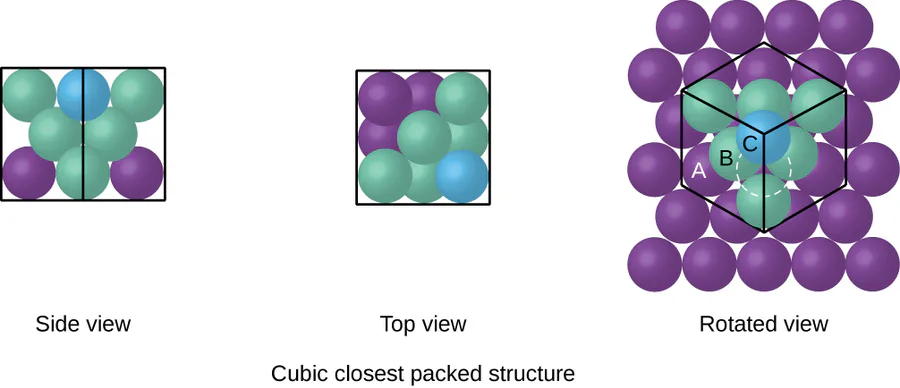
Unit Cells of Metals
The structure of a crystalline solid, whether metal or not, is best described by considering its simplest repeating unit, which is referred to as its unit cell.

13

When metal atoms are arranged with spheres in one layer directly above or below spheres in another layer, the lattice structure is called simple cubic. Note that the spheres are in contact.
14

An atom in a simple cubic lattice structure contacts six other atoms, so it has a coordination number of six.
15

16
17

18

19
X-Ray Crystallography
The size of the unit cell and the arrangement of atoms in a crystal may be determined from measurements of the diffraction of X-rays by the crystal, termed X-ray crystallography. Diffraction is the change in the direction of travel experienced by an electromagnetic wave when it encounters a physical barrier whose dimensions are comparable to those of the wavelength of the light. X-rays are electromagnetic radiation with wavelengths about as long as the distance between neighboring atoms in crystals (on the order of a few Å).


This illustration shows an X-ray diffraction image similar to the one Franklin found in her research. (credit: National Institutes of Health)
20
Multiple Choice
The crystal having highest melting point is
Molecular crystal
Ionic crystal
Covalent crystal
Metallic crystal
21
Multiple Choice
Which of the following is a covalent or network solid?
Ice
NaCl
Diamond
SiC
22
Multiple Choice
A. Ionic solids are hard and brittle
B. Covalent solids are good conducters
A is correct
B is correct
Both A and B are correct
Both A and B are wrong
23
Multiple Choice
Which of the following is an amorphous solid
Copper
Quartz glass
Silicon carbide
Sodium chloride
24
Multiple Choice

What type of material is this one?
Crystal
Amorphous
Ionic crystal
Covalent crystal
25
Multiple Choice
The type of crystalline solid that is a good conductor in solid as well as molten state?
Ionic solid
Metallic solid
Covalent solid
Molecular solid
26
Multiple Choice
Which of the following is not a characteristic of crystalline solid
Definite and characteristic heat of fusion.
Long range order
Isotropic in nature
Clean cleavage or smooth edges on cutting with a knife
Presenter: Dr. Luis Bello
Show answer
Auto Play
Slide 1 / 26
SLIDE
Similar Resources on Wayground

21 questions
MASTER OF FERMENTATION
Presentation
•
University
22 questions
Tone and Mood
Presentation
•
KG
22 questions
The Periodic Table: Unlocking the Secrets of Element Properties
Presentation
•
University
20 questions
Agriculture, Retail, Manufacturing and Service Industries
Presentation
•
KG - University
20 questions
States of Matter Review
Presentation
•
3rd Grade
19 questions
Simple Present vs Present Continuous
Presentation
•
University
22 questions
Simple past vs Present perfect
Presentation
•
University
20 questions
Intro Matrices
Presentation
•
KG - University
Popular Resources on Wayground
10 questions
Safety Day 2026 – Student Review

Quiz
•
9th Grade
21 questions
Continents and Oceans
Quiz
•
6th Grade
20 questions
Parts of Speech
Quiz
•
5th Grade
16 questions
Subject & Predicate
Quiz
•
5th Grade
25 questions
Multiplication Facts
Quiz
•
5th Grade
12 questions
Map Skills
Quiz
•
3rd Grade
22 questions
Continents and Oceans
Quiz
•
5th Grade
15 questions
Rounding Decimals
Quiz
•
5th Grade