Category 3 Evolution Review
Presentation
•
Biology
•
9th Grade
•
Medium
+7
Standards-aligned
Aleyah Lyles
Used 10+ times
FREE Resource
17 Slides • 21 Questions
1
EOC Review Category 3
Biological Evolution and
Classification
2
3
4
5
Survival of the
Fittest:
● High Fitness
● Only the BEST
Traits survive
to give to the
next
generation.
● Decreases
Variation
6
Due to NATURAL SELECTION…
• Adaptations may develop (like mimicry,
camouflage, etc.) that specialize a species
for its environment.
Insecticide-resistant insects
ANTIBIOTIC
RESISTANCE
BACTERIA
7
Common Ancestry
• The theory of Evolution is a possible
explanation for allllllllll the diversity of life
stating that we all have one common
ancestor…Bacteria
8
Whoa, whoa, whoa...where is the
evidence for Common Ancestry?
• 1. Fossil record
– Variety of organisms existed at different times…
– Going from simple, ancient species and then more
complex species
OLDEST ON
THE
BOTTOM
MOST MODERN
ON THE TOP
9
• Anatomical Homology- structural similarities
that serve different purposes.
Can you
fly????
No, but bone
structure looks
similar.
10
Don’t Forget Vestigial Structures too!
11
Multiple Choice
The ___________ record provides evidence for evolution by showing how species have changed over time.
fossil
time
embryological
analogous structure
12
Multiple Choice
A ___________ structure in two different species has the same developmental and evolutionary history, but serves different functions in the two species.
analogous
embryology
homologous
fossil
13
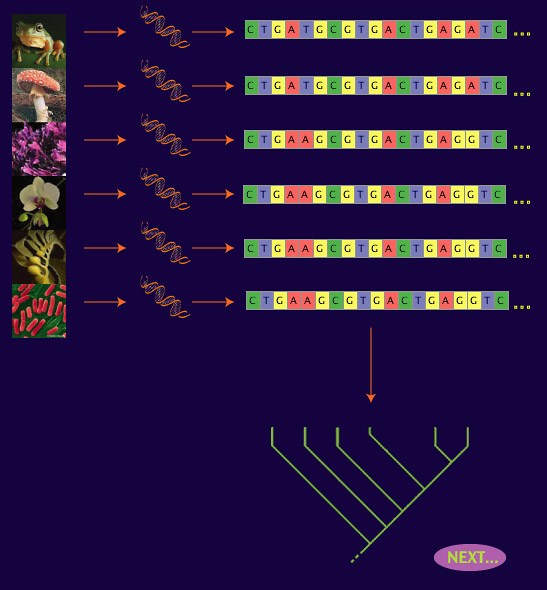
• Molecular homology- similar DNA sequences/
similar genomes
Who is most closely related to the mouse?
14
• Developmental Homologies- similarities in
embryonic development.
All look pretty similar!
15
Multiple Choice
Based on the DNA sequences shown, the unknown species is most closely related to ________.
Species I
Species II
Species III
Species IV
16
Multiple Choice
The example shown of these 2 mammals incubating their offspring in a pouch provides evidence that they______.
belong to the same species
must range great distances to eat
have very similar skeletal structures
are descended from a common ancestory
17
Reproductive Success…Influences
Evolution
• Elements affecting Reproductive success:
– Genes for better traits
• Help it get food, avoid prey/disease, or attract a mate
– Competition for limited resources OR change like
a new disease
– Higher reproduction rates= quicker evolution
Fruit Flies= hundreds
of offspring in 3-4
weeks
18
Genetic Drift
• Change in Gene pool by chance
events….tends to population's genetic
variation.
Ex: Flood killing 95% of
worms.
WORM POP. IS
NOW LESS
DIVERSE
19
Gene Flow
• Genes moving in…..and Genes
moving out of a population.
• AKA organisms moving in……and organisms
moving out.
20
Multiple Choice
A random change in gene frequency in a population is called...
genetic drift
gene flow
continental drift
genetic variation
21
“Did King Phillip Come Over For Grape Soda?”
What question did the merchant ask?
Did
King
Phillip
Come
Over
For
Grape
Soda
Domain
Kingdom
Phylum
Class
Order
Family
Genus
Species
Remembering this
question can help
you remember the
order of the
Taxonomic
Categories.
22
Cladogram
• Same idea, but adds on derived characteristics
Salamander has all traits behind it.
23
Multiple Choice
Based on the cladogram, the chimp will be more closely related to the _________.
Hagfish
Salamander
Lizard
Mouse
24
Multiple Choice
What is biological fitness?
Being able to escape from predators
Being among the strongest in a population
Being able to survive, find a mate, and produce offspring.
Being ale to survive long enough to reach adult age.
25
Multiple Choice
Which beetles are more fit for the environment?
Green beetles
Brown beetles
26
Multiple Choice
A
B
C
D
27
Multiple Choice
Which organism's DNA will differ the most from the bird?
Rodents
Raufinned fish
Sharks
Amphibians
28
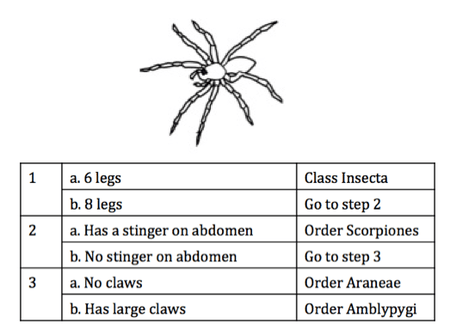
Multiple Choice
Class Insecta
Order Amblygygi
Order Araneae
Order Scorpiones
29
Multiple Choice
What is the correct order of Taxonomy from least specific to most specific.
Domain, Kingdom, Family, class, Genus, Species
Kingdom, Species, Family, Order, Class, Domain, Genus, Phylum
Class, Domain, Family, Genus, Kingdom, Order, Phylum, Species
Domain, Kingdom, Phylum, Class, Order, Family, Genus, Species
30
Multiple Choice
Common ancestry can also be seen in the developing embryos of most vertebrates. This is called:
DNA studies
embryology
extinction
fossil record
31
Multiple Choice
Which rock layer would contain the oldest fossils?
1
2
3
4
32
Multiple Choice
Members of this kingdom are eukaryotic, multicellular, heterotrophic, and do NOT have cell walls.
Plantae
Protista
Animalia
Achaebacteria
33
Multiple Choice
Which two trees are the most closely related?
Taiwan beech and Taiwan catkin yew
Taiwan catkin yew and Lodgepole pine
Lodgepole pine and Japanese maple
Japanese maple and Taiwan beech
34
Multiple Choice
Charles Darwin wrote that "organisms with traits that are best suited to their environment will survive and __________ ".
reproduce more often.
become extinct.
never reproduce.
lose all their traits.
35
Multiple Choice
This mechanism of evolution occurs when individuals, and their genetic material, move from one population to another and interbreed within the new population.
Extinction
Gene flow
Genetic drift
Natural Selection
36
Multiple Choice
Which kingdom contains organisms that are unicellular, prokaryotic and live in extreme environments?
Animal
Archaebacteria
Eubacteria
Plant
37
Multiple Choice
Which location on the phylogenic tree identifies characteristics shared by species B,C,D,E,F
Location 1
Location 2
Location 3
Location 4
38
Multiple Choice
Two organisms that are closely related would have...
very similar DNA molecules.
the same exact DNA molecules.
no protein molecules in common.
completely different DNA molecules.
EOC Review Category 3
Biological Evolution and
Classification
Show answer
Auto Play
Slide 1 / 38
SLIDE

Similar Resources on Wayground
34 questions
9/11 Cell Transport Quizizz 25-26
Presentation
•
9th Grade
33 questions
gene regulation and meiosis
Presentation
•
9th Grade
33 questions
Cell Cycle
Presentation
•
9th Grade
33 questions
Plant Systems
Presentation
•
9th Grade
33 questions
Biomolecules Homework Lesson
Presentation
•
9th Grade
33 questions
Nondisjunction
Presentation
•
9th Grade
33 questions
Mean, Median and Mode
Presentation
•
9th Grade
35 questions
Introducción al Presente Indicativo
Presentation
•
9th Grade
Popular Resources on Wayground
20 questions
"What is the question asking??" Grades 3-5
Quiz
•
1st - 5th Grade
20 questions
“What is the question asking??” Grades 6-8
Quiz
•
6th - 8th Grade
10 questions
Fire Safety Quiz
Quiz
•
12th Grade
20 questions
Equivalent Fractions
Quiz
•
3rd Grade
34 questions
STAAR Review 6th - 8th grade Reading Part 1
Quiz
•
6th - 8th Grade
20 questions
“What is the question asking??” English I-II
Quiz
•
9th - 12th Grade
20 questions
Main Idea and Details
Quiz
•
5th Grade
47 questions
8th Grade Reading STAAR Ultimate Review!
Quiz
•
8th Grade
Discover more resources for Biology
24 questions
BIOLOGY STAAR REVIEW
Quiz
•
9th Grade
30 questions
Biology STAAR Review #3
Quiz
•
9th Grade
16 questions
AP Biology: Unit 1 Review (CED)
Quiz
•
9th - 12th Grade
50 questions
Biology EOC Review
Quiz
•
9th Grade
25 questions
photosynthesis and cellular respiration
Quiz
•
9th Grade
20 questions
AP Biology: Unit 3 Review (CED)
Quiz
•
9th - 12th Grade
20 questions
Enzymes
Quiz
•
9th Grade
20 questions
Food Chains and Food Webs
Quiz
•
7th - 12th Grade