Search Header Logo
7th Science Final Exam Review

7th Science Final Exam Review

Assessment

Presentation

Biology

9th - 12th Grade

Medium

Created by

Jacob Ahee

Used 121+ times

FREE Resource

46 Slides • 99 Questions

1

  • Are built by numerous cells:

    • Cells --> Tissues -->Organs --> Organ systems --> Organisms

  • Humas are built by 10 main organ systems but, are not the only ones organized in this way...

Multicellular organisms

What other examples of multicellular organisms do you know?

media

2

media
media

3

media

4

media

5

media

6

media

7

media

8

media

9

media

10

media

11

media

12

media

13

Multiple Choice

Prokaryotic cells do not have…….

1

membrane bound organelles

2

cell membrane

3

DNA

4

genetic material

14

Multiple Choice

Question image

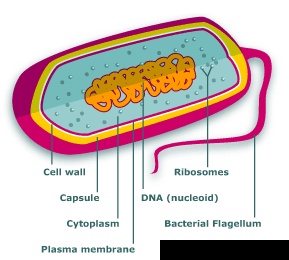
Which type of cell?

1

Prokaryote

2

Eukaryote

3

Both

4

Neither

15

Multiple Choice

Question image
Which type of cell?
1

Prokaryote

2

Eukaryote

16

Multiple Choice

Question image
This is a picture of:
1

Prokaryote

2

Eukaryote

17

Multiple Choice

Which type of cells has a chloroplast?

1

Prokaryote

2

Plant Cell

3

Animal Cell

4

Bacteria

18

Photosynthesis

Living Systems....

media

19

media

20

media

21

Multiple Select

Question image

What are the raw materials needed by photosynthesis? Pick 2.

1

carbon dioxide

2

oxygen

3

glucose

4

water

22

Multiple Select

Question image

What are the products made by photosynthesis? Pick 2.

1

carbon dioxide

2

oxygen

3

glucose

4

water

23

Multiple Choice

Question image

How does a plant use energy in glucose?

1

It is ONLY stored.

2

It is ONLY used right away.

3

It is BOTH stored and used right away.

24

Multiple Choice

Question image
Classify the picture with the correct label.
1

Element

2

Compound

3

Mixture of Elements

4

Mixture of Compounds

25

  • Made from one type of atom

  • Cannot be broken down by chemical or physical means

  • Found on the periodic table

Elements

media

26

  • Created when 2 or more elements chemically combine by sharing or transferring their electrons

  • Can only be separated used chemical means

Compounds

media

27

  • Physical combinations of two or more substances that keep their own chemical properties

  • Are only physically combined (mixed)

  • Can be separated by physical means

Mixtures

media

28

Multiple Choice

Question image
Classify the picture with the correct label.
1
Element
2
Compound
3
Mixture of Elements and Compounds
4
Mixture of Elements

29

Multiple Choice

Question image
Classify the picture with the correct label.
1
Element
2
Compound
3
Mixture of Elements & Compounds
4
Mixture of Elements

30

Multiple Choice

which one only has one type of atom In it.
1
Element
2
compound

31

Atomic Number, Average Atomic Mass, Mass Number, Isotopes

media

32

Multiple Choice

Which one has more than one type of atom in it
1
Element
2
Compound 

33

Multiple Choice

Question image
What does the 1.00794 stand for?
1

Hydrogen

2

atomic number

3

atomic mass

4

atomic explosion

34

media

35

Multiple Choice

Question image
Most of the elements on the periodic table are classified as _____.
1
Metals
2
Nonmetals
3
Metalloids
4
Periods

36

Multiple Choice

Metals are found on the ______________ side of the periodic table.

1

nonmetals

2

left

3

right

4

metals

37

Multiple Choice

This group of elements have properties that are opposite those of metals. ______________________

1

luster

2

nonmetals

3

metalloids

4

metals

38

Multiple Choice

This group of elements sit along a stair step line on the periodic table and have properties of both metals and nonmetals. _________________________

1

luster

2

metals

3

nonmetals

4

metalloids

39

Multiple Choice

Copper is a common metal. Which of the following properties does this metal most likely have?

1

High conductivity, high malleability, and low luster

2

Low conductivity, low malleability, and low luster

3

High conductivity, high malleability, and high luster

4

Low conductivity, high malleability, and high luster

40

Multiple Choice

Which of the following is a good conductor of heat?
1
Metal
2
Nonmetal
3
Metalloid

41

Multiple Choice

Question image
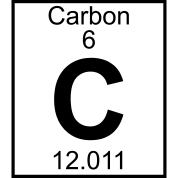
What does the 6 represent?
1
atomic mass
2
atomic number
3
element name
4
chemical symbol 

42

Multiple Choice

Question image
What does 12.011 represent?
1
atomic mass
2
atomic number
3
element name
4
chemical symbol 

43

Multiple Choice

the positively charged subatomic particle contained in the nucleus of an atom

1

proton

2

neutron

3

electron

4

matter

44

Multiple Choice

a subatomic particle, contained in the nucleus of an atom, having the same mass as a proton but no electrical charge

1

proton

2

neutron

3

electron

4

matter

45

Multiple Choice

a negatively charged subatomic particle that orbits the nucleus of an atom

1

proton

2

neutron

3

electron

4

matter

46

media
media

​During a physical change there is no chemical change. Water remains water no matter if it is a solid, liquid, or gas because the molecules have not changed.

​​Physical Change

​A chemical change occurs when the atoms of one or more substances are rearranged creating one or more new substances. Iron rusting is an example of a chemical change.

​​Chemical Change

47

Multiple Choice

Question image

This change is a

1

chemical reaction

2

physical change

3

musical change

4

Ice Ice baby

48

Multiple Choice

How is a chemical change different from a physical change?

1

there is no difference

2

a physical change creates a new substance

3

a chemical change creates a new substance

49

Multiple Choice

Question image

A precipitate is a ___________ that forms when 2 liquids react together.

1

solid

2

liquid

3

gas

4

plasma

50

Multiple Choice

Is burning wood a chemical or physical change?
1
chemical
2
physical

51

Multiple Choice

Is glass breaking a chemical or physical change?

1

chemical

2

physical

52

Multiple Choice

Is spoiling food a physical or chemical change?
1
phyiscal
2
chemical

53

Match

Match the following

Physical change

(Shape)

Physical change

(solubility)

Chemical Change

(Flammability)

Chemical Change

Both a Physical & Chemical change

Cutting paper

Dissolving

Kool-Aid

Lighting a match

Creating a new substance

Bubbles

54

media

55

Multiple Choice

__________ are made up of solutes and solvents.
1

Solutions

2

Suspension

3

Colloid

56

Multiple Choice

Which is an example of a solute?
1
Milk
2
Sugar
3
Water
4
Ginger Ale

57

Multiple Choice

Which is an example of a solvent?
1
Salt
2
Iced Tea mix
3
Water
4
Sugar

58

Multiple Choice

Describe a solute.
1
part of solution present in largest amount
2
gets dissolved
3
water
4
surrounds and breaks apart

59

Multiple Choice

What is able to dissolve other substances?
1
Solute
2
Salt
3
Suspension
4
Solvent

60

Multiple Choice

Question image

Which of the following actions will NOT increase the rate of dissolution (dissolving)?

1

Stirring the solution

2

Decreasing the temperature

3

Increasing the surface area of the

solute

4

Increasing the temperature

61

Multiple Choice

Which of these choices is the formula for average speed?

1
2
3

62

media

Memorize the graph shapes and then you can read distance/time graph you have on a quiz or test.

63

Multiple Choice

Which of these graphs represent a constant speed?

1
2
3

64

Multiple Choice

Calculate the average speed of a car that travels 60 km in 2 hours.

1

12 km/h

2

30 km/h

3

25 km/h

4

35 km/h

65

Multiple Choice

If Steve throws the football 50 meters in 3 seconds, what is the average speed of the football?

1

16.7 m/s

2

15.5 m/s

3

25.3 m/s

4

22 m/s

66

media

67

Multiple Choice

Scott travels north 5 miles and then goes west 3 miles before coming straight back south 2 miles. What is his distance?
1

10

2

7

3

8

4

6

68

Multiple Choice

Distance and direction of an object's change in position from a starting point
1
displacement
2
distance
3
motion
4
reference point

69

Multiple Choice

 Jermaine runs exactly 2 laps around a 400 meter track. What is the displacement?
1
800
2
400
3
0
4
200

70

Multiple Choice

Bill runs 400 meters to Andy's house, turns around, and runs 400 meters back home.  What is Bill's distance?
1
0 meters
2
400 meters
3
800 meters
4
1600 meters

71

Multiple Choice

Bill runs 400 meters to Andy's house, turns around, and runs 400 meters back home.  What is Bill's displacement?
1
0 meters
2
400 meters
3
800 meters
4
1600 meters

72

Multiple Choice

What is acceleration?

1

an increase in speed

2

a decrease in speed

3

a change in direction

4

all of these are examples

73

Multiple Choice

Question image

Describe the object's motion from B to C:

1

Speeding Up

2

Slowing Down

3

Constant Speed

4

Not Moving

74

Multiple Choice

Question image

Describe the object's motion from C to D:

1

Speeding Up

2

Slowing Down

3

Constant Speed

4

Not Moving

75

Multiple Choice

Match the description to the graph:

"The car is stopped."

1
2
3

76

Multiple Choice

Match the description to the graph:

"The car is traveling at a constant speed."

1
2
3

77

Multiple Choice

Match the description to the graph:

"The car is coming back."

1
2
3
4

78

Multiple Select

Which of the graphs shows that one of runners started in the same place?

1
2

79

Multiple Choice

In which of the following graphs below did one runner overtake (run past) the other?

1
2
3
4

80

Explanation Slide...

When two forces act on an object in opposite directions, their forces are subtracted from each other.

81

​1. Forces occur in pairs and they can be either balanced or unbalanced.

​Force =

Push or a Pull

media

82

media
  1. Balanced forces do not cause change in motion.

a. This includes if the object is:

i. Not moving

ii. Or moving at a constant speed.

b. They are equal in size and opposite in direction.

​Examples of balanced forces in motion and at rest

​Balanced Forces

83

media

​Examples of unbalanced forces

​Unbalanced Forces

​3. An unbalanced force always causes a change in motion.

a. When unbalanced forces act in the same or opposite directions you can find the net force

i. Net force is the overall force acting on an object.

ii. It is a combination of the magnitude and the direction.​

iii. ​Magnitude is the difference or the sum between the two forces.

iv. Direction goes with the stronger force

84

Multiple Choice

Question image

How will this object move?

1

It will not move

2

It will move in both directions

3

It will move to the right

4

It will move to the left

85

Multiple Choice

Question image

How will this object move?

1

It will not move

2

It will move in both directions

3

It will move to the right

4

It will move to the left

86

Heat Transfer

The thermal energy exchange between two objects of different temperatures; energy moves in a predictable pattern from warmer sites to cooler sites until all sites have reached the same temperature

media

87

Conduction

Transfer of heat by direct touch. The spoon is directly touching the liquid.

media

88

Radiation

Transfer of heat through electromagnetic waves. On a sunny day, you can feel the warmth of the Sun's rays on your skin.

media

89

Convection

Transfer of energy through heat rising through air or a liquid.

media

90

Convection

Transfer of energy through heat rising through air or a liquid.

media

91

Convection

Transfer of energy through heat rising through air or a liquid.

media

92

Multiple Choice

Question image

A group of friends gather around a fire to stay warm. This is an example of ________.

1

conduction

2

convection

3

radiation

93

Multiple Choice

Question image

In heat transfer, heat always flows from the _______________ substance to the _______________ substance.

1

hotter to colder

2

colder to hotter

3

hotter to hotter

4

colder to colder

94

Multiple Choice

Which is an example of heat being transferred by conduction?

1

a furnace heating the air in a school

2

an ice cube melting in a person’s hand

3

a pot of water on a stove boiling

4

the sun heating water in a swimming pool

95

Multiple Choice

Question image

The baby chickens kept warm by the heat lamps. This is an example of ________.

1

conduction

2

convection

3

radiation

96

Multiple Choice

Question image

The handle of a metal spoon warms up when it is placed in a hot bowl of soup because of ________.

1

convection

2

conduction

3

radiation

97

Multiple Choice

Question image

Near the ceiling of a room the air is warmer. The warm air rises because of ________.

1

conduction

2

convection

3

radiation

98

Multiple Choice

Which best describes the process of convection?
1
Convection is the primary way  heat travels  through rays.
2
Convection is the primary way heat travels  through metals.
3
Convection is the primary way heat travels  through appliances.
4
Convection is the primary way heat travels  through liquids and gasses.

99

Multiple Choice

Question image

The type of heat transfer that creates currents in water is called ________.

1

conduction

2

convection

3

radiation

100

Multiple Choice

Question image

The heat transferred from the Sun to the Earth by waves is called ________.

1

conduction

2

radiation

3

convection

101

Reorder

Reorder the following from lowest to highest Kinetic Energy

Solid

Liquid

Gas

1
2
3

102

Matter

Anything that has volume and mass

media

103

Multiple Select

Three things about particles all change together in a correlation relationship (aka when one goes up, they all go up)

1

Particle Movement

2

Temperature

3

Mass

4

Energy

104

Fill in the Blanks

Type answer...

105

106

Multiple Choice

When temperature increases, average _____ increases.

1

potential energy

2

kinetic energy

3

gravitational potential energy

4

chemical energy

107

Multiple Choice

How would the planets move if the Sun disappeared?

1

The planet would stop moving because gravity is no longer affecting it.

2

The planet would move for a little while longer, but then stop.

3

The planet would move in a straight line in the direction it had been traveling, because of its inertia.

4

The planet would stop moving, but then start moving again because it would attach to another celestial object or planet.

108

Inner Planets

  • The inner planets are Mercury, Venus, Earth, and Mars

  • These planets are rocky (meaning if you landed, you could stand on the surface - although you may not survive long)

  • These planets also have very few moons: Mercury and Venus has 0, Earth has 1, Mars has 2

  • These planets are much smaller than the outer planets

109

Outer Planets

  • The outer planets are Jupiter, Saturn, Uranus, and Neptune

  • These planets are gas planet (meaning if you landed, you could not stand on the surface)

  • These planets have A LOT of moons: Jupiter has 53, Saturn has 79, Uranus has 27, Neptune has 14

  • These planets are much larger than the inner planets

110

WHAT IS GRAVITY AND INERTIA?​

GRAVITY AND INERTIA

GRAVITY - is a force of attraction between all objects.

INERTIA - ​is the tendency of a moving object to keep moving in a straight line.

Some text here about the topic of discussion

111

Multiple Choice

The orbital speeds of planets closer to the Sun will be faster than planets farther away because.....

1

The gravity decreases as the distance between the objects increase.

2

The gravity increases as the distance between the objects decrease.

3

The gravity increases as the mass of the object increases.

4

The gravity between the objects decrease as the objects warm up.

112

Multiple Choice

Which to things affect the strength of gravitational pull?

1

Distance and Weight

2

Heat and Density

3

Mass and Distance

4

Gas and Dust

113

Multiple Choice

Question image

The pull of gravity decreases when the distance between two objects

1

Increases

2

Decreases

114

Multiple Choice

All of the planets in the solar system orbit around

1

Earth

2

Sun

3

Jupiter

4

The Milky Way

115

Multiple Choice

The asteroid belt separates the terrestrial planets and the gas giants, so it must be in between

1

Earth and Mars

2

Jupiter and Saturn

3

Mars and Jupiter

4

Mercury and Venus

116

Multiple Choice

If a new planet was discovered that was small, rocky, and dense, it would be the most like

1

Mercury

2

Jupiter

3

Saturn

4

Neptune

117

Multiple Choice

How does the motion of planets change as they get nearer to the sun?

1

they speed up

2

they slow down

3

they change orbit direction

4

they stop orbiting

118

Multiple Choice

The main difference between a comet (dirty snowball) and an asteroid is...

1

What they are made of

2

Their size

3

The speed they travel

4

Where they are located

119

media

120

media

121

media

122

media

123

media

124

media

125

Multiple Choice

The main difference between meteroids, meteors and meteorites is...

1

What they are made of

2

Their size

3

The speed they travel

4

Where they are located

126

Multiple Choice

What separates the inner and the outer planets?

1

Oort cloud

2

Sun

3

Kuiper belt

4

Asteroid belt

127

Multiple Choice

Which of the following is NOT a characteristic of the inner planets?

1

Smaller

2

Rocky

3

Gaseous

4

Shorter years

128

Multiple Choice

What causes the planets to have a slightly elliptical orbit?

1

Moon’s gravity

2

Sun’s gravity

3

Planet’s inertia

4

BOTH Sun’s gravity and Planet’s inertia

129

Multiple Choice

When a planet is farther from the Sun, the gravitational attraction between them decreases and the planet moves/orbits ______.

1

Slower

2

Faster

3

The same speed

4

Become circular

130

Multiple Choice

This evidence shows ancient animals lived on several continents, even though they are an ocean apart.

1

Mountain Range Evidence

2

Glacial Evidence

3

Fossil Evidence

131

Multiple Select

Mark only those that are evidence for Plate Tectonics:

1

Rock Strata

2

Porosity

3

Fossil Record

4

Acceleration

5

Continental Drift

132

Multiple Choice

Tectonic plates consist of

1

continental crust

2

mesospheric crust

3

both continental and oceanic crust

4

oceanic crust

133

Multiple Choice

The idea that the continents were once part of a single landmass that broke apart and

moved is

1

Continental Drift

2

Tectonic Plates

3

Transform

134

Multiple Choice

The movement of the tectonic plates is caused by

1

the rotation of the Earth

2

convection currents in the Asthenosphere

3

the gravity of the iron-nickel core

4

the Moho discontinuity

135

Match

Match the following

divergent

convergent

transform

136

Multiple Choice

At which plate boundary is new crust formed?

1

divergent

2

convergent

3

continental

4

transform

137

Multiple Choice

What type of crusts are involved with one plate subducting beneath another?

1

continental and continental

2

Oceanic and continental

3

oceanic and divergent

4

continental and convergent

138

Multiple Select

What types of landforms are formed at convergent boundaries?

PICK TWO

1

volcanoes

2

new crust

3

Trenches

4

rift valley

139

Multiple Choice

Question image

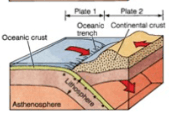
What is the WHOLE AREA called where the oceanic crust goes beneath the continental crust?

1

subtraction zone

2

section zone

3

secondary zone

4

subduction zone

140

Multiple Choice

At which boundary is crust neither consumed or created?

1

divergent

2

convergent

3

transform

4

oceanic

141

Multiple Choice

Question image

When a continental plates collide what may be formed?

1

islands

2

mountains

3

volcanoes

4

rift valleys

142

Multiple Choice

Question image

When tectonic plates slide beside each other what type of boundary is it?

1

convergent

2

divergent

3

transform fault

4

slickensides

143

Multiple Choice

Question image

Identify this type of plate boundary:

1

convergent

2

divergent

3

transform fault

4

none of these

144

Multiple Choice

Question image

Identify the type of boundary:

1

convergent

2

divergent

3

transform fault

4

none of these

145

  • Are built by numerous cells:

    • Cells --> Tissues -->Organs --> Organ systems --> Organisms

  • Humas are built by 10 main organ systems but, are not the only ones organized in this way...

Multicellular organisms

What other examples of multicellular organisms do you know?

media

Show answer

Auto Play

Slide 1 / 145

SLIDE