

CONSTRUCTIVE & DESTRUCTIVE PROCESSES REVIEW

Presentation
•
Science
•
5th Grade
•
Practice Problem
•
Hard
Standards-aligned

Nicholas Hoo
Used 7+ times
FREE Resource
3 Slides • 4 Questions
1

a quick review of:
CONSTRUCTIVE & DESTRUCTIVE PROCESSES
2

CONSTRUCTIVE FORCES INCLUDE MOUNTAIN BUILDING, VOLCANIC ERUPTION, AND DEPOSITION OF SEDIMENT.
CONSTRUCTIVE lANDFORMS
CONSTRUCTIVE & DESTRUCTIVE PROCESSES
Surface features on the Earth are shaped through the interaction of ongoing processes that build up (constructive) or break down (destructive) landforms.
LANDFORMS ARE THE RESULT OF A COMBINATION OF CONSTRUCTIVE AND DESTRUCTIVE FORCES
DELTA: can be found where faults are located under the ocean. It is formed from the silt, sand and small rocks that flow downstream in the river and are deposited in the delta.
GLACIERS: Sheets of very old ice that move along Earth’s surface.
RIDGES: Are formed when tectonic plates collide and both push up. This creates hills and mountains.
DESTRUCTIVE LANDFORMS
DESTRUCTIVE FORCES INCLUDE WEATHERING AND EROSION. ORGANISMS CAN ALSO CONTRIBUTE TO THESE PROCESSES.
VALLEYS: A low place between mountains. The rocks are eroded by water, ice, and wind and particles are quickly stripped and washed down the mountain sides.
CANYONS: A deep valley with very steep sides, formed by wind and water erosion
CAVES: A large hole in the ground or in the side of a hill or mountain. Weathering and erosion work together to form caves.
3
VOLCANIC ACTIVITY
When magma breaks the crust, it is called lava. When lava cools, it hardens to rock. The islands of the state of Hawaii are landforms created by volcanoes.
A Volcano is a break in Earth’s crust that lets magma come out from the mantle and onto Earth’s surface. Magma is the molten rock below Earth’s crust. Magma can push through weakness in the crust.
EROSION
The movement of materials from one place to another by natural methods.
CONSTRUCTIVE & DESTRUCTIVE PROCESSES
DEPOSITION
A constructive process whereby soil and rock that are eroded from one location are deposited as sediment in another location. As the sediment from a river is deposited at the mouth of a river over time, new land is created, which is called a delta. An example is the Mississippi Delta.
WEATHERING
A destructive process where Earth materials such as rocks and soil are broken down into smaller parts.
EARTHQUAKE
EARTHQUAKES happen when tectonic plates suddenly slide around. The plates shake, and the energy from that creates waves that echo through Earth.
Release of energy: Earthquakes help the Earth to release its energy. The force from Earthquakes can make lots of stuff like trenches and they also insert rock to the earth, build up the crust with mountains.
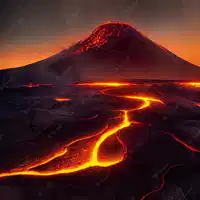
CONSTRUCTIVE PROCESSES
CONSTRUCTIVE FORCES INCLUDE MOUNTAIN BUILDING, VOLCANIC ERUPTION, AND DEPOSITION OF SEDIMENT.

DESTRUCTIVE PROCESSES
DESTRUCTIVE FORCES INCLUDE WEATHERING AND EROSION. ORGANISMS CAN ALSO CONTRIBUTE TO THESE PROCESSES.
4
Multiple Choice
Deposition of sediments can change the depth of a lake over time. A student wants to make a model that shows how the process takes place.
Which model would provide data about changes in the depth of a lake caused by deposition?
Fill a beaker with water. Slowly allow the water to evaporate from the beaker. Measure the change in the depth of the water.
Fill a beaker with water. Slowly drop sand, gravel, and dead plant material into the beaker. Measure the change in the depth of the water.
Fill a plastic box with water. Put a hose in the water on one end of the box and turn the water on to a slow flow. Measure the depth of the water when the box is full.
Fill a plastic box with sand, gravel, and dead plant material. Put a hose in the middle of the box and turn the water on to a slow flow. Measure the depth of the water when the box is full.
5
Multiple Choice

The picture shows two steep valleys and two rivers that join together and become one large river in a wider valley.
A student claims that both valleys have been formed by the same process over a long period of time.
Which argument BEST explains why the student's claim is correct or incorrect?
The student's claim is correct; the evidence in the picture shows that both valleys were formed by the constructive force of deposition because flowing water carries large rocks from far away and drops them along a river, making the banks taller.
The student's claim is correct; the evidence in the picture shows that both valleys were formed by the destructive forces of weathering and erosion because flowing water breaks down rock and carries the small pieces downstream.
The student's claim is not correct; the evidence in the picture shows that Valley 1 was formed by the destructive forces of weathering and erosion because flowing water breaks down rock and carries the small pieces downstream, but Valley 2 was formed by the constructive force of deposition because flowing water carries large rocks from far away and drops them along a river, making the banks taller.
The student's claim is not correct; the evidence in the picture shows that Valley 1 was formed by the constructive force of deposition because flowing water carries large rocks from far away and drops them along a river, making the banks taller, but Valley 2 was formed by the destructive forces of weathering and erosion because flowing water breaks down rock and carries the small pieces downstream.
6
Multiple Choice
A student observes a large rock at the base of a volcano in a river valley that gets a lot of snow in the winter and floods in the spring. The student claims that the large crack in the rock was caused by a destructive process called weathering.
Which argument BEST describes the student's claim
The student's claim is correct because water fills small cracks in rocks, freezes, and expands, making the cracks larger over time.
The student's claim is correct because the rock was carried from the top of the volcano to its base by a glacier, creating many cracks over time.
The student's claim is not correct because the rock was picked up by moving water and rolled against other rocks, smoothing its surface and causing cracks in a short period of time.
The student's claim is not correct because large cracks in rocks are caused when lava from a volcano covers the rock so its temperature rises and falls in a short period of time, causing it to break.
7
Multiple Choice
Carli and Felicia went to a Georgia Coastal island over Spring Break. In Science class, they are learning about how the coastal island beaches have been shrinking. They noticed signs on the sand dunes that said "Do Not Disturb the Sea Oats." They were discussing reasons why people should not bother the plants. What is the best reason for protecting the sea oats?
They have branching roots that prevent the sand from eroding
They add nitrogen to the soil and should not be disturbed.
They are placed there to make the beach more beautiful.
They are poisonous plants and should not be handled.
a quick review of:
CONSTRUCTIVE & DESTRUCTIVE PROCESSES
Show answer
Auto Play
Slide 1 / 7
SLIDE
Similar Resources on Wayground

6 questions
WALA: SHADOWS
Presentation
•
5th Grade
6 questions
alam semesta
Presentation
•
KG
6 questions
alat transportasi
Presentation
•
KG
8 questions
Conductors and Insulators
Presentation
•
5th Grade
7 questions
Kinetic Energy 2022-2023
Presentation
•
5th - 6th Grade
6 questions
Dash to GMAS Day One
Presentation
•
5th Grade
8 questions
SS Week 17 Urbanization
Presentation
•
5th Grade
6 questions
Microorganisms
Presentation
•
5th Grade
Popular Resources on Wayground
20 questions
Math Review

Quiz
•
3rd Grade
15 questions
Fast food
Quiz
•
7th Grade
20 questions
Context Clues
Quiz
•
6th Grade
20 questions
Inferences
Quiz
•
4th Grade
19 questions
Classifying Quadrilaterals
Quiz
•
3rd Grade
20 questions
Figurative Language Review
Quiz
•
6th Grade
20 questions
Equivalent Fractions
Quiz
•
3rd Grade
10 questions
Identify Fractions, Mixed Numbers & Improper Fractions
Quiz
•
3rd - 4th Grade
Discover more resources for Science
25 questions
5th Grade NC Science EOG Review Part 1
Quiz
•
5th Grade
29 questions
5th Grade Science EOG Review Weather/Matter/Body Systems
Quiz
•
5th Grade
20 questions
NC Science EOG Prep (5th Grade)
Quiz
•
5th Grade
18 questions
Matter (SOL)
Quiz
•
5th Grade
17 questions
Waves - Sound and Light (SOL)
Quiz
•
5th Grade
26 questions
Human Body Systems Review
Quiz
•
5th Grade
50 questions
5th Grade Science EOG Review
Quiz
•
5th Grade
20 questions
Science Review (EOG Edition)
Quiz
•
5th Grade