Natural Selection CFU Prep
Presentation
•
Biology
•
7th Grade
•
Medium
+8
Standards-aligned
Heather Ziemba
Used 117+ times
FREE Resource
6 Slides • 50 Questions
1

Adaptations and Natural Selection
CFU Prep
2
They can happen when there is an error with cell division or DNA replication, or when they are exposed to a carcinogen.
Mutations can be good, bad, or neutral.
Good mutations are ADAPTATIONS!
​
Mutations are changes in DNA.
3
These are body parts that help an organism survive better.
examples: camouflage, sharp claws, bright colors, feathers, thick fur
​​Physical/Structural Adaptations
​These are instinctual actions that an organism does to survive.
examples: hibernation, migration, building a nest or burrow; food choices
​​Behavioral Adaptations
4
Drag and Drop
5
Multiple Choice
To escape animals
to hunt for food
to survive in their habitats
All of these are correct
6
Multiple Choice
Which of the following examples are of behavioral adaptations?
Migration
Claws
Teeth
Eyes
7
Multiple Choice
Which of the following are examples of structural adaptations?
Hibernation
Migration
Eyes
Mating calls
8
Multiple Choice
A behavioral adaptation
Poor breeding
A physical adaptation
Plastic surgery gone horribly wrong
9
Multiple Choice
Mimicry
Scent
Hibernation
Camouflage
10
Multiple Choice
To make their life better
To Survive in their envorment.
To make people happy
ALL of the above
11
Multiple Choice
The long neck of a giraffe
Penguins huddling together for warmth
A camel's hump used to store water
A polar bear's white fur used for camouflage
12
Multiple Choice
Behavioral Adaptation
Structural Adaptation
13
Multiple Choice
Behavioral Adaptation
Structural Adaptation
14
Multiple Choice
A __________________ is a permanent change in the genetic makeup of an organism.
Mutation
Adaptation
Natural Selection
Evolution
15
Multiple Choice
What causes many variations within a population?
Natural Selection
Adaptation
Mutation
Environmental Changes
16
Multiple Choice
death of the organism in which they develop
genetic variation needed for a population to evolve
benefits for the individual, not for the population
Hardey-Weinberg equilibrium within a population
17
Multiple Choice
Individuals will only create offspring well-suited to the climate change
The individuals would produce more offspring
Individuals better suited to the new climate will help less-suited individuals survive
Some individuals will posses traits better suited to the new climate and be more likely to pass them on
18
Multiple Choice
selective breeding
physiological
structural
mutation
19
Multiple Choice
DNA
tRNA
genotype
phenotype
20
Multiple Select
Check off all that apply: Mutations can be _____.
Good (Adaptations)
Bad
Neutral
21
Multiple Choice
True or false: All mutations are adaptations.
True
False
22
Multiple Choice
True or false: All adaptations are mutations.
True
False
23
Natural selection: is a natural process in which the organisms that are best adapted to their environment survive and are able to reproduce. These organisms pass down their genes, and the adaptations become more and more common in the population over time.
Conditions for Natural Selection:
Adaptations
Variation
Overproduction
Selective Pressure
24
ADAPTATION:
​
can be physical or behavioral.
Must be genetically inheritable
Starts as a random mutation that just happens to help an organism be more fit.
EXAMPLE: The orange bugs are less appetizing
VARIATION:
​
there is more than one version of the trait in the population.
if everyone is the same, no one has an advantage.
EXAMPLE: The population has green bugs and orange bugs.
25
OVERPRODUCTION:
​
more offspring are born than survive.
the individuals that are the most "fit" survive and pass down their genes. Over time, their traits show up more in the population.
EXAMPLE: Out of every 16 bugs born in each generation, 3 of them are eaten by birds before being able to reproduce.
SELECTIVE PRESSURE:
​
This is something that makes it difficult to survive.
Predators, competiton for food, mates, or resources, extreme environmental conditions.
EXAMPLE: The birds are the bug's predator.
26
Multiple Choice
Natural selection happens when an individual's genes ______________ from the genes of other members of its species.
Become different
Stay the same
Become separated
27
Multiple Choice
Which of the following is the correct definition of natural selection?
The idea that organisms less equipped for their environment tend to survive longer
The idea that organisms more well equipped for their environment tend to survive longer
The idea that organisms more well equipped for their environment tend to not survive
None.
28
Multiple Choice
Mutations can be inherited or be
Chosen by the individual organism
Caused by environmental factors
Refused at any time
29
Multiple Choice
Which of the following best describes what the image represents?
Genetic Drift
Migration
Mutation
Natural Selection
30
Multiple Choice
Natural selection occurs during the lifetime of a single organism.
True
False
31
Multiple Choice
What is most likely to happen to moth populations in the picture shown?
Light moths--hunted easily, dark moths--population increase
Dark moths--hunted easily, dark moths--population increase
Light moths--hunted easily, light moths--population increase
Lights moths will change their color to match dark moths.
32
Multiple Choice
TRUE or FALSE: Natural selection will still occur if individuals are exactly the same.
TRUE
FALSE
33
Multiple Choice
How do you "win" at natural selection?
survive
go extinct
survive & reproduce
34
Multiple Choice
Due to pollution, a pond becomes darker over time. Which trait variation became more common?
light fish
dark fish
35
Multiple Choice
Evolution
Natural Selection
Extinction
Artifical Selection
36
Multiple Choice
Because they are more likely to survive and reproduce.
Because they come from dominant alleles.
Because they come from recessive alleles.
Because the trait is an acquired phenotype.
37
Multiple Choice
Natural Selection is driven by a change in the environment and survival of the
Earth
Fastest
Fittest
Biggest
38
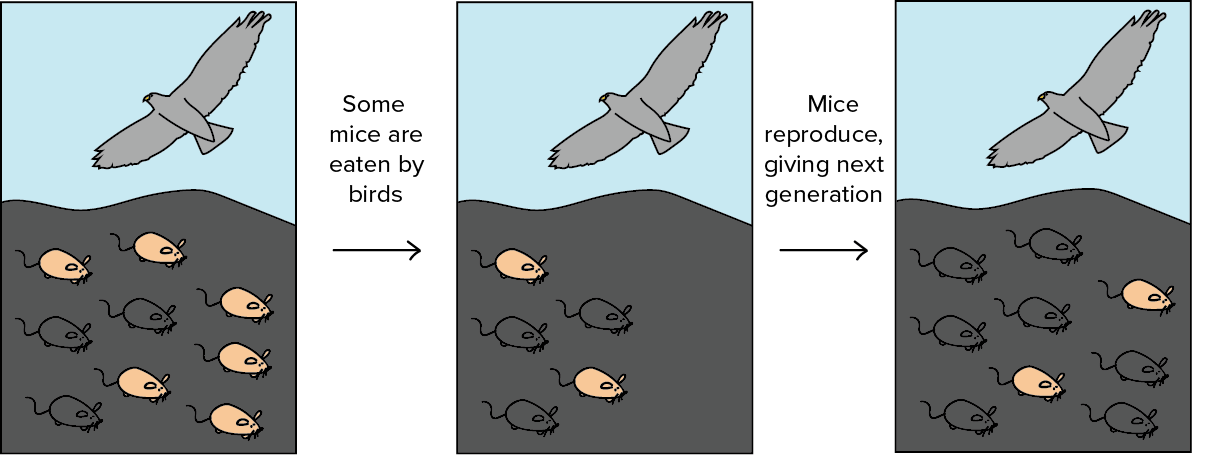
Multiple Choice
The light mice can reproduce more successfully than the dark mice
The hawks eat more dark mice than light mice because the dark mice taste better
The hawks eat more light mice than dark mice because they can see the light mice more easily
The hawks eat more dark mice than light mice because they can see the dark mice more easily
39
Multiple Choice
True
False
40
Multiple Choice
ability to survive and reproduce in a specific environment
organisms with traits well suited to their environment survive and reproduce at a greater rate
a growing population causes a scarcity of resources
differences in the DNA sequence
41
Multiple Choice
genes.
variations.
traits.
theories.
42
Multiple Choice
One condition of natural selection is a selective pressure. What is a selective pressure?
Something that makes it harder for an organism to survive.
Differences in a population
A mutation that helps an organism survive
More offspring being born than surviving
43
Multiple Choice
One condition of natural selection is an adaptation. What is an adaptation?
Something that makes it harder for an organism to survive.
Differences in a population
A mutation that helps an organism survive
More offspring being born than surviving
44
Multiple Choice
One condition of natural selection is variation. What is variation?
Something that makes it harder for an organism to survive.
Differences in a population
A mutation that helps an organism survive
More offspring being born than surviving
45
Multiple Choice
In this example of natural selection, describe the variation.
The fox, its predator
The rabbits can have dark, light, or medium colored fur.
White or medium fur.
The darker fur rabbits are more likely to be eaten and fewer of them survive.
46
Multiple Choice
In this example of natural selection, describe the adaptation.
The fox, its predator
The rabbits can have dark, light, or medium colored fur.
White or medium fur.
The darker fur rabbits are more likely to be eaten and fewer of them survive.
47
Multiple Choice
In this example of natural selection, describe the selective pressure.
The fox, its predator
The rabbits can have dark, light, or medium colored fur.
White or medium fur.
The darker fur rabbits are more likely to be eaten and fewer of them survive.
48
Multiple Choice
In this example of natural selection, describe the role of overproduction.
The fox, its predator
The rabbits can have dark, light, or medium colored fur.
White or medium fur.
Less fit rabbits survive, rabbits that are more fit survive and pass down their genes.
49
Multiple Choice
In this example of natural selection, describe the role of overproduction.
Competition for food.
The giraffes can have long or short necks.
Long necks.
Giraffes that are less fit do not survive to pass down their genes.
50
Multiple Choice
In this example of natural selection, describe the variation in this example.
Competition for food.
The giraffes can have long or short necks.
Long necks.
Giraffes that are less fit do not survive to pass down their genes.
51
Multiple Choice
In this example of natural selection, describe the adaptation in this example.
Competition for food.
The giraffes can have long or short necks.
Long necks.
Giraffes that are less fit do not survive to pass down their genes.
52
Multiple Choice
In this example of natural selection, describe the selective pressure in this example.
Competition for food.
The giraffes can have long or short necks.
Long necks.
Giraffes that are less fit do not survive to pass down their genes.
53
Multiple Choice
Each row shows a different generation of male peacock feathers. What is the variation?
finding mates
Some feathers are larger and some are smaller.
larger features to attract mates
Peacocks that do not mate do not pass down their genes.
54
Multiple Choice
Each row shows a different generation of male peacock feathers. What is the selective pressure?
finding mates
Some feathers are larger and some are smaller.
larger features to attract mates
Peacocks that do not mate do not pass down their genes.
55
Multiple Choice
Each row shows a different generation of male peacock feathers. What is the adaptation?
finding mates
Some feathers are larger and some are smaller.
larger features to attract mates
Peacocks that do not mate do not pass down their genes.
56
Multiple Choice
Each row shows a different generation of male peacock feathers. Describe the role of overproduction.
finding mates
Some feathers are larger and some are smaller.
larger features to attract mates
Peacocks that do not mate do not pass down their genes.
Adaptations and Natural Selection
CFU Prep
Show answer
Auto Play
Slide 1 / 56
SLIDE

Similar Resources on Wayground
50 questions
The Great Depression and New Deal
Lesson
•
7th Grade
51 questions
Unit 2 Energy Conservation & Transfer
Lesson
•
6th Grade
51 questions
Plant/Animal Cells
Lesson
•
7th Grade
51 questions
The Reformation
Lesson
•
7th Grade
52 questions
Energy
Lesson
•
7th Grade
48 questions
Texas Revolution
Lesson
•
7th Grade
51 questions
G7 - Chapter 12 Final Revision
Lesson
•
7th Grade
53 questions
Energy flow, symbiosis and Limiting factors
Lesson
•
7th Grade
Popular Resources on Wayground
10 questions
5.P.1.3 Distance/Time Graphs
Quiz
•
5th Grade
10 questions
Fire Drill
Quiz
•
2nd - 5th Grade
20 questions
Equivalent Fractions
Quiz
•
3rd Grade
15 questions
Hargrett House Quiz: Community & Service
Quiz
•
5th Grade
20 questions
Main Idea and Details
Quiz
•
5th Grade
20 questions
Context Clues
Quiz
•
6th Grade
20 questions
Inferences
Quiz
•
4th Grade
15 questions
Equivalent Fractions
Quiz
•
4th Grade
Discover more resources for Biology
20 questions
Food Chains and Food Webs
Quiz
•
7th - 12th Grade
15 questions
Pedigrees
Quiz
•
7th - 12th Grade
20 questions
inherited vs acquired traits
Quiz
•
7th Grade
10 questions
Natural Selection and Adaptation in Evolution
Interactive video
•
6th - 10th Grade
10 questions
Cell Structure and Function Concepts
Interactive video
•
6th - 10th Grade
38 questions
Ecosystems and Biomes Test Review
Quiz
•
7th Grade
32 questions
Flow of Energy
Quiz
•
7th - 12th Grade
61 questions
Genetics
Quiz
•
6th - 8th Grade