Search Header Logo
  1. Resource Library
  2. Math
  3. Sequences And Series
  4. Arithmetic Series
  5. Year 12 Flipped Learning Sum Of An Arithmetic Series
Year 12 Flipped Learning - Sum of an Arithmetic series

Year 12 Flipped Learning - Sum of an Arithmetic series

Assessment

Presentation

Mathematics

12th Grade

Practice Problem

Medium

CCSS
HSF.BF.A.2, 8.EE.C.7B

Standards-aligned

Created by

Lesley Thorpe

Used 2+ times

FREE Resource

12 Slides • 14 Questions

1

​Year 12 Flipped Learning:

​Lesson 2: Sum of an arithmetic series

Deadline for Completion:

End of day on Monday 8th May

media
  • Read the information

  • Watch the videos

  • Complete the notes in your handbook

  • Attempt the questions in the quizziz.

​If you need more help please ask a maths teacher during a supported study session.

You need to practice using the online textbook.

2

Poll

Rate your progress on this lesson:

3

media

​In Lesson 1 you met an Arithmetic Progression:

A sequence of numbers which is defined as having a start number a and a common difference d.

​You should be able to use the formula for the nth term:

Un = a + (n - 1)d

to calculate terms in a sequence or to solve problems in order to find the value of a or d.

​4, 11, 18, 25, ......

4

media
media

5

media

​Try answering this question yourself,

Then watch Martin explain the answer using the QR code or you can access the video in teams in the P11 channel.

media
media

6

media
media

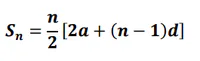
​These two formulae are given to you in the formulae booklet.

​You don't need to remember them, but remember that you are given them!

7

media

​You will need to learn this "proof" as it is a standard question that is asked frequently in exam papers!

​It follows Gauss' solution for pairing numbers...

​Have a try yourself - then watch the following video for how it should be done in an exam

8

9

media

​How to learn a proof:

  1. Read the proof or watch the video

  2. Cover the example or stop the video

  3. Without cheating! have a go at writing the proof yourself.

  4. Check your written proof against the example or the video.

​The more times you practise this... the better you will remember it!

10

media

​Use the formula.

This questions is just "fancy substitution"!

media

​a = -4

d = 9

n = 35

​Check your answer: 5215

11

​Use the formula.

This question is just "solving an inequality"!

media

​a = 4

d = 5

n = ?

Sn > 2000

media

Remember to use a sketch graph and your calculator to help you solve your quadratic inequality!

​ n > 27.99 or n < -28.59

n is a term in a sequence and is not negative, nor a decimal.

So what is n?

12

media
media

​a + 8d = 18

​nth term formula: Un = a + (n - 1)d

​9a + 36d = 72

Remember to use your calculator to help you solve your simultaneous equations!

​a = -2 and d = 2.5

13

media

​FINAL EXAMPLE

​a = 7

d = -2

SN = -2900

n = ?

media

​ N = 58 or N = -50

14

Match

Question image

Match the following Arithmetic Sequences to their parameters:

a = 5

d = -4

a = 5

d = 8

a = -7

d = 8

a = -7

d = 0.5

a = 2.3

d = 0.5

5, 1, -3, -7........

5, 13, 21, 29,.....

-7, 1, 9, 17.....

-7, -6.5, -6, -5.5....

2.3, 2.8, 3.3, 3.8, 4.3...

15

Multiple Choice

Question image

Which is the correct formula for the nth term of an arithmetic sequence?

1

a + d

2

a + bx

3

a + (n - 1)d

4

a + (n + 1)d

16

Multiple Choice

Question image

What is the correct formula for the sum of an arithmetic series

1

n2(a + (n  1)d)\frac{n}{2}\left(a\ +\ \left(n\ -\ 1\right)d\right)

2

n2(a + l)\frac{n}{2}\left(a\ +\ l\right)

3

n2(a + (n + 1)d)\frac{n}{2}\left(a\ +\ \left(n\ +\ 1\right)d\right)

4

n2(2a + (n  1)d)\frac{n}{2}\left(2a\ +\ \left(n\ -\ 1\right)d\right)

17

Multiple Choice

Question image

The first term of an arithmetic sequence is 14. The fourth term is 32. what is the common difference?

1

6

2

8

3

14

4

4

18

Multiple Choice

Question image

How many term of the Arithmetic Series 5 + 8 + 11 ...

will sum to 670?

1

25

2

20

3

15

4

22

19

Multiple Choice

Question image

How many terms in the Arithmetic Series

64 + 62 + 60 + 58 + ....

will sum to a total of 0?

1

-64

2

64

3

46

4

65

20

Multiple Choice

Question image

Find the sum of the first 15 terms of the Arithmetic Series:

2 + 6 + 10 + 14 + .......

1

423

2

465

3

315

4

450

21

Multiple Choice

Question image

Find the sum of the first 40 terms of the Arithmetic Series:

30 + 27 + 24 + 21 + ......

1

-1140

2

3540

3

-2940

4

1540

22

Multiple Choice

Question image

Find the sum of the Arithmetic Series:

5 + 7 + 9 + ............ + 75

1

4140

2

1040

3

1440

4

1140

23

Multiple Choice

Question image

Find the sum of the Arithmetic Series:

34 + 29 + 24 + ............. + -111

1

1551

2

-1515

3

-1155

4

1155

24

Multiple Choice

The sum of the first three terms of an Arithmetic Series is 12

If the 20th term is -32, find the first term and the common difference.

1

a = 4

d = -1.8

2

a = 6

d = 2

3

a = 6

d = -2

4

a = 4

d = -2

25

Fill in the Blanks

media image

Type answer...

26

Poll

Rate your progress on this question:

​Year 12 Flipped Learning:

​Lesson 2: Sum of an arithmetic series

Deadline for Completion:

End of day on Monday 8th May

media
  • Read the information

  • Watch the videos

  • Complete the notes in your handbook

  • Attempt the questions in the quizziz.

​If you need more help please ask a maths teacher during a supported study session.

You need to practice using the online textbook.

Show answer

Auto Play

Slide 1 / 26

SLIDE