

L6_3.3.7 Translocation BCS

Presentation
•
Biology
•
12th Grade
•
Practice Problem
•
Easy

Ben Scott
Used 1+ times
FREE Resource
17 Slides • 11 Questions
1

Translocation
LO: To describe and explain the mechanism of
translocation in plants
Q2: Why do plants
need to translocate
assimilates
throughout the
plant?
What is Osmosis?
2
Draw
Draw a xylem
3
Draw
Draw a phloem
4

5


Contents of Sieve Tubes
• Aphids can be used to
‘sample’ phloem sap
• Such experiments also
demonstrate mass flow of
phloem sap (around 10000 x
faster than diffusion)
Conclusion: The rate of movement
is too quick to be caused just by
diffusion.
6

Translocation
• Assimilates are organic molecules the plant
has made e.g. products of photosynthesis
such as sucrose.
• Assimilates are transported around the plant
via sieve tube elements
• Production sites known as SOURCES
• Storage or usage sites known as SINKS
Translocation is the transport of
assimilates through a plant
7

Explain why leaves and green fruits act as sources
while ripe fruits, roots, old leaves and stems are
sinks
8

Translocation
Phloem sap moves by
translocation, which
involves:
1) Active loading at
sources tissues
2) Mass flow through
sieve tubes
3) Active unloading at
sink tissues
9
Hotspot
Where is the highest concentration of glucose?
10
Hotspot
Where is the highest water potential?
11
Hotspot
Where are the H+ ions actively pumped?
12
Hotspot
Where is the sucrose/H+ protein pump?
13
Hotspot
which cell has the most mitochondria?
14


1. Active loading at the source
• Companion cell uses ATP
to pump H+out into cell
wall
• H+ diffuses back (down
gradient) into companion
cell via cotransporter
proteins accompanied by
sucrose.
• Concentration of sucrose
is now high in companion
cell → diffuses into sieve
tube elements via
plasmodesmata
Companion cell Source cell
High [H+]
Low [H+]
15

Active loading - Also called
secondary active transport
16


SOURCE
2. Mass flow
1. Increasing sucrose concentration in sieve
tubes near source makes Ψ more –ve.
2. Water moves into phloem from xylem
3. At sink sucrose used up or converted to
starch so Ψ less –ve than source.
4. Water moves out of sink into xylem
5. This creates a flow due to differences in
hydrostatic pressure →known as mass
flow
More
positive
hydrostatic
pressure
More
negative
hydrostatic
pressure
SINK
This process is
completely
passive
17

3. Transfer of sucrose from sieve tube
elements
• Sucrose diffuses or is
actively transported
out of sieve tube
elements by
companion cells into
sink.
18

Card Sort
Try completing the card sort for this
process
19
Reorder
Put the following in order
20
Reorder
Put the following in order
21

1. Triose sugars are produced in photosynthesising leaves, some of
which are converted to sucrose.Sucrose moves from mesophyll cells
across leaf to phloem tissue, using either symplast or apoplast
pathway.
2. At the phloem tissue, a large excess of H+ions is created in the
apoplast outside the companion cells as H+ions are pumped out of
companion cells into the cell wall using ATP.
3. H+ions move back into the cell down their concentration gradient,
through a protein which acts as a cotransporter for H+ions and
sucrose.
4. Sucrose molecules then move from the companion cell into the sieve
tube, through the plasmodesmata which connect them (the symplast
pathway).
5. Loading a high concentration of sucrose into a sieve element greatly
decreases the water potential of the sap inside it.
22

6. Water moves down the water potential gradient by osmosis,
entering the sieve element. This causes a corresponding increase
in hydrostatic pressure.
7. A hydrostatic pressure gradient is created between source and sink
and causes a mass flow of water and dissolved solutes through the
through the sieve tubes, from high to low pressure.
8. At the sink, sucrose moves out of the phloem into surrounding
tissue by either the symplast or apoplast routes. Similar methods to
those used for loading are used for this unloading process.
9. Once in the tissue, sucrose is converted into something else by
enzymes, e.g invertase enzyme hydrolyses sucrose into glucose and
fructose. This decreases sucrose concentration and maintains
concentration gradient.
10.Water follows sucrose by osmosis, maintaining the hydrostatic
pressure gradient and allowing mass flow to continue.
23

Translocation Qs
24
Open Ended
Explain, with a suitable example, how some parts of the plant can act as both a 'source' and a 'sink' (2)
25
Open Ended
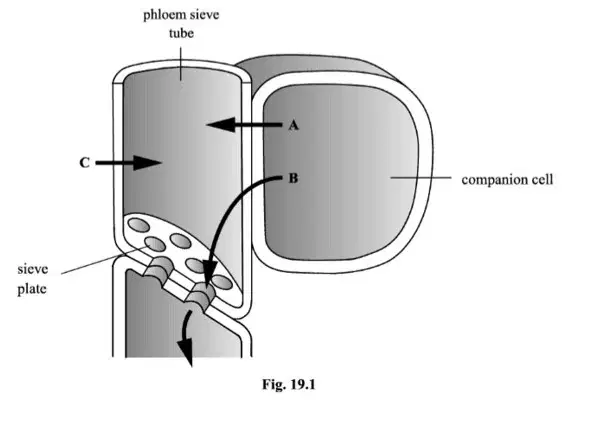
With reference to the diagram explain the process of the loading of sucorse into the phloem and its movement in the phloem (6)
26
Translocation Qs
27

28

Translocation
LO: To describe and explain the mechanism of
translocation in plants
Q2: Why do plants
need to translocate
assimilates
throughout the
plant?
What is Osmosis?
Show answer
Auto Play
Slide 1 / 28
SLIDE
Similar Resources on Wayground

21 questions
Cold War Intro
Presentation
•
KG
20 questions
Climate and Currents Notes
Presentation
•
12th Grade
21 questions
Political Cartoons
Presentation
•
12th Grade
22 questions
Microarray Bioinformatics GT medicine
Presentation
•
12th Grade
21 questions
Week 7 homework - Topic 6.3 + 6.4
Presentation
•
12th Grade
22 questions
How a Bill Becomes a Law
Presentation
•
12th Grade
21 questions
Best Method: Solving Systems of Equations
Presentation
•
7th - 10th Grade
21 questions
Electric Field
Presentation
•
12th Grade
Popular Resources on Wayground
16 questions
Grade 3 Simulation Assessment 2

Quiz
•
3rd Grade
19 questions
HCS Grade 5 Simulation Assessment_1 2526sy
Quiz
•
5th Grade
10 questions
Cinco de Mayo Trivia Questions

Interactive video
•
3rd - 5th Grade
17 questions
HCS Grade 4 Simulation Assessment_2 2526sy
Quiz
•
4th Grade
24 questions
HCS Grade 5 Simulation Assessment_2 2526sy
Quiz
•
5th Grade
13 questions
Cinco de mayo
Interactive video
•
6th - 8th Grade
20 questions
Math Review
Quiz
•
3rd Grade
30 questions
GVMS House Trivia 2026
Quiz
•
6th - 8th Grade
Discover more resources for Biology
210 questions
Unit 1 - 4 AP Bio Review
Quiz
•
9th - 12th Grade
16 questions
AP Biology: Unit 1 Review (CED)
Quiz
•
9th - 12th Grade
20 questions
AP Biology: Unit 3 Review (CED)
Quiz
•
9th - 12th Grade
21 questions
AP Biology: Unit 6 Review (CED)
Quiz
•
9th - 12th Grade
14 questions
AP Biology: Unit 4 Review (CED)
Quiz
•
9th - 12th Grade
20 questions
Food Chains and Food Webs
Quiz
•
7th - 12th Grade
39 questions
Unit 7 & 8 AP Biology CED Review
Quiz
•
9th - 12th Grade
18 questions
Population Dynamics
Quiz
•
7th - 12th Grade