

8.10 & 8.11 The Convention Ends

Presentation
•
History
•
8th Grade
•
Medium

Elizabeth McKee
Used 6+ times
FREE Resource
20 Slides • 27 Questions
1
By the end of summer, the hard work of designing the Constitution was completed. However, the new proposal still had to be approved by the states.

2

3

4
Multiple Choice
Congress
Electoral College
House of Reprentatives
Senate
5
The first question before the framers was how many states would have to ratify, or approve, the Constitution before it could go into effect. Should ratification require approval by all 13 states or by a majority of 7 states? Ultimately, the framers compromised on 9 states.
6
Multiple Choice
What word means to formally approve a plan or an agreement. The process of approval is called ratification.
Enlightenment
Republic
Ratify
Electoral College
7
Multiple Choice
How many states were needed to ratify the constitution?
10
13
9
7
8
was who should ratify the Constitution—the people or the state legislatures? Ratification by state legislatures would be faster and easier. James Madison, however, argued strongly that the people were “the fountain of all power” and should decide. The majority of delegates agreed, and after the delegates signed the Constitution, the document was later ratified at special conventions by delegates elected by the people in each state. However, ratification did not come without difficulty.
9
On September 17, 1787, the delegates declared the Constitution complete. As this last meeting began, Franklin shared his final thoughts, which would be printed in more than 50 newspapers.
10
“I confess that I do not entirely approve of this Constitution,” Franklin began before pointing out that no convention could produce a perfect plan. “It therefore astonishes me,” Franklin continued, “to find this system approaching so near to perfection . . . and I think it will astonish our enemies. ” Franklin added that he approved the final plan “because I expect no better, and because I am not sure that it is not the best. ” He urged every member of the convention to “put his name to this instrument. ”
11
Multiple Choice
Which of these quotes might have come from Ben Franklin?
It gives too much power to the federal government.
Even though I don't like everything about this plan, it is as close to perfect as we are going to get.
It does not protect the rights of the people.
12
Not everyone was won over by Franklin's words. Thirteen delegates left the convention before it ended and did not sign the Constitution.
13
Three other delegates—Edmund Randolph and George Mason, both of Virginia, and Elbridge Gerry of Massachusetts—also did not sign.
George Mason believed it gave too much power to the national government
Elbridge Gerry refused to sign because he believed the new plan did not protect the rights of the people.
14
Multiple Choice
Which of these quotes might have come from George Mason?
It gives too much power to the federal government.
Even though I don't like everything about this plan, it is as close to perfect as we are going to get.
It does not protect the rights of the people.
15
Multiple Choice
Which of these quotes might have come from Elbridge Gerry?
It gives too much power to the federal government.
Even though I don't like everything about this plan, it is as close to perfect as we are going to get.
It does not protect the rights of the people.
16
When the signing was over, Franklin confessed that he had often looked at the sun carved on the back of George Washington's chair and wondered whether it was about to rise or set. “But now,” he said, “I have the happiness to know that it is a rising and not a setting sun. ” A new day was dawning for the United States.

17
The Constitution had to be approved by nine states. This political cartoon shows 11 states, pictured as columns, supporting the Constitution, while two states are hesitating.

18
Newspapers in every state printed the Constitution as soon as they could get it. What readers found was a plan that would create a “federal” system of government, in which a strong national government shared power with the states. Before long, the entire country was debating the same issues that had kept the convention in session for four long months.
19
Multiple Choice
Which of these describes a federal system of government?
Government is run by one political party.
A single leader makes all of the government decisions.
Individual states have power over the national government.
Power is shared by the national and state governments.
20
Supporters of the Constitution called themselves Federalists. The Federalists argued that the Constitution would create a national government that was strong enough to unite the quarreling states into a single republic.
21
James Madison, Alexander Hamilton, and John Jay led the Federalist campaign for ratification. In a series of newspaper essays, they recalled the weaknesses of the government under the Articles of Confederation. They showed how the Constitution would remedy those weaknesses by creating a stronger, more effective union of the states.

22
The Federalist leaders also addressed the fears of many Americans that a strong government would threaten their freedom or take away their rights. The powers given to the government, they pointed out, were strictly limited. In addition, those powers were divided among three branches so that no one branch could become too powerful. The influential articles written by Madison, Hamilton, and Jay were later collected and published as The Federalist Papers.
23
Multiple Choice

The ___________ are for the ratification (approval) of the U.S Constitution.
Federalists
Anti-Federalists
Whiggs
Representatives
24
Multiple Choice
Federalists supported a strong ____________ government.
National
State
Monarchy
Republican
25
Multiple Choice
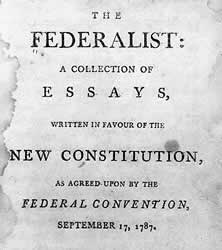
The "Federalist Papers" were written to:
Explain and convince the people into supporting the new U.S Constitution.
spark a new revolution among the American people against their government.
oppose a strong centralized government.
create a new monarchy.
26
Anti-Federalists, opponents of the Constitution, found much to dislike about the new plan. Congress, they feared, would burden the country with taxes. They also claimed that the president had power enough to rule like a king, and the judicial branch would overpower state courts.
27
The Anti-Federalists also complained about what was missing from the plan, primarily that the plan listed the powers of the government but not the rights of the people (NO BILL OF RIGHTS).
Most of all, the Anti-Federalists feared change, and the idea of giving up any state power to form a stronger Union made them uneasy (They wanted to keep the Articles of Confederation but just amend or fix it).

28
Multiple Choice
Anti-Federalists preferred strong ____________ governments.
National
State
Central
Republican
29
Multiple Choice
Why did Antifederalists want a bill of rights in the Constitution?
to list their rights
to protect their rights
to prevent ratification of the Constitution
to argue with Federalists
30
Multiple Choice
The Anti-Federalists wanted to keep the ____________ ____ ___________ because it kept the Federal government weak.
Constitution
Declaration of Indepdence
Magna Carta
Articles of Confederation
31
After listening to the arguments, Madison wrote that the question facing the nation was “whether the Union shall or shall not be continued. There is, in my opinion, no middle ground to be taken.”
32

33
I am going to give you 14 statements and you have to tell me if a FEDERALIST or ANTI-FEDERALIST would have thought this way.
34
Multiple Choice
1. The Constitution is a Bill of Rights because it guarantees citizens a role in government.
Federalists
Anti-Federalists
35
Multiple Choice
2. The United States is too large to have a central government. People won't know their leaders and will lose control over the government.
Federalists
Anti-Federalists
36
Multiple Choice
3. The Constitution forbids creating titles of nobility like "Duke" or "King," so the government will always belong to the people.
Federalists
Anti-Federalists
37
Multiple Choice
4. The Supreme Court is the weakest branch of government because it doesn't control the military and can't pass laws.
Federalists
Anti-Federalists
38
Multiple Choice
5. The Constitution already contains a few rights, so we may as well add a whole Bill of Rights.
Federalists
Anti-Federalists
39
Multiple Choice
6. The Constitution creates a Supreme Court that is too powerful because the judges don't answer to anyone.
Federalists
Anti-Federalists
40
Multiple Choice
7. A strong President is necessary to protect country against foreign attack and make sure laws are carried out properly.
Federalists
Anti-Federalists
41
Multiple Choice
8. Who would say: The President created by the Constitution is really just a king.
Federalists
Anti-Federalists
42
Multiple Choice
9. The Constitution gives the federal government just a few powers that are very well defined.
Federalists
Anti-Federalists
43
Multiple Choice
10. Nothing in the Constitution says the federal gov. has power to limit people's freedoms in the first place.
Federalists
Anti-Federalists
44
Multiple Choice
11. The Constitution says federal laws are "the supreme law of the land," so the federal gov. could just take complete control.
Federalists
Anti-Federalists
45
Multiple Choice
12. The Constitution contains no Bill of Rights to protect individual liberties like freedom of speech, trial by jury, and the right against searches and seizues.
Federalists
Anti-Federalists
46
Multiple Choice
13. It will not be possible for the federal gov. to overpower the states, because states are necessary part of the federal gov.
Federalists
Anti-Federalists
47
Multiple Choice
14. The Constitution gives the federal government enough power to overpower the states.
Federalists
Anti-Federalists
By the end of summer, the hard work of designing the Constitution was completed. However, the new proposal still had to be approved by the states.
Show answer
Auto Play
Slide 1 / 47
SLIDE
Similar Resources on Wayground

43 questions
H11/H12 Remediation Lesson
Presentation
•
8th Grade
41 questions
Parallel Lines & Transversals
Presentation
•
8th Grade
42 questions
Metamorphic Rocks Lesson
Presentation
•
8th Grade
43 questions
TCI Lesson 11.3 Alexander Hamilton and the Federalist Party
Presentation
•
8th Grade
43 questions
Genes and Heredity
Presentation
•
8th Grade
39 questions
Credit, Debit, & Credit Scores
Presentation
•
8th Grade
43 questions
Bill of Rights
Presentation
•
8th Grade
40 questions
Causes of the War of 1812
Presentation
•
8th Grade
Popular Resources on Wayground
10 questions
How much do you know about our Portrait of an Eagle?

Quiz
•
10th Grade
10 questions
Fast Food Slogans
Quiz
•
6th - 8th Grade
21 questions
Continents and Oceans
Quiz
•
6th Grade
20 questions
Parts of Speech
Quiz
•
5th Grade
16 questions
Subject & Predicate
Quiz
•
5th Grade
25 questions
Multiplication Facts
Quiz
•
5th Grade
12 questions
Map Skills
Quiz
•
3rd Grade
22 questions
Continents and Oceans
Quiz
•
5th Grade
Discover more resources for History
10 questions
Exploring the Journey of Early Humans

Interactive video
•
6th - 10th Grade
21 questions
13 colonies map review
Quiz
•
8th Grade
10 questions
Exploring Jamestown: John Smith and Pocahontas
Interactive video
•
6th - 10th Grade
20 questions
The Early Colonies
Quiz
•
7th - 11th Grade
10 questions
Recap on Mesopotamia: Key Concepts and Facts
Interactive video
•
6th - 10th Grade
16 questions
Government Unit 2
Quiz
•
7th - 11th Grade
34 questions
Judicial Branch and Juvenile Justice
Quiz
•
8th Grade
18 questions
Causes of the American Revolution Review
Quiz
•
8th Grade