

federalims

Presentation
•
History
•
8th Grade
•
Practice Problem
•
Medium

Sebastian Rueda
Used 3+ times
FREE Resource
8 Slides • 9 Questions
1

Dissolution
Elections between federalism and centralism
The Great Colombia
2

Great Colombia refers to a historical political entity that existed during the early 19th century in South America. It was formed as a result of the efforts of Simón Bolívar, a prominent military and political leader known as the "Libertador." Great Colombia encompassed the territories of present-day Colombia, Venezuela, Ecuador, Panama, and parts of Peru, Guyana, Brazil, and northern Brazil.
GREAT COLOMBIA
3
The Great Colombia
The Great Colombia refers to the short-lived republic that existed from 1819 to 1831. It was formed by the union of several South American territories, including present-day Colombia, Venezuela, Ecuador, and Panama, under the leadership of Simón Bolívar. The dissolution of the Great Colombia had significant consequences for the subsequent political landscape of these regions.
4
Multiple Choice
When did Great Colombia come to an end?
The Great Colombia came to an end. After facing challenges related to political instability, regional tensions, and differences in governance ideologies, the union dissolved. The dissolution resulted in the formation of separate nations, including present-day Colombia, Venezuela, Ecuador, and Panama. This marked a turning point in the history of these regions, as they embarked on separate paths of independent nationhood.
1810
1819
1930
1831
5
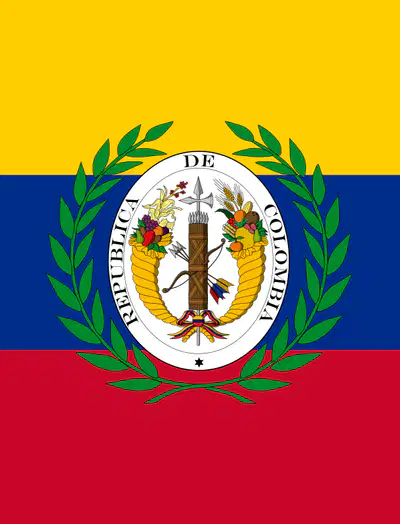
By 1830, Great Colombia had disintegrated into three separate countries: Colombia (comprising present-day Colombia and Panama), Venezuela, and Ecuador. Each nation embarked on its own path of independent development, though they all shared a common historical and cultural heritage from the era of Great Colombia.
DISSOLUTION
6
The path taken by Colombia towards its consolidation as a State was centered on the presence of two political-administrative trends that grew stronger throughout the 19th century and determined two stages under which the configuration of the country was traced under different guidelines: political centralism and federalism.
CENTRALISM AND FEDERALISM

7
Poll
IF COLOMBIA WAS FEDERALIST, WOULD BE A BETTER COUNTRY?
YES
NO
MAYBE
8
Multiple Choice
What was the Patria Boba?
The term "Patria Boba" refers to a period of political instability and chaos that occurred in the early 19th century in the territory that would later become Colombia. It was characterized by internal divisions, power struggles, and weak governance following the collapse of Spanish colonial rule. The term "Patria Boba" can be translated as "Foolish Fatherland" or "Silly Homeland," highlighting the chaotic and uncertain nature of the time.
A) A military coup in Colombia
B) A period of political instability in Colombia
C) A rebellion against Spanish rule in Colombia
D) A celebration of Colombian independence
9
Multiple Choice
How did the First Republic of Colombia come to an end?
The First Republic of Colombia, also known as the Republic of Colombia or the Gran Colombia, came to an end primarily due to internal conflicts and regional tensions. After the initial euphoria of independence, political differences arose among the leaders, including Simón Bolívar and Francisco de Paula Santander. These differences, along with regional rivalries and disagreements over centralism versus federalism, led to the collapse of the republic.
A) Through a peaceful transition of power
B) Due to a foreign invasion
C) Following a large-scale revolt by the populationions
D) Because of internal conflicts and regional tens
10
Multiple Choice
What happened in Septembrina Night?
The Septembrina Night refers to a significant event that took place in Bogotá, Colombia, on September 10, 1828. It was a violent uprising led by factions opposed to the government of Simón Bolívar. The uprising was primarily motivated by political and regional tensions, with various groups seeking to challenge Bolívar's centralist policies. The revolt resulted in the sacking of government buildings, the arrest and exile of Bolívar, and a temporary setback for the centralist cause.
A) The signing of a peace treaty between Colombia and Spain
B) A celebration of Colombian culture and heritage
C) A violent uprising against the government of Simón Bolívar a
D) The formation of a new political party in Colombia
11
Multiple Choice
Why was Great Colombia created?
was created with the aim of liberating the Spanish colonies in South America from Spanish colonial rule and establishing a united and independent nation. Simón Bolívar, the primary driving force behind the creation of Great Colombia, envisioned a federation of states that would work together for the development and progress of the region. Bolívar believed that by uniting the territories of modern-day Colombia, Venezuela, Ecuador, and Panama, the region could better resist external threats and promote stability and progress.
A) To establish a socialist regime in South America
B) To promote religious freedom in the region
C) To unite the territories and gain independence from Spain
D) To expand Colombia's colonial empire
12
Multiple Choice
How did Nueva Granada add to the Great Colombia project?
which encompassed present-day Colombia and Panama, played a crucial role in the creation of Great Colombia. It was one of the main regions that initially declared independence from Spanish rule. Nueva Granada, led by figures such as Antonio Nariño and Francisco de Paula Santander, joined forces with Simón Bolívar and his Venezuelan troops to fight against the Spanish colonial forces. The union of Nueva Granada with Venezuela and other territories formed the core of Great Colombia and provided a strong base for the project.
A) By providing financial support to the project
B) Through military conquest and annexation
C) By negotiating a peaceful merger with other territories
D) By offering diplomatic assistance to Simón Bolívar
13
Multiple Choice
What were the consequences after independence?
The consequences of independence varied across the newly independent nations, but there were some common outcomes. These included political instability, economic challenges, and social changes. The former Spanish colonies faced difficulties in establishing stable governments, leading to power struggles and internal conflicts. Economically, they had to transition from colonial trade patterns to new systems, which often led to disruptions and difficulties. Socially, independence brought about changes in class structures, the status of indigenous populations, and the abolition of slavery in some areas. Additionally, many countries experienced ongoing regional disputes and border conflicts, as well as challenges in establishing strong national identities and systems of governance.
A) Economic prosperity and stability
B) Social equality and harmony
C) Political unity among all the newly independent nations
D) Political instability, economic challenges, and social changes
14
Multiple Choice
How did the tension and wars in the 19th century in Colombia start?
The tension and wars in the 19th century in Colombia were largely rooted in ideological differences, regional disputes, and struggles for power between political factions and regional leaders. Conflicts emerged as the country grappled with questions of centralism versus federalism and the role of the church in governance.
A) Due to external invasions
B) Due to economic disputes
C) Due to ideological differences and regional struggles
D) Due to religious conflicts
15


Colombia's path towards its consolidation as a State was centered on the presence of two political-administrative trends that grew stronger throughout the 19th century and determined two stages under which the country's configuration was traced along different lines
political centralism and federalism.
Centralism reached its consolidation in the period between 1832 and 1858, with the creation of the State of New Granada in the national convention of 1831.
Consolidation
16
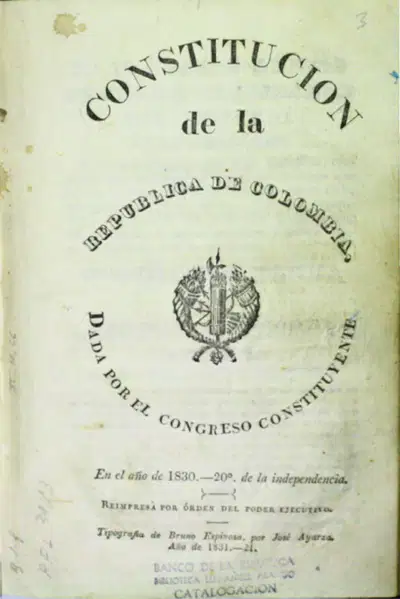
Centralism reached its consolidation in the period between 1832 and 1858, with the creation of the State of New Granada in the national convention of 1831.
Centralism
In 1832 the Constitution of New Granada was promulgated, which was centralist and governed the territories comprising Bogotá, Tunja, Socorro, Vélez, Pamplona, Magdalena, Cartagena, Panama, Veraguas, Antioquia, Neiva, Popayán, Pasto and Barbacoas.
17
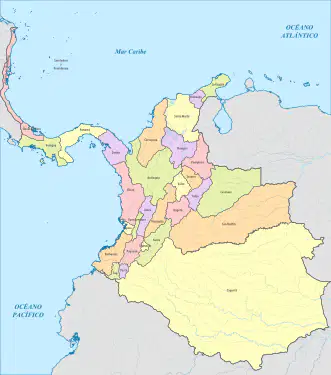
Between 1832 and 1853, the constitution was changed three times, the last one, was in 1853 when the process towards the federal regime began; which was consolidated in 1858 with the establishment of the federalist regime.
Dissolution
Elections between federalism and centralism
The Great Colombia
Show answer
Auto Play
Slide 1 / 17
SLIDE
Similar Resources on Wayground

12 questions
Reading SOL Passage #2
Presentation
•
8th Grade
12 questions
Erie canal
Presentation
•
8th Grade
16 questions
Constitution DCP Review
Presentation
•
8th Grade
11 questions
Hindu Muslim NAtionalism
Presentation
•
8th Grade
12 questions
Ch. 8.7-8.8 Lesson Review
Presentation
•
8th Grade
12 questions
Slope from 2-points
Presentation
•
8th Grade
12 questions
Solving Systems By Substitution
Presentation
•
8th Grade
12 questions
Density
Presentation
•
8th Grade
Popular Resources on Wayground
20 questions
Math Review

Quiz
•
3rd Grade
15 questions
Fast food
Quiz
•
7th Grade
20 questions
Context Clues
Quiz
•
6th Grade
20 questions
Inferences
Quiz
•
4th Grade
19 questions
Classifying Quadrilaterals
Quiz
•
3rd Grade
20 questions
Figurative Language Review
Quiz
•
6th Grade
20 questions
Equivalent Fractions
Quiz
•
3rd Grade
10 questions
Identify Fractions, Mixed Numbers & Improper Fractions
Quiz
•
3rd - 4th Grade
Discover more resources for History
20 questions
Unit 9: Civil War
Quiz
•
8th Grade
21 questions
The Cold War
Quiz
•
8th - 11th Grade
50 questions
50 States and Capitals
Quiz
•
8th Grade
27 questions
4th Quarter Benchmark
Quiz
•
8th Grade
10 questions
Exploring the Byzantine Empire: Key Events and Milestones

Interactive video
•
6th - 10th Grade
20 questions
Civil Rights Movement
Quiz
•
8th Grade
10 questions
Exploring the American Civil War: Key Events and Figures
Interactive video
•
6th - 10th Grade
25 questions
US HISTORY REVIEW
Quiz
•
6th - 8th Grade