

Reflexive verbs

Presentation
•
World Languages
•
University
•
Practice Problem
•
Easy
Standards-aligned

Navila Castro
Used 58+ times
FREE Resource
9 Slides • 13 Questions
1

2
A reflexive verb is used to indicate that the subject does something to or for him or herself. In other words it "reflects" the action of the verb back to the subject. Reflexive verbs always use reflexive pronouns

3
The pronoun SE attached to an infinitive (verb in its definition form) identifies the verb to be reflexive.
When the verb is conjugated (changed to match the subject), the pronoun agrees with the subject.
4
Multiple Choice
Usted __ Acuesta
se
te
nos
me
5
Multiple Choice
Yo __ duermo
nos
te
me
se
6
Multiple Choice
Nosotras __ divertimos
nos
te
me
se
7
Multiple Choice
Tú __ despiertas
nos
te
me
se
8
Multiple Choice
Vosotros __ arreglaís
nos
se
me
os
9
pronouns (me, te, se, nos, os) generally appear before the verb. With infinitives and present participles (in the -ing form)
they can be attached at the end
Pronoun placement
PRESENT PARTICIPLES
Ella se está cepillando los dientes. OR
Ella está cepillandose los dientes. Both mean she is brushing her teeth.
INFINITIVES
Yo me voy a dormir. OR
Yo voy a dormirme.
Both mean I am going to sleep.
10
The reflexive verb estirarse means to stretch oneself.
Estirarse > me Estirar se > Yo me Estirar > Yo me estiro

11
The reflexive verb arreglarse means to get oneself ready.
Arreglarse > nos Arreglar se > Nosotros nos Arreglar > Nosotros nos Arreglamos

12
The reflexive verb cepillarse means to brush.
Cepillarse > se Cepillar se > Ellas se Cepillar > Ellas se cepillan (los dientes).

13
The reflexive verb afeitarse means to shave.
Afeitarse > se Afeitar se > Él se Afeitar > Él se Afeita
When you use 2 verbs in a row, the second remains in its infinitive

14
Multiple Choice
Yo dormirse (ue)
yo me duermo
yo duermo
yo me dormo
15
Multiple Choice
Yo acostarse (ue)
yo me acostar
yo acuesto
yo me acuesto
16
Multiple Choice
Yo cepillarse
yo cepillo
yo me cepillo
yo me cepillar
17
Multiple Choice
Tú afeitarse
tú afeitas
tú te afeitar
tú te afeitas
18
Multiple Choice
Tú bañarse
tú te bañas
tú te bañar
tú bañas
19
Multiple Choice
Nosotros estirarse
nosotros estiramos
nosotros nos estiramos
nosotros estirarse
20
Multiple Choice
Nosotros divertirse
nosotros nos divertimos
nosotros nos divertirse
nosotros divertimos
21
Multiple Choice
Ella despertarse (ie)
ella despertarse
ella se desperta
ella se despierta
22
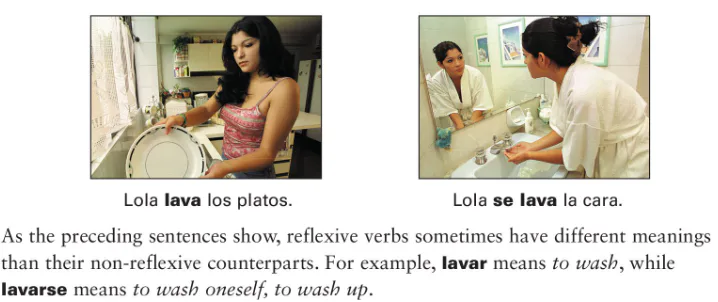
In Spanish, a number of verbs can be reflexive or non-reflexive. If the verb acts upon the subject, then the reflexive form is used. If the verb acts upon something other than the subject, then the non-reflexive form is used.
Show answer
Auto Play
Slide 1 / 22
SLIDE
Similar Resources on Wayground

19 questions
General Interview Question
Presentation
•
University
17 questions
Memoria y velocidad 2
Presentation
•
University
18 questions
HSK 3 第三课 桌子上放着很多饮料 课文1
Presentation
•
University
16 questions
Fundamentos de la planeación
Presentation
•
University
16 questions
Subject, object, possessive pronouns & possesive adjectives
Presentation
•
University
17 questions
Las Relaciones Personales
Presentation
•
University
19 questions
REPORTED SPEECH
Presentation
•
University
18 questions
-ar -er -ir tener venir
Presentation
•
University
Popular Resources on Wayground
10 questions
Safety Day 2026 – Student Review

Quiz
•
9th Grade
21 questions
Continents and Oceans
Quiz
•
6th Grade
20 questions
Parts of Speech
Quiz
•
5th Grade
16 questions
Subject & Predicate
Quiz
•
5th Grade
25 questions
Multiplication Facts
Quiz
•
5th Grade
12 questions
Map Skills
Quiz
•
3rd Grade
22 questions
Continents and Oceans
Quiz
•
5th Grade
15 questions
Rounding Decimals
Quiz
•
5th Grade