
WHI 2.01 and 2.02

Presentation
•
Social Studies
•
9th - 12th Grade
•
Medium

Tracee McDonald
Used 2+ times
FREE Resource
18 Slides • 25 Questions
1

Module 2.01
Indus River Valley Civilization


2
Multiple Choice

Hinduism
Confucianism
Shintoism
Zoroastrianism
3

2.01: Indus River Valley Civilization
Virginia Standards of Learning associated with
M2.01:
•WHI.3 The student will apply social science skills to understand the ancient river valley civilizations, including those of Mesopotamia, Egypt, the Indus
River Valley, and China and the civilizations of the Hebrews and Phoenicians, by
•WHI. 3a locating these civilizations in time and place and describing their major geographic features;
•WHI.3b describing the development of social, political, and economic patterns, including slavery;
•WHI.3c explaining the development and interactions of religious traditions;
•WHI.4 The student will apply social science skills to understand the civilizations of Persia, India, and China in terms of chronology, geography, social
structures, government, economy, religion, and contributions to later civilizations by
•WHI.4b locating India in time and place, including its origins, early development, and the debate over the Aryan migrations;
•WHI.4c describing the origins, beliefs, traditions, customs, and spread of Hinduism;
•WHI.d describing the origins, beliefs, traditions, customs, and spread of Buddhism;
4

Word Wall
• Indus River Valley
• Gangetic Plain, Deccan Plateau, coastal plains
of India
• Harappa
• Mohenjo Daro
• Aryans
• Hinduism
• brahman
• Concepts in Hinduism:
• atman
• moksha
• dharma
• karma
• ahimsa
• reincarnation
• Castes
• untouchables
• Vishnu, Shiva, Devi
• Buddhism
• Siddhartha Gautama ("Buddha")
• Concepts/Beliefs in Buddhism
• Theravada Buddhism
• Mahayana Buddhism
5
Draw
Draw an arrow to show why this area is shaped like it is. Why did people settle here?
6


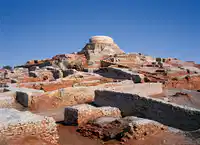
Harappa and Mohenjo Daro
These were twin cities that flourished about 700 years
We do not know much about them. No names of rulers, tax records, literature, etc.
These are carefully laid out cities. Used clay bricks.
Complex plumbing systems.
Organized government
7


Mohenjo Daro
Harappa
8
Open Ended
What do you think happened to these two cities? Why did they disappear?
9
Multiple Select
What are the two rivers of India?
Indus
Yellow
Ganges
Tigris
10
Multiple Select
What are the two Mountain Ranges of India?
Alps
Hindu Kush
Himalayas
Rockys
11

Migrated across Europe to India
Early Aryans built no cities and left little evidence
Vedas: a collection of hymns, chants, and other religious teachings
Society had a pyramid structure
Aryans
12
Multiple Choice
Who settled India?
Aryans
Persians
Egyptians
Assyrians
13
Multiple Choice
Aryans invaded India through the ____ _____ in the Hindu Kush Mountains.
The Royal Road
The Silk Road
The Royal pass
Khyber Pass
14

Hinduism and Buddhism
•What are the similarities and differences?

15

Hinduism
•Hinduism
Scholars consider the older of the two, Hinduism, as a combination of Aryan history, culture, and multiple faiths.
There is no official founder of the religion and historians estimate that it developed into a more organized belief system during the “Vedic Age”, or the time period between 1500 and 500 BCE.
The basic beliefs of Hinduism can be found in a long series of stories called The Vedas.

16

Hinduism
The most basic of Hindu beliefs is the belief in the ancient concept of brahman.
Brahman interacts with humans in spiritual and physical ways.
Humans have an “essential self” called atman, with which they should achieve moksha or spiritual purity.

17
Multiple Choice
Shintoism
Hinduism
Buddhism
Judaism
18
Multiple Select
Holy texts of Hinduism
Four Noble Truths
Eight Fold Path
Vedas
Upanishads
19
Multiple Choice

This is one of the many forms of Brahman celebrated by
Taoists
Hindus
Jews
Zoroastrians
20
Multiple Choice

What is the primary religion of region D?
Hinduism
Islam
Roman Catholic
Confucianism
21
Multiple Choice
A major belief of Hinduism is that:
Rebirth is based upon an individual's karma
There are two opposing forces in the universe
Following the 8 Fold Path will lead to enlightenment
There is only one god
22
Multiple Choice

Which religion best completes the graphic?
Hinduism
Buddhism
Taoism
Judaism
23


Buddhism
This faith was started by a Hindu prince named Siddhartha Gautama in the late 6th century BCE in modern-day Nepal.
Gautama’s view of the world changed after traveling great distances across the Gangetic Plain, and noting that human suffering was the basic trait in human life.
After decades of meditation, Gautama believed he had achieved an understanding of and a cure for such suffering. As his reputation grew, he became known as Buddha, or “Enlightened One.”
•"china - buddhism figure" by Xuan Che is licensed under CC BY 2.0
24

Eight fold path
•Right View
•Right Thought
•Right Speech
•Right Action
•Right Livelihood
•Right Effort
•Right Awareness
•Right Concentration

25
Multiple Choice

Siddhartha Gautama
Confucius
Abraham
Zoroaster
26
Multiple Choice
Enlightenment
Salvation
Reincarnation
Karma
27
Multiple Choice
Ten Commandments
Four Noble Truths
Twelve Tables
Eightfold Path
28

2.02
Early Empires in India
29

Objectives
◦ WHI.1 The student will demonstrate skills for historical thinking, geographical analysis, economic decision making, and
responsible citizenship by
◦ WHI.1b using geographic information to determine patterns and trends to understand world history;
◦ WHI.3 The student will apply social science skills to understand the ancient river valley civilizations, including those of
Mesopotamia, Egypt, the Indus River Valley, and China and the civilizations of the Hebrews and Phoenicians, by
◦ WHI.3a locating these civilizations in time and place and describing their major geographic features;
◦ WHI.3b describing the development of social, political, and economic patterns, including slavery;
◦ WHI.3c explaining the development and interactions of religious traditions;
30

Word Wall
◦ Chandragupta Maurya
◦ Maurya Empire
◦ Pataliputra
◦ Asoka
◦ Dravidians
◦ Sri Gupta
◦ Gupta Empire
◦ "zero"
◦ "joint family"
31

Mauryan Empire
◦ In 321 BCE Chandragupta Maurya founded the first Indian empire, called the Maurya Empire
◦ Asoka, the grandson of Chandragupta, took power in 268 BCE and worked to expand the territory controlled
by the empire. He adopted Buddhism and sent missionaries, or a person sent on a religious mission, to spread
Buddhism and to present the empire in a favorable way. Additionally, he added to the number of roads and
hospitals within his empire.
◦ What religion characterized this empire?
32
Multiple Choice
Hinduism
Buddhism
Shintoism
Judaism
33

Four noble truths
◦ The origin of suffering is attachment
◦ Life means suffering
◦ The cessation of suffering is attainable
◦ The path to the cessation of suffering

34
Multiple Choice
Siddhartha Gautama
Confucius
Lau Tzu
Asoka
35
Multiple Choice
Used to end desires in Buddhism
Four Noble Truths
Eight Fold Path
10 Commandments
5 Pillars
36
Multiple Choice

Which direction did Asoka's missionaries spread Buddhism from India?
1
2
3
4
37
Multiple Choice

Which of the following best completes the shaded area on the diagram?
Sacred texts include the Vedas
Major religion of India today
Strict social class system
Believe in the Four Noble Truths
38

Gupta Empire
◦ Founded by Sri Gupta in 320 CE, the Gupta Empire grew from the unification of northern Indian kingdoms. At
its height, the Gupta Dynasty ruled the territory from the Indus River Valley across northern India along the
length of the Ganges River Valley and southward along the eastern coastline of the Indian subcontinent.
◦ The villages of the Gupta Empire enjoyed much more independence and power than those under the Maurya,
but they still showed great loyalty to the dynasty overall. The empire fell to nomadic invaders from central
Asia and collapsed around 540 CE.
◦ What religion characterized this empire?
39
Multiple Choice

Which empire is associated with this river system?
Chinese empire
Gupta empire
Phoenician empire
Babylonian empire
40
Multiple Choice
Which Indian empire was responsible for advances in mathematics, such as the concept of zero and the decimal system?
Gupta
Aryan
Mauryan
Harrapan
41


The Caste System
"File:Pyramid of Caste
system in India.png" by
Kwj2772 Disc. kowiki. is
licensed with CC BY-SA
3.0. To view a copy of this
license, visit
https://creativecommons.
org/licenses/by-sa/3.0
42
Multiple Choice

What does this diagram represent?
Class system of China
Political system of Greece
Caste system of India
Feudal system of Japan
43
Open Ended

What is one thing that you learned today?
Module 2.01
Indus River Valley Civilization
Show answer
Auto Play
Slide 1 / 43
SLIDE
Similar Resources on Wayground

41 questions
Nixon, Ford, Carter
Presentation
•
9th - 12th Grade
38 questions
Newton's Third law
Presentation
•
9th - 12th Grade
37 questions
ServSafe - Food Handler 4b - TCS Foods
Presentation
•
9th - 12th Grade
35 questions
World War II Review for CA#12
Presentation
•
9th - 12th Grade
37 questions
The Enlightenment
Presentation
•
9th - 12th Grade
40 questions
Balancing and 5 Types of Chemical Reactions
Presentation
•
9th - 12th Grade
36 questions
2nd 6wks
Presentation
•
9th - 12th Grade
37 questions
Monotheistic Beliefs PP
Presentation
•
9th - 12th Grade
Popular Resources on Wayground
10 questions
How much do you know about our Portrait of an Eagle?

Quiz
•
10th Grade
10 questions
Fast Food Slogans
Quiz
•
6th - 8th Grade
21 questions
Continents and Oceans
Quiz
•
6th Grade
20 questions
Parts of Speech
Quiz
•
5th Grade
16 questions
Subject & Predicate
Quiz
•
5th Grade
25 questions
Multiplication Facts
Quiz
•
5th Grade
12 questions
Map Skills
Quiz
•
3rd Grade
22 questions
Continents and Oceans
Quiz
•
5th Grade
Discover more resources for Social Studies
10 questions
Exploring the Age of Exploration: Key Events and Figures

Interactive video
•
6th - 10th Grade
17 questions
1.3 Review
Presentation
•
11th Grade
10 questions
Exploring the 13 Colonies Regions
Interactive video
•
6th - 10th Grade
8 questions
Smith Unit 5 Quick Check #1 Big Business, Monopolies &Technology
Quiz
•
11th Grade
46 questions
Unit 1 Test REVIEW Ancient Greece and Rome
Quiz
•
9th - 12th Grade
10 questions
Exploring Ancient Mesopotamia Through Song
Interactive video
•
6th - 10th Grade
27 questions
Supply & Demand Test Review
Quiz
•
12th Grade
36 questions
Unit 5 Key Terms
Quiz
•
11th Grade - University