Search Header Logo
Semester 2 Summer Review

Semester 2 Summer Review

Assessment

Presentation

Biology

9th Grade

Medium

Created by

MADIE SIMMS

Used 2+ times

FREE Resource

101 Slides • 118 Questions

1

media

Plants

Non-Vascular
Vascular

Bryophytes,Horn
worts, liverworts,
mossess

Vascular
ferns

Pinetrees,
Cycads,
Gingkos

Gymnosperms

Flowering
plants

Vascular

Angiosperms

2

media

1. Non-Vascular Plants

Low growing

Get materials (food) from their surroundings

Have small root-like structures called rhizoids (help adhere to
their substrate)

Undergo asexual reproduction via vegetative propagation an
asexual reproduction using spores

Examples: Bryophytes, Hornworts, liverworts, and mosses

3

media
media

Plant (flowering) Reproduction

4

media
media

Carpel/Pistil: (female parts of a flower)

These are the FEMALE parts of the flower

Stigma- collects pollen

Style- connects stigma & Ovary

Ovary with Ovules- protect and provide nutrients for embryo

5

Multiple Select

Which parts are included in the carpel. Select all that apply.

1

ovary

2

anther

3

filament

4

Stigma

5

style

6

media
media

Stamen (male Parts of Flower)

7

media
media

Stamen: (male parts of a flower)

These are the MALE parts of the flower

Anther- Produces pollen

Filament- supports pollen

8

Multiple Select

Which parts of the flower are included in the stamen? Select two answers

1

ovary

2

anther

3

stigma

4

style

5

filament

9

Multiple Choice

What part of the flower attract pollinators?

1

Sepal

2

Petals

3

Style

4

Anther

10

Multiple Choice

Question image

10B Several structures work together to allow flowering plants to reproduce. The diagram shows a typical flower.


Which table correctly identifies the function of each structure or group of structures in the reproduction of the plant?

1
2
3
4

11

media
media

Plant Tropisms

12

media
media

Gravitropism/Geotropism

A tropism in which a plant responds to gravity

Roots grow positively while stems/trunks grow negatively

13

Multiple Choice

Question image

10B: A student conducted an investigation to study phototropism in grasses. The only different between the control group and the experimental group was light conditions. The control group was provided full light, while the experimental group was shaded on one side. The diagrams show the average heights and positions of blades of grass in the investigation. Which statement best explains why the grass tips of the experimental group bent toward the light?

1

Water evaporated faster on the side of the plant having full light

2

Light sensors in the grass tips stimulated a hormone in the shoot system

3

The xylem in the root system absorbed more nutrients from the shaded side

4

The side facing the light has a greater chance of absorbing carbon dioxide from the atmosphere

14

media
media

Hydrotropism

A plant’s roots grow toward the direction of water (positive tropism)

15

media
media
media
media

Thigmotropism

Vine-like plants exhibit positive tropism as they grow around an object

Thigmonasty: Plants like venus fly traps or sensitivity plants (mimosas) have
leaves which close in response to stimuli. They are responding to vibration or
touch

16

Multiple Choice

Question image

10B The mimosa plant displays thigmotropism by collapsing its leaves in response to touch, as shown in the pictures. The plant on the left is undisturbed. The upper stem of the plant on the right has been touched.


What is the most likely benefit of this mechanism for the plant?

1

Protection from a loss of minerals to the environment

2

Protection from poor light availability

3

Protection from herbivores by becoming less attractive

4

Protection from overwatering

17

10A: Animal Body System Interactions

media

18

media

19

media

20

media

21

Multiple Choice

The digestive and respiratory rely on the ___ systems to transport needed materials to the cells.

1

circlatory and excretory

2

circulatory and muscular

3

nervous and digestive

4

nervous and skeletal

22

media

23

Multiple Choice

10A: How do the circulatory system and immune system work together to respond to an injury?

1

Increased blood flow kills healthy cells which prevents infection at the site of injury

2

Increased blood flow removes infected cells from the body at the site of the injury

3

Increased blood flow carries white blood cells to the site of the injury

4

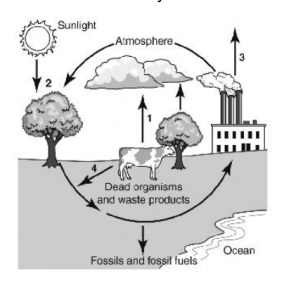
Increased blood flow allows for an increase in the exchange of O2 and CO2 at the site of the injury

24

Multiple Choice

What 2 systems: Absorb and deliver the digested nutrients to the cells

1

Digestive and muscular

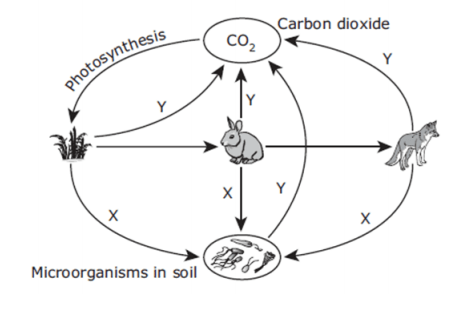
2

Muscular and lymphatic

3

Digestive and circulatory

4

Nervous and skeletal

25

media

26

Multiple Choice

10A Which four body systems interact to allow a person to sneeze?

1

Muscular, immune, nervous, respiratory

2

Nervous, respiratory, circulatory, skeletal

3

Respiratory, endocrine, skeletal, circulatory

4

Lymphatic, skeletal, respiratory, muscular

27

Multiple Choice

Which of the following correctly describes an interaction that occurs between two body systems of a rabbit that helps the rabbit outrun a pursuing coyote?

1

The skeletal system releases additional calcium, and the circulatory system retains more sodium in the blood to provide muscles with ions for contractions

2

The digestive system increases the rate of digestion, and the excretory system ceases to provide tissues with more nutrients

3

The respiratory system increases the breathing rate, and the circulatory system increases blood pressure to provide tissues with more oxygen

4

The endocrine system releases hormones that prepare the immune system to deal with possible injuries.

28

media

29

Multiple Choice

What 2 systems: Allow organs to contract and push food through

1

Muscular and Skeletal

2

Excretory and Muscular

3

Endocrine and Muscular

4

Muscular and Digestive

30

media

31

media

32

Multiple Choice

The two most important regulatory systems for the maintenance of homeostasis are:

1

Circulatory and nervous

2

Endocrine and circulatory

3

Lymphatic and circulatory

4

Nervous and endocrine

33

Multiple Choice

Question image

Pelicans prevent serious wing damage by entering the water in the manner shown. Which two organ systems in the pelican work together the most to accomplish this maneuver?

1

Circulatory and nervous systems

2

Nervous and muscular systems

3

Muscular and digestive sysems

4

Digestive and circulatory systems

34

media

35

media

36

Multiple Choice

Question image

10A A feedback mechanism in the human body is shown.

1

The nervous and reproductive systems work together to stimulate the production of insulin.

2

The circulatory and endocrine systems work together to keep blood sugar levels constant.

3

The excretory and nervous systems work together to convert glycogen into glucose.

4

The immune and circulatory systems work together to circulate blood through the pancreas.

37

Multiple Choice

What 2 systems: Controls the production of sex cells

1

Excretory and Reproductive

2

Endocrine and Reproductive

3

Endocrine and Muscular

4

Endocrine and Respiratory

38

media

39

Multiple Choice

Question image

10A The fuzzy millipede, Polyxenus fasciculatus, is found in Texas and is preyed upon by most species of ants. To protect itself against the ants, it ejects fibers from a tuft located at the tail end of its body. The tufts have hooks at the tips and barbs along their length that lock and interlink with the ant’s setae, small hairs that cover the body of the ant. When an ant attacks, the millipede flexes its back end toward the ant and wipes the tufts against it. As the ant attempts to remove the tufts, it entangles itself more, becoming immobilized.


Which two systems most directly interact in the fuzzy millipede’s defense against ants?

1

Muscular and integumentary

2

Immune and muscular

3

Integumentary and endocrine

4

Endocrine and immune

40

media

41

media

42

media

43

Multiple Choice

Question image

10A: This picture shows bean-shaped glands called nodes. The clusters of cells in nodes include macrophages that break down viruses and other potentially harmful materials. Nodes also contain cells that produce protein particles capable of capturing harmful materials that flow in tissue fluid through the nodes. Different parts of the body are drained by nodes in different regions of the body. Which body systems are directly responsible for regulating these nodes and protecting the body from harmful materials in tissue fluid?

1

Immune and lymphatic systems

2

Digestive and nervous systems

3

Endocrine and digestive systems

4

Circulatory and nervous systems

44

media

45

Multiple Choice

10A: The female reproductive and endocrine systems work interactively for which main purpose?

1

To maintain homeostasis by removing waste products from the body

2

To release neurotransmitters during times of stress

3

To control hormone levels to prepare the body for pregnancy

4

To exchange gases to support cellular aerobic respiration

46

Multiple Choice

Puberty begins when the hypothalamus signals the pituitary to release follicle-stimulating hormone (FSH) and luteinizing hormone (LH). During this process, which are the primary body systems that are interacting?

1

Immune, reproductive, and nervous

2

Circulatory, integumentary, and excretory

3

Reproductive, endocrine, and nervous

4

Excretory, reproductive, and endocrine

47

media

48

media

49

media

50

Multiple Choice

Question image
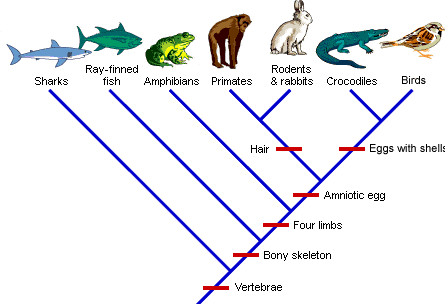
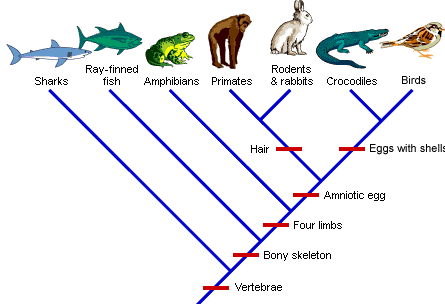
Which two orgainsms have hair? 
1

Sharks & Ray Finned Fish

2

Primates & Rodents

3

Birds & Crocodiles

4

Rabbits & Birds

51

media

52

Multiple Choice

Question image
According to this cladogram, sharks are MOST closely related to which organism? 
1

Amphibians

2

Ray finned fish

3

Crocodiles

4

Birds

53

Multiple Choice

Question image

8B The cladogram shows the evolution of land plants as indicated by fossil records.


Which discovery would challenge the validity of this cladogram?

1

A large aquatic vascular plant about 200 million years old

2

A species of algae that has existed for less than one million years

3

A moss species that has existed for less than 380 million years

4

A fossil of a fern more than 425 million years old

54

Multiple Choice

Question image

8B A cladogram is shown.


All the animals to the right of the hagfish would have the common characteristic of —

1

fur

2

claws or nails

3

lungs

4

jaws

55

Multiple Choice

Question image

7A This cladogram shows the evolutionary relationships among some mammals based on homologous structures.


Which statement is supported by this cladogram?

1

Hippopotamuses are more closely related to cows than to javelinas.

2

Toothed whales are more closely related to mouse deer than to hippopotamuses.

3

Javelinas and pigs are more closely related than baleen whales and toothed whales.

4

Cows and mouse deer are more closely related than javelinas and pigs

56

media

57

Multiple Choice

Question image
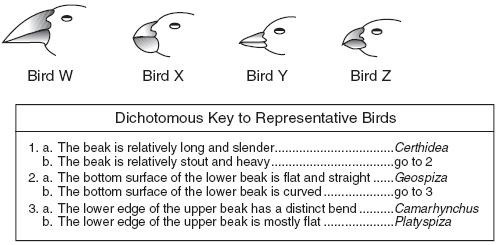
What is the name of bird W?
1

Certhidea

2

Geospiza

3

Camarhynchus

4

Platyspiza

58

Multiple Choice

Question image
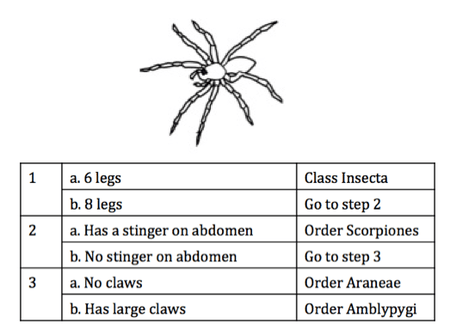
An illustration and a dichotomous key are given. What is the correct classification for this organism?
1

Class Insecta

2

Order Amblygygi

3

Order Araneae

4

Order Scorpiones

59

media

60

media

61

media

62

Multiple Choice

Question image

The smallest unit

of a compound consisting of two or more atoms

bonded together.

1

Organelle

2

Cell

3

Molecule

4

Atom

63

media

64

media

65

Multiple Choice

Question image

The basic building block of living things, made up of organelles.

1

Tissue

2

Organelle

3

Cell

4

Atom

66

media

67

Multiple Choice

10C Recent studies in bone research indicate that using ultrasound on a broken bone can decrease the healing time by 25%. Which of these are the most basic levels of organization involved when a bone heals?

1

Cells and tissue

2

Cells and organ system

3

Organ system and organism

4

Tissue and organ system

68

media

69

Multiple Choice

Question image

Group of tissues with similar functions.

1

Organelles

2

Cells

3

Tissues

4

Organs

70

media

71

Multiple Choice

10C The human body is composed of organ systems. Which list represents a system organized from least to most complex?

1

Heart, cardiac muscle, muscle tissue, muscle cell

2

Lung tissue, trachea, nostrils, circulatory system

3

Muscle cell, muscle tissue, biceps muscle, muscular system

4

Integumentary system, skin cell, hair, sweat glands

72

media

73

media

74

Multiple Choice

Question image

10C The diagrams show some of the levels of biological organization. In what order are the levels in the diagrams?

1

Population, community, ecosystem

2

Organism, community, population

3

Organism, population, community

4

Ecosystem, population, community

75

Multiple Choice

10C Which answer choice best describes a community

1

Praying mantises caring for their young

2

Three-spined sticklebacks living in estuaries

3

Different species of lizards occupying the same niche in a desert

4

Roosting mother bats recognizing their offspring

76

media

77

Multiple Choice

10C A science class is planning a field trip to a local farm that has a large pond. Which of the following lists the order of biological organization from smallest to largest that the students can expect to find at the pond?

1

Organism, community, population, ecosystem

2

Organism, population, community, ecosystem

3

Population, organism, community, ecosystem

4

Population, organism, ecosystem, community

78

media

79

Multiple Choice

Question image

A biological community that includes various species and their physical environment (Biotic and Abiotic Factors).

1

Organism

2

Community

3

Biosphere

4

Ecosystem

80

media

81

media

82

Multiple Choice

All living things share the same genetic code. This means they all share the same

1

same bases of DNA (ATCG) but in different order/sequence

2

same genome (exact same order/sequence of DNA bases)

83

Multiple Choice

Question image

The closest evolutionary relationship most likely exists between the

1

Human and the gorilla

2

Human and chimpanzee

3

Chimpanzee and gorilla

4

Horse and zebra

84

media

85

media

86

Multiple Choice

Question image

The similarities in the human arm and bat wing indicates that they

1

may share a common ancestor

2

are competitive with each other

3

eat the same food

4

are both birds

87

Multiple Choice

Question image

Which statement best represents the illustration?

1

All of the above animals are mammals.

2

All of the above share homologous structures.

3

All of the above structures show no evidence of relationship.

4

All of the above animals evolved in the same habitat.

88

media

89

media
media

Interactions Between

Organisms (Symbiosis)

90

media

91

media

92

Multiple Choice

The science of describing, classifying, and naming living things is called:

1

Geology

2

Biology

3

Taxonomy

4

Chemistry

93

Multiple Choice

A scientific name consists of 
1

Genus and Order

2

Genus and Domain

3

Genus and species

4

Kingdon and Phylum

94

media

95

Multiple Choice

8A Scientists around the world use a standardized taxonomic system. Why would scientists want to use a taxonomic system that is standardized?

1

In order to avoid confusion with the identification of organisms

2

Because Linnaeus established the system

3

So that Latin names can be applied for a practical purpose

4

In order to place organisms in different groups

96

media

97

media

98

Multiple Choice

Question image
The 8 levels of classification, most broad to most specific.
1

Domain, Genus, Family, Order, Class, Phylum, Kingdom, Species

2

Domain, Species, Kingdom, Genus, Phylum, Family, Class, Order

3

Domain, Kingdom, Phylum, Class, Order, Family, Genus, Species

4

Order, Kingdom, Species, Domain, Phylum, Family, Class, Genus

99

Multiple Choice

The most general in the order of classification is?
1

Kingdom 

2

Phylum 

3

Class 

4

Order

100

Multiple Choice

How many Domains are there?
Name them:
1

3; Archaea, Bacteria, Eukarya

2

2; Bacteria, Eukarya

3

1; Eukarya

4

3; Bacteria, Eukarya, Protists

101

media

102

media

103

media

104

Multiple Choice

Question image

8A: Organisms are classified today using the Linnaean system, and the following table shows the taxonomic classification of two marine organisms living along the Pacific Coast. Taxonomic classification is important to marine biologists because it provides a way to:

1

prove that marine evolution occurs

2

discover and name every marine organism on Earth

3

designate Latin as the universal language of marine biology

4

identify marine organisms and find evolutionary relationships between them

105

Multiple Choice

Question image

8B: A student used a microscope to study four members of the phylum Ciliophora. Members of this phylum move when propelled by hundreds of tiny cilia. Although these organisms belong to the same phylum, they are classified as different:

1

families

2

species

3

kingdoms

4

orders

106

Multiple Choice

8B Many tree frog populations are threatened due to habitat loss. In an effort to promote conservation, tree frogs may be bred in captivity. A zoo acquired male and female tree frogs from two different populations. In the zoo, the tree frogs were able to successfully mate within their own population, but breeding attempts between the two populations were unsuccessful.


Based on this information, which statement correctly describes the relationship between the two populations of tree frogs?

1

They are in the same species but different kingdoms.

2

They are in the same class but different phyla

3

They are in the same family but different orders

4

They are in the same genus but different species.

107

Multiple Choice

Question image

The diagram represents an example of what type of homology?

1

Vertebrate homology

2

Molecular homology

3

Biogeographical homology

4

Anatomical homology

108

media

Interactions Among Organisms

Species interactions within ecological webs

Five species interactions:

1.Competition

2.

Predation

3.

Symbiosis: mutualism

4.

Symbiosis: commensalism

5.

Symbiosis: parasitism

109

media

110

media
media

1. Competition

Multiple organisms of the same species or different species are fighting
for resources (water, food, habitat, mate)

111

media

112

media
media

2. Predation

One species (predator) feeds on and often kills another organism
(prey)

Predator-prey relationships include herbivores as well (they “kill”
plants for food

113

Multiple Choice

Question image

In a recent study, scientists investigated the effects of microorganisms naturally found in the body. They raised mice in two different environments and compared their immune system functions in response to a bacterial infection. Their data are shown. Which conclusion about the microorganisms naturally found in the body is most likely supported by these data?

1

All microorganisms are harmful to the body

2

Microorganisms are important in promoting healthy immune systems.

3

All bacteria in the body increase the effectiveness of the immune system.

4

Bacteria that cause infections decrease the number and variety of immune cells in the body.

114

media

Symbiosis (mutualism, commensalism, parasitism)

Organisms that have adapted to their environments together may
evolve together

Organisms make the best of their habitat by building a partnership
called symbiosis

Symbiosis translates to “living together” as it describes the
relationship between TWO species

Species in which at least one of them benefits

Three types of symbiotic relationships

Mutualism

Commensalism

Parasitism

115

Multiple Choice

Question image

The illustration above shows the structures of two unrelated species. Each have a similar function but are different in structure. This is an example of -

1

Vestigial structures

2

Cyclic Structures

3

Analogous Structures

4

Homologous Structures

116

Multiple Choice

How does Symbiosis occur?

1

Only between species.

2

Only between communities.

3

Between different species in a community.

4

Between different communities.

117

Multiple Choice

Microorganisms are known to be present in some food products such as yogurt. One student claims that microorganisms in food always have a negative effect on human health, while a second student disagrees. The second student claims that some microorganisms in food can have a positive effect on human health. Which statement BEST supports the second student's claim?

1

Microorganisms can destroy any pathogens that affect the immune system.

2

Microorganisms reproduce too slowly to affect the immune system,

3

Microorganisms known to be in food are no longer living and would not affect the digestive system.

4

Microorganisms can aid in the absorption

118

media
media
media

3. Symbiosis: Mutualism

Relationship in which two organisms both benefit from the actions
of the other

Example: Bees pollinating flowers, clownfish and sea anemones

119

media

120

Multiple Select

Question image

12A: Four common relationships between organisms are listed in the box. Which statements best describe a mutualistic relationship?Select all that apply.

1

Example 1

2

Example 2

3

Example 3

4

Example 4

121

Multiple Choice

11A Which role of protists has the most positive effect on maintaining the plant population in an ecosystem?

1

Protists are a major food source for animals.

2

Protists produce approximately 75 percent of the oxygen on Earth

3

Protists decompose dead materials, returning nutrients to the soil.

4

Protists found in the gut of animals assist in digestion.

122

media
media
media

4. Symbiosis: Commensalism

Relationship in which one organism benefits and the other is
unaffected

Example: small fish swimming along sharks (eating leftovers) and
egret birds sitting on cattle (birds eat insects flying around cattle)

123

Multiple Choice

___________________ structures are structures found in an organism that serve no known function.

1

convergent

2

embryonic

3

verstigial

4

homologous

124

media

125

Open Ended

11A: A student researching bacteria concluded a report with the following claim: All bacteria disrupt the health of organisms they inhabit, including humans.

Is this claim valid or invalid? AND what makes the claim valid or invalid.

126

Multiple Choice

A relationship between two organisms in which one organism benefits and the other is unaffected...

1

Mutualism 

2

Competition

3

Parasitsm 

4

Commensalism 

127

Multiple Choice

Question image

The possibility that these bones were once useful gives support to

1

artificial reproduction

2

the theory of evolution

3

the process of fossil formation

4

concept of regeneration

128

Drag and Drop

Question image
12A: A remora is a fish that has an adhesive disk on the back of its head that it uses to attach itself to a large shark. When food floats away from the shark's mouth as it feeds, the remora collects the scraps. Drawings of shark with a remora attached and the remora's adhesive disk are shown. The relationship between the remora and the shark is an example of:


Drag these tiles and drop them in the correct blank above
Commensalism
Predation
Parasitism
Competition

129

Multiple Choice

12A: Which of these best demonstrates mutualism between certain types of bacteria and humans?

1

Intestinal bacteria obtain nutrients from the gut and produce vitamin K used by humans

2

Bacteria become resistant to antibacterial medication that humans use for treatment

3

Invasive bacteria at an area of injury produce toxins that damage healthy tissues of the human body

4

Bacteria in improperly prepared food is consumed by humans, causing food poisoning

130

Multiple Choice

12A Parrotfish are herbivores that are found in coral reefs. To escape predation, a parrotfish will graze with a rabbitfish, which has venomous spines at the end of its pelvic fins. The rabbitfish does not benefit from this relationship. Which type of relationship do the parrotfish and the rabbitfish have in the coral-reef environment?

1

Commensalism

2

Mutualism

3

Predator-prey

4

Parasitic

131

media

132

media
media
media

3. Symbiosis: Parasitism

Relationship in which one organism benefits (the parasite) while the
other is harmed

Example: Tick and dog, parasites

133

Multiple Choice

11A: Saprophytes are fungi that feed on dead and decomposing organisms. They secrete enzymes that digest components of cell walls, such as cellulose and lignin. Which statement explains why these fungi are an important part of the biogeochemical cycle?

1

Saprophytes perform gas exchange that assists the cellular activities of autotrophs

2

Saprophytes extract minerals from living tissue to recycle them back to the soil

3

Saprophytes transport nutrients through the xylem and phloem in autotrophs

4

Saprophytes return organic material to the soil for use by living organisms

134

Multiple Choice

Which symbols best describe parasitism?
1

+,+

2

+,-

3

+,0

4

-,0

135

Multiple Choice

Question image

The similarities in embryonic development shown in the diagrams suggest that these organisms -

1

develop the same exact way

2

may have evolved from the same common ancestor

3

are all the same species

4

have the same adaptations as adults

136

Multiple Choice

12A Bats eat insects that damage crops and mosquitoes that are vectors for disease. One million bats can eat several tons of insects per night, saving billions of dollars in pesticides yearly. Agricultural and public health scientists are concerned about the spread of white-nose syndrome (WNS). WNS is a result of a fungus that can infect cave-dwelling bats. While bats hibernate during winter months, the fungus covers the bats’ face and wings. WNS has a near 100% mortality rate, and 5.7 million bats have died since the discovery of the fungus in 2006. Many scientists are searching for ways to protect these bats. The relationship between this fungus and bats can best be defined as —

1

commensal, because the bats provide a surface for the fungus to grow

2

parasitic, because the fungus obtains nutrients and shelter from the bats

3

competitive, because both organisms use caves as shelter during the winter

4

mutualistic, because the relationship involves two distinct species living together

137

Multiple Choice

Question image

11A Health professionals sometimes recommend nutritional supplements that contain a variety of species of bacteria to promote good digestive health. The product label for one of these supplements is shown.


Why does this type of bacteria-filled supplement benefit human health instead of causing illness?

1

Stomach acids and digestive enzymes kill the bacteria in this type of supplement, protecting the person against future infections by live organisms.

2

The human digestive system contains billions of beneficial bacteria that enhance digestion and nutrient absorption, synthesize vitamins, and help limit the growth of harmful bacteria.

3

These species of bacteria remove all the other species of microorganisms living in the human digestive system and ensure that no microorganisms survive to contaminate the body.

4

These bacteria are able to deactivate viruses that may inhabit the human digestive system and are used to protect against further viral infections

138

media
media
media
media

Symbiotic Relationships Summary

Relationship in which two
organisms both benefit from
the actions of the other

Relationship in which one
organism benefits (the parasite)
while the other is harmed

Relationship in which one
organism benefits and the
other is unaffected

1. Mutualism

3. Parasitism

2. Commensalism

139

media

140

Open Ended

Question image

12A The ocean sunfish (Mola mola) is a large, flat fish that spends most of its time in deep water feeding mainly on jellyfish. Sunfish often have many species of copepods, small crustaceans, that bury their heads into the soft tissue of the sunfish. Sunfish will swim to the surface of the water and lie sideways, allowing seabirds to eat the copepods from their skin

Describe the relationship of the sunfish and each of the other organisms (jellyfish, copepods, seabirds)

141

Multiple Choice

11A: A student researching bacteria concluded a report with the following claim: All bacteria disrupt the health of organisms they inhabit, including humans.


Which statement correctly addresses the validity of the claim?

1

The claim is valid because many studies and experiments have shown that bacteria disrupt homeostasis

2

The claim is invalid because there are many types of bacteria that help organisms maintain homeostasis.

3

The claim is invalid because only microorganisms such as viruses disrupt the health of organisms.

4

The claim is valid because bacteria cause disease

142

Match

Question image

12A In any environment or ecosystem, organisms can have several different types of relationships. Three types of relationships are described.


Which of these correctly describes the relationships between the organisms?

Commensalism

Parasitism

Mutualism

Relationship X

Relationship Y

Relationship Z

143

media

144

Multiple Choice

Question image

12 A Some relationships between different organisms are shown in the table.


Which table correctly identifies each type of interaction described?

1
2
3
4

145

media

146

Multiple Choice

11B During secondary succession, which of these best describes why decomposing pioneer plants give way to larger, more complex plants species, such as hardwood trees?

1

Increased amounts of sunlight are able to reach the ground while the pioneer species are decomposing.

2

Increased soil temperatures from decomposing pioneer species help tree seeds germinate more quickly.

3

Increased amounts of decomposing pioneer species remove nutrients that tree seedlings need to grow and mature.

4

Increased amounts of soil from decomposing pioneer species allow plants with more extensive root systems to become established.

147

Multiple Choice

Question image

The diagram below represents a section of undisturbed sedimentary rock. The

general location of fossils of several closely related species is indicated. According to recently adapted evolutionary theory, which is the most probable

correct assumption to be made concerning species A, B, C, and D?

1

B was already extinct when C evolved.

2

C evolved more recently that A, B, and D.

3

D is the ancestor of A, B, and C.

4

A is the ancestor of C and D.

148

Multiple Choice

Question image

12A The diagrams show a partial food web containing the Glyptapanteles wasp and the life cycle of this wasp.

1

• Competition: stinkbugs

• Parasitism: geometrid moths

2

• Competition: geometrid moths

• Commensalism: stinkbugs

• Mutualism: guava and eucalyptus trees

3

• Competition: stinkbugs and geometrid moths

• Commensalism: guava and eucalyptus trees

4

• Parasitism: geometrid moths

• Commensalism: stinkbugs

• Mutualism: guava and eucalyptus trees

149

Multiple Choice

Question image

12A In any environment or ecosystem, organisms can have several different types of relationships. Three types of relationships are described.


Which of these correctly describes the relationships between the organisms?

1

X: mutualism

Y: parasitism

Z: commensalism

2

X: commensalism

Y: mutualism

Z: parasitism

3

X: parasitism

Y: commensalism

Z: mutualism

4

X: commensalism

Y: parasitism

Z: mutualism

150

media

151

Multiple Choice

Question image

12 A Some relationships between different organisms are shown in the table.


Which table correctly identifies each type of interaction described?

1
2
3
4

152

media

153

Multiple Choice

Question image

12A: Four common relationships between organisms are listed in the box. Which statements best describe these relationships?

1

Relationships 1 and 4 are examples of mutualism

Relationship 2 is an example of commensalism

Relationship 3 is an example of parasitism

2

Relationships 1 and 2 are examples of commensalism

Relationships 3 and 4 are examples of mutualism

3

Relationships 1 is an example of commensalism

Relationships 2 and 4 are examples of mutualism

Relationships 3 is an example of predation

4

Relationships 1, 2, and 4 are examples of mutualism

Relationships 3 is an example of parasitism

154

media

155

Multiple Choice

12A Bats eat insects that damage crops and mosquitoes that are vectors for disease. One million bats can eat several tons of insects per night, saving billions of dollars in pesticides yearly. Agricultural and public health scientists are concerned about the spread of white-nose syndrome (WNS). WNS is a result of a fungus that can infect cave-dwelling bats. While bats hibernate during winter months, the fungus covers the bats’ face and wings. WNS has a near 100% mortality rate, and 5.7 million bats have died since the discovery of the fungus in 2006. Many scientists are searching for ways to protect these bats. The relationship between this fungus and bats can best be defined as —

1

commensal, because the bats provide a surface for the fungus to grow

2

parasitic, because the fungus obtains nutrients and shelter from the bats

3

competitive, because both organisms use caves as shelter during the winter

4

mutualistic, because the relationship involves two distinct species living together

156

Multiple Choice

Which factor may have played a role in the development of the polar bear in Alaska and the brown bear in Russia into separate species?

1

geographic isolation

2

temporal isolation

3

artificial selection

4

behavioral isolation

157

Multiple Choice

12A Parrotfish are herbivores that are found in coral reefs. To escape predation, a parrotfish will graze with a rabbitfish, which has venomous spines at the end of its pelvic fins. The rabbitfish does not benefit from this relationship. Which type of relationship do the parrotfish and the rabbitfish have in the coral-reef environment?

1

Commensalism

2

Mutualism

3

Predator-prey

4

Parasitic

158

media

159

media

160

Multiple Choice

The fossils of an extinct amphibian can be found in South America, Africa, and Australia. Which of the following statements best describes this occurrence?

1

These continents were once next to one another before the process of continental drift separated them.

2

Underwater tunnels once connected these continents.

3

Ancient amphibians were able to swim long distances and cross oceans that separated the continents.

4

The same amphibians evolved separated in three different areas of the world.

161

media

162

media

163

Multiple Choice

Which of the following best explains how natural selection occurs?

1

Individuals acquire traits during their lives that they pass on to offspring.

2

Only individuals with adaptive traits want to reproduce and pass their traits to offspring.

3

Traits are genetically based, and individuals with adaptive traits are more likely to survive and pass on their traits to offspring.

4

When organisms reproduce, they pass along only their most useful traits to offspring.

164

Open Ended

Write the following sentence below.


Genetic diversity increases the chance for beneficial traits in a population to be selected for by nature, which will also increase the survival of that population. Genetic variety is always good.

165

Multiple Choice

What is the survival value of a fish or frog species that lays hundreds of eggs each time it reproduces compared to a species which lays only a single egg?

1

More eggs laid increases the likelihood that more males will be attracted to the eggs for fertilization.

2

Single-egged laying species are generally more reproductively efficient and do not need to lay multiple eggs.

3

More eggs laid increases the likelihood that more offspring will survive predation or failed fertilization.

4

There is no survival value for the species, only for the individual.

166

Multiple Choice

Cacti grow slowly compared to most other plants. The fact that cacti keep their stomata closed for much of the day can help explain this growth characteristic. Which of these best explains the advantage of keeping stomata closed during the day?

1

It limits water loss through transpiration.

2

It conserves oxygen produced in photosynthesis.

3

It recycles carbon dioxide within plant systems.

4

It protects plant tissues from predators

167

Multiple Choice

Some mesquite trees have deeper roots than any other plant in the desert. How are deep roots an adaptation for survival in the desert?

1

Deep roots can protect the tree from predators.

2

Roots encounter cooler conditions far below the desert surface.

3

Roots can extend great distances to reach water.

4

Deep roots interact with beneficial bacteria below the surface.

168

Multiple Choice

Question image

The diagram above illustrates the change that occurred in a bug population over 10 years, a probable explanation for this change would be that over time there was –

1

A decrease in the ability of gene “a” to adapt

2

An increase in the ability of gene “a” to adapt

3

An increase in the population of the insect

4

A decrease in the mutation rate of gene “A”

169

Multiple Choice

The long-term survival of any species of organism of organism is possible only if the organisms can -

1

migrate when temperatures change

2

reproduce successfully

3

find protection from predators

4

locate a constant food source

170

Multiple Choice

Why might a species of finch have a slightly shorter beak that its ancestors’ beaks?

1

The ancestor finches had a viral fungi that eroded the keratin of the beaks to the size they are today.

2

The shorter-beaked finches had a feeding advantage that became more successful over time.

3

The shorter-beaked finches had beaks that were worn down from overuse.

4

The shorter beaked finches resulted from a finch mating with a different species.

171

Multiple Choice

According to fossil records, the horses that lived 50 million years ago were much smaller, weaker, and slower than modern horses. Which process is most likely responsible for the changes that have led to the increased size, strength, and speed in horses?

1

commensalism

2

inbreeding

3

migrating

4

natural selection

172

Multiple Choice

Question image

The diagram above shows the effect of spraying a pesticide on a population of insects over three generations. Which concept is represented in the diagram?

1

survival of the fittest

2

dynamic equilibrium

3

succession

4

extinction

173

Multiple Choice

Question image

Certain insects resemble the twigs of trees. Based on modern evolutionary theory, the most probable explanation for this is that -

1

A mutation that caused the resemblance.

2

The insects ate the wood

3

Genes were transferred from the trees to the insects.

4

Predators began eating insects that looked like twigs

174

media

175

media

176

Multiple Choice

A small spider mite species has populations on several islands in the South Pacific. They live inside coconuts and exclusively eat smaller insects on the outer husk of the coconuts. During heavy storms, coconuts containing the spider mites can be carried from one island to another where the mites successfully breed with members of the same species on the new island. This is an example of –

1

Genetic drift (small populations)

2

Mutation

3

Gene flow

4

Non-random mating

177

Multiple Choice

Question image

Female birds of paradise choose males that have long, brightly colored feathers because they tend to be healthy and will lead to healthy offspring. This is an example of

1

Gene flow

2

Non-random mating

3

Mutation

4

Genetic Drift

178

Multiple Choice

What kingdom's organisms often live in super harsh environments?
1

archea

2

animalia

3

plantae

4

protista

179

Multiple Choice

8B Many tree frog populations are threatened due to habitat loss. In an effort to promote conservation, tree frogs may be bred in captivity. A zoo acquired male and female tree frogs from two different populations. In the zoo, the tree frogs were able to successfully mate within their own population, but breeding attempts between the two populations were unsuccessful.


Based on this information, which statement correctly describes the relationship between the two populations of tree frogs?

1

They are in the same species but different kingdoms.

2

They are in the same class but different phyla

3

They are in the same family but different orders

4

They are in the same genus but different species.

180

media

181

media

182

media

183

Multiple Choice

What is formed during primary succession that doesn't need to be formed during secondary succession?
1

pioneer species

2

soil

3

climax community

4

lichens

184

Multiple Choice

Question image
What type of succession is shown going from figure A to figure B?
1

primary succession

2

eutrophication

3

secondary succession

4

intermediate

185

Multiple Choice

Question image
After a forest fire, an ecosystem would start regrowth through -
1

primary succession

2

secondary succession

3

climax community

4

limiting factors

186

Multiple Choice

Which catastrophic event will most likely have the effect of returning an ecosystem to primary succession?
1

A tornado

2

A volcanic eruption

3

A flood

4

A drought

187

Multiple Choice

11B During ecological succession, how does the growth of young hardwoods affect the organisms living in an ecosystem?

1

Grasses and low shrubs are unable to obtain the amount of light they need to survive, so there are small numbers of them.

2

The trees provide shelter and food for a variety of mammals, insects, and birds.

3

In autumn, falling leaves provide a source of energy for decomposers such as fungi.

4

All of the above

188

Multiple Choice

11B How do an increase in the organic matter in soil and an increase in soil depth affect the population of plants in an area?

1

Larger plants become the dominant organisms.

2

Mosses replace flowering plants.

3

Nitrogen-fixing bacteria kill young trees

4

Grasses become diseased.

189

Multiple Choice

11B During secondary succession, which of these best describes why decomposing pioneer plants give way to larger, more complex plants species, such as hardwood trees?

1

Increased amounts of sunlight are able to reach the ground while the pioneer species are decomposing.

2

Increased soil temperatures from decomposing pioneer species help tree seeds germinate more quickly.

3

Increased amounts of decomposing pioneer species remove nutrients that tree seedlings need to grow and mature.

4

Increased amounts of soil from decomposing pioneer species allow plants with more extensive root systems to become established.

190

Multiple Choice

Question image

A student goes on a hike over the weekend. The student notices that the path created by all the hikers is compressed dirt with little plant life. The trail is shown in the image. Which table BEST describes the stage of succession occurring on the trail?

1
2
3
4

191

media

12D: Carbon and Nitrogen Cycles

192

media
media

The carbon cycle is critical to ecosystems as it is part of the food chain.

All living things are made of carbon and it is recycled in various ways in an
environment

193

media
media

1.

Plants remove carbon dioxide (CO2) from the atmosphere during
photosynthesis

1

194

Multiple Choice

Which of the following removes carbon from the atmosphere?
1

Combustion

2

Respiration

3

Photosynthesis

4

Death

195

media
media

2. Animals eat plants, releasing carbon dioxide (cellular respiration) into the atmosphere and the water when
they exhale

Plants do cellular respiration too!!!!; release carbon dioxide back into the atmosphere.

1

2

196

Multiple Choice

Question image
What is happening at 1?
1

respiration: releasing CO2

2

decomposing CO2 in the soil

3

photosynthesis: absorbing CO2

4

turning CO2 from the atmosphere into organic molecules

197

media
media
media

3. When an living organisms die their bodies decompose and release carbon dioxide
into the atmosphere (due to bacteria and fungi in soil)

3 #

198

Multiple Choice

Question image
The diagram shows the flow of organic molecules through an ecosystem. What two processes are identified by the labels X and Y?
1

X : Respiration Y : Predation

2

X : Adaptation Y : Decomposition

3

X : Fermentation Y : Nitrogen Fixation

4

X : Decomposition Y : Respiration

199

media
media

4. Dead organisms that did not decompose over time become fossil fuels, which then are
used to power factories (combustion), releasing carbon dioxide back into the atmosphere

3

4

200

Multiple Choice

What process occurs when coal (fossil fuel) is used for energy?
1

Decomposition

2

Combustion

3

Pressurization 

4

Respiration 

201

media
media

1.

Plants take up carbon dioxide through photosynthesis

2.

Plants and animals release carbon dioxide through cellular respiration

3.

Dead organisms decompose (help from bacteria and fungi), releasing carbon dioxide

4.

Dead organisms over time become fossil fuels, used as fuel to power factories
(combustion) which releases carbon dioxide (combustion)

202

Multiple Choice

What does NOT produce carbon dioxide?
1

Photosynthesis

2

Burning Fossil Fuels

3

Animal respiration

4

Plants decaying

203

Multiple Choice

Question image

12D: This diagram demonstrates why the ocean is a large carbon sink. An increase in the amount of carbon dioxide in the atmosphere can cause atmospheric temperatures to increase. Which statement explains how this could affect the ocean as a carbon sink?

1

Less atmospheric carbon dioxide would be available to phytoplankton

2

Dissolved carbon dioxide gas in the ocean would increase because surface winds would cause a deeper circulation pattern, making more room for gas

3

Less carbon dioxide gas would be contained in the ocean because increasing precipitation would dilute the carbon entering the ocean

4

Less carbon dioxide would be dissolved in the ocean because increasing atmospheric temperatures would cause ocean temperatures to increase

204

Open Ended

12D What would be the most likely effect of a wildfire that burned a large area of a forest? AND what cycle would it affect the most?

205

media

The Nitrogen Cycle

Nitrogen is an important element in ecosystems. It makes up almost 80% of
earth's air and is needed by organisms to make amino acids

Atmospheric nitrogen cannot be used by living things, so it must be changed by
BACTERIA into usable forms

206

Multiple Select

Question image

Living organisms need nitrogen to make: Select all that apply.

1

food

2

sugar/phosphate backbone

3

Proteins

4

DNA bases

5

Amino acids

207

media
media

208

Multiple Choice

What converts nitrogen into a useable form for plants and animals?
1

bacteria

2

fungi

3

rain

209

media
media

Chemical Symbols

NH₃- ammonia gas

NO₂- nitrogen dioxide

NH₄- ammonium ( a salt)

NO₃- nitrate ion

N₂- nitrogen gas

210

media
media

Nitrogen Fixation

Atmospheric nitrogen (N₂) is
changed into ammonium gas
(NH₃) by bacteria (nitrogen
fixing bacteria)

Lighting also changes N₂ into
NH₃

211

Multiple Choice

When nitrogen gas is turned in to a form that plants and animals can use is called 
1

Combustion

2

Photosynthesis

3

Decomposition

4

Nitrogen Fixation

212

media
media

Ammonification

Organic nitrogen from
dead plants and animals
changed into ammonium
(NH₄) by bacteria and
fungi

213

media
media

Nitrification

Amonnina (NH₃) gets
converted to nitrite ( NO₃)
by nitrifying bacteria

(amonnina gets created
from organic nitrogen that is
released by decomposing
dead organisms)

214

media
media

Assimilation

Plants absorbing NO₃ to
use

Animals get the nitrogen
(amino acids) they need
by eating plants

215

Multiple Choice

12D: As part of the nitrogen cycle, animals acquire some amino acids by doing which of the following?

1

Breathing air

2

Eating plants

3

Drinking water

4

Producing waste

216

media
media

Denitrification

Organic nitrogen (is changed to
atmospheric nitrogen (N₂) by
bacteria

217

Multiple Choice

12D: Atmospheric nitrogen has to be combined with other elements, or fixed, in order to be used by plants. Lightning is one way that nitrogen is fixed. When lightning occurs, the extreme heat breaks the bonds in nitrogen molecules, allowing nitrogen to combine with oxygen and from nitrogen oxides. In what way is most of the nitrogen fixed by lightning made available for use by plants?

1

It is moved by the wind toward dry areas

2

It is incorporated into the exoskeletons of flying insects that eat plants

3

It is inhaled and exhaled by birds roosting in trees during rainstorms

4

It is carried by rain to the soil.

218

media
media

The Nitrogen Cycle

Nitrogen fixation-Atmospheric nitrogen
(N₂) is changed into NH₃ by bacteria

Ammonification- Organic nitrogen from
dead plants and animals changed into
ammonium (NH₄) by bacteria and fungi

Nitrification- NH₃ get converted by
bacteria into NO₃

Assimilation- Plants absorb NO₃ to use
(animals get nitrogen by eating plants)

Denitrification- Organic nitrogen (is
changed to atmospheric nitrogen (N₂) by
bacteria

219

Multiple Choice

Question image

12D The diagram represents the nitrogen cycle in a student’s aquarium. Ammonia, nitrites, and, to a lesser degree, nitrates can be harmful to fish. The student wants to keep the nitrogen in this aquarium cycling normally without having to continually change the water.


Which of the following should the student add more of to help remove nitrates and improve the natural cycling of nitrogen in this aquarium?

1

Fish

2

Plants

3

Nitrobacter

4

Water

media

Plants

Non-Vascular
Vascular

Bryophytes,Horn
worts, liverworts,
mossess

Vascular
ferns

Pinetrees,
Cycads,
Gingkos

Gymnosperms

Flowering
plants

Vascular

Angiosperms

Show answer

Auto Play

Slide 1 / 219

SLIDE