Search Header Logo
Phy Y11 C22 C23 IGCSE Atom Model Radioactivity Nuclear Reaction

Phy Y11 C22 C23 IGCSE Atom Model Radioactivity Nuclear Reaction

Assessment

Presentation

Physics

9th - 12th Grade

Medium

NGSS
HS-PS1-8, HS-PS3-3, HS-ESS3-4

Standards-aligned

Created by

Kewin Aljoe

Used 7+ times

FREE Resource

41 Slides • 105 Questions

1

Atom Model
radioactivity

Nuclear Decay

media
media

2

3

J.J. Thomson (1897 / England)


Known For: electrons were smaller particles of an atom and were negatively charged.

Experiment:
Cathode Ray Tube Experiment

Visual Representation

media
media

4

5

Ernest Rutherford (1911 / England)


Known For: Protons (positive charged) and atoms were mostly empty space

Experiment:
Gold Foil Experiment

Visual Representation

media
media
media

6

Vocabulary

Alpha particles (a)

are composite particles consisting of two protons and two neutrons tightly bound together

7

8

Multiple Select

Rutherford's experiment providing evidence that:

1

a very small nucleus surrounded by mostly empty space

2

a nucleus containing most of the mass of the atom

3

a nucleus that is positively charged

4

a very small nucleus surrounded by electrons

9

Niels Bohr (1913 / England)


Known For: Energy levels of electrons
Electrons can jump across energy levels

Experiment:
Emissions Spectrum (color of light)

Visual Representation
"Planetary model"

media
media

10

11

Erwin Schrödinger (1926 / Austria)


A.K.A.: Modern Model of the Atom

Known For: Quantum mechanics

electrons can only exist in specified energy states

Experiment:
mathematical equations

Visual Representation
"Electron Cloud model"

media

12

James Chadwick (1932 / England)


Known For: Discovered neutrons

neutral particles in the nucleus of an atom

Experiment:
mathematical equations (atom was too heavy with just protons)

Visual Representation
"Quantum model"

media
media

13

Summary of what is known about the current model of the atom:

​Subatomic Particles

​Symbol

​Relative charge

​Relative mass (amu)

​Actual mass

​electrons

​e

-1

​1/1840

​9.11 X 10

​protons

​p

​+1

​1

​1.67 X 10

​neutrons

o

0

​1

​1.67 X 10

14

Nuclide notation is a way of showing the atomic number and mass of an atom.

We can use the nuclide notation to work out the number of protons neutrons and electrons.​

N

7

14

Mass number

Atomic Number

15

media

16

Explanation Slide...

The proton number, also known as the atomic number, indicates the number of protons in a nucleus. For this nuclide, the correct proton number is 10, which corresponds to the element neon.

17

Multiple Choice

Question image

What is the proton number of a nucleus of this nuclide?

1

10

2

12

3

22

4

32

18

Explanation Slide...

A neutral atom of radium-226 has 88 electrons, which equals its atomic number. The atomic number indicates the number of protons and, in a neutral atom, the number of electrons is equal to the number of protons.

19

Multiple Choice

Question image

How many electrons orbit the nucleus of a neutral atom of radium-226?

1

0

2

88

3

138

4

226

20

Multiple Choice

Positive ion formed by

1

gaining proton (s)

2

losing proton (s)

3

gaining electron (s)

4

losing electron (s)

21

Multiple Choice

Negaitive ion formed by

1

gaining proton(s)

2

losing proton(s)

3

gaining electron(s)

4

losing electron(s)

22

Multiple Select

nucleon consist of

1

proton

2

electron

3

neutron

4

nucleus

23

Multiple Choice

Question image

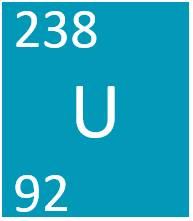
The diagram shows nuclide notation for Uranium. What is the number of electron in the Uranium?

1

92

2

146

3

238

4

330

24

Multiple Choice

Question image

The diagram shows nuclide notation for Uranium. What is the number of neutron in the Uranium?

1

92

2

146

3

238

4

330

25

Multiple Choice

the relative charge on a nucleus equal to number of

1

proton

2

electron

3

neutron

4

nucleon

26

Multiple Choice

the relative mass of a nucleus equal to number of

1

proton

2

electron

3

neutron

4

nucleon

27

Multiple Choice

"Nuclide of an element with same proton number but different mass number".

This is definition for

1

nucleon

2

nuclide

3

isotope

4

mass

28

media

29

Nuclear fission 

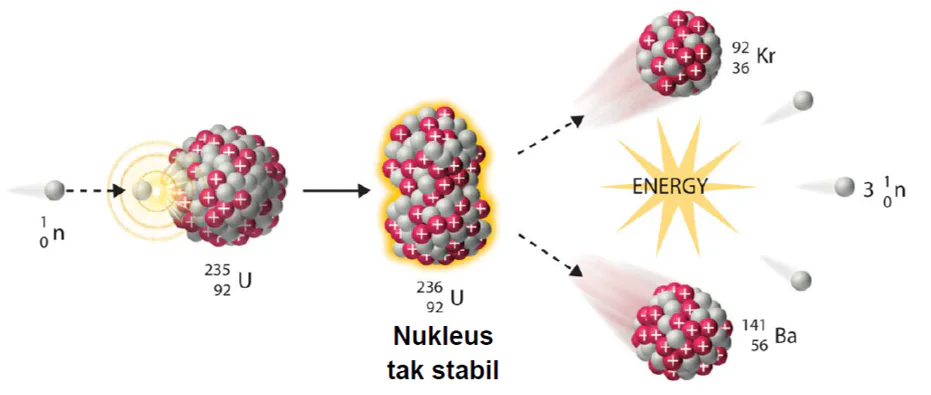
Nuclear fission is the splitting of a large atomic nucleus into smaller nuclei.

In a nuclear reactor , a neutron is absorbed into a nucleus (typically uranium-235@PLUTONIUM).

This causes the nucleus to become uranium-236, which is violently unstable.

The entire nucleus splits into two large fragments called 'daughter nuclei '. (Krypton and Barium)

media

30

media

31

FUSION

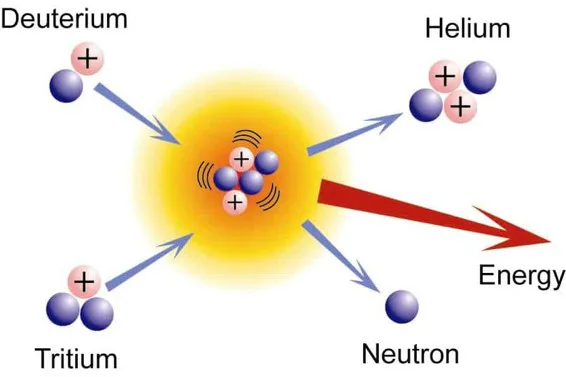
  • What we see as light and feel as warmth is the result of a fusion reaction in the core of our Sun: hydrogen nuclei collide, fuse into heavier helium atoms and release tremendous amounts of energy in the process.

media

32

DIFFERENT NUCLEAR FISSION AND FUSSION.

Nuclear fission and fusion involve the disintegration and combination of the elemental nucleus.


 In the case of nuclear fission, an atom divides into two or smaller or lighter atoms.


Nuclear fusion occurs when two or more atoms join or fuse together to form a large or heavy atom.

33

Multiple Choice

Question image

The diagram shows process of

1

radiation

2

nuclear fission

3

nuclear fusion

4

nuclear energy

34

Multiple Choice

Question image

The diagram shows process of

1

radiation

2

nuclear fission

3

nuclear fusion

4

nuclear energy

35

Multiple Choice

Nuclear ______ splits into neutron and then into smaller nuclei

1

Fission

2

Fusion

36

Multiple Choice

nuclear _______ is where two small nuclei collide.

1

fission

2

fusion

37

Multiple Choice

nuclear _______ has a much greater release of energy

1

fission

2

fusion

38

Multiple Choice

A hydrogen bomb relies on nuclear ______

1

fission

2

fusion

39

Multiple Choice

Nuclear ______ emitted alpha particles

1

fission

2

fusion

40

Multiple Choice

Which come first nuclear fission or Nuclear Fusion

1

fission

2

fusion

41

Multiple Choice

nuclear _____ have nuclei that are not stable and undergo subsequent radioactive decays.

1

fission

2

fusion

42

Multiple Choice

nuclear ______ can only occur with conditions that have extreme high pressures and temperatures.

1

fission

2

fusion

43

Multiple Choice

The sunshine we enjoy every day comes from nuclear _____

1

fission

2

fusion

44

Multiple Choice

Nuclear ______ process uses large atoms, such as Polonium?

1

fission

2

fusion

45

Multiple Choice

Nuclear power uses ____ for fuel.
1
steel
2
coal
3
uranium
4
hydrogen

46

Multiple Choice

The splitting of a nucleus into smaller nuclei is
1
fusion
2
fission
3
decay
4
gamma radiation

47

Multiple Choice

What is a chain reaction?
1
When electrons are emitted causing electricity
2
When a nuclear fission reaction occurs, the protons emitted can strike other nuclei in the sample, and cause them to split
3
When a nuclear fission reaction occurs, the neutrons emitted can strike other nuclei in the sample, and cause them to split
4
When a nuclear fission reaction occurs, the electrons emitted can strike other nuclei in the sample, and cause them to split

48

Multiple Choice

What do  control rods do in a nuclear reactor?
1
Regulate the rate of reaction  by absorbing and slowing neutrons
2
Produce electricity
3
Produce neutrons to increase the rate of reaction
4
Reduce heat produced by the uranium rods

49

Multiple Choice

Nuclear energy uses _____ to turn turbines to power a generator.
1
wind
2
water
3
steam
4
solar

50

Multiple Choice

One disadvantage of nuclear energy is ___.
1
it is a fossil fuel
2
it leaves behind radioactive waste
3
it emits large amounts of pollution into the atmosphere
4
there are no disadvantages

51

Multiple Choice

Isotopes of the same element have different ____________. 
1
 numbers of protons  
2
numbers of electrons
3
 symbols 
4
numbers of neutrons

52

53

54

media

55

Multiple Choice

Question image

In order of most to least penetrating radiation we have
1

Alpha , Beta,  Gamma

2

Beta , Gamma , Alpha

3

Gamma, Beta, Alpha

4

Gamma, Alpha, Beta

56

media

57

58

Multiple Choice

Which type of radiation is the most ionising?
1

alpha

2

beta

3

gamma

59

Multiple Choice

Which type of radiation is the least ionising?
1

alpha

2

beta

3

gamma

60

Multiple Choice

Question image
What type of radiation can be stopped by a piece of paper?
1

Alpha radiation

2

Beta radiation

3

Gamma radiation

61

Multiple Choice

Question image
What type of radiation can be stopped by a thick lead sheet?
1

Alpha radiation

2

Beta radiation

3

gamma radiation

62

Multiple Choice

This type of electromagnetic wave has the most energy and therefore can be very dangerous.

1

Microwaves

2

Radio Waves

3

X Rays

4

Gamma Rays

63

64

65

Multiple Choice

Question image

What does Z represent?

1

Atomic Mass (protons + neutrons)

2

Atomic Number (protons)

3

Charge (protons - electrons)

4

Element Symbol

66

Multiple Choice

Question image

What does X represent?

1

Atomic Mass (protons + neutrons)

2

Atomic Number (protons)

3

Charge (protons - electrons)

4

Element Symbol

67

Multiple Choice

Question image

What does A represent?

1

Atomic Mass (protons + neutrons)

2

Atomic Number (protons)

3

Charge (protons - electrons)

4

Element Symbol

68

Multiple Choice

Question image

What type of radiation is this?

1

Alpha

2

Beta

3

Gamma

69

Multiple Choice

Question image

What type of radiation is this?

1

Alpha

2

Beta

3

Gamma

70

Multiple Choice

Question image

What type of radiation is this?

1

Alpha

2

Beta

3

Gamma

71

72

Multiple Choice

Which particle has a negative charge

1

Alpha

2

Electron

3

Proton

4

Neutron

73

Multiple Choice

When nuclei decay, massive amounts of __________ is released.

1

energy

2

electrons

3

protons

4

neutrons

74

media

75

Multiple Choice

Question image
Different isotopes have...
1
different masses
2
different atomic numbers
3
different electrons
4
different protons

76

Multiple Choice

Question image
What is an isotope? 
1
A charged atom
2
An atom with different amounts of neutrons
3
An atom with different amounts of protons
4
A neutral atom

77

Multiple Choice

Question image

What is the mass number of Uranium

1

92

2

238.029

3

340.029

4

None of these

78

79

Multiple Choice

Which atoms combine together during fusion reaction on the sun?
1

Helium and Hydrogen atoms

2

Hydrogen atoms

3

Hydrogen and Lithium atoms

4

Hydrogen and Carbon atoms

80

81

Multiple Choice

Where does fusion occur naturally?
1

Underwater

2

All around us

3

In the radioactive waste

4

On the sun

82

83

Multiple Choice

How do nuclear power-plants work?
1

Fusion

2

Half-life

3

Fission

4

Fusion or fission

84

Multiple Choice

The splitting of a nucleus into smaller nuclei is
1
fusion
2
fission
3
half-life
4
gamma radiation

85

Multiple Choice

Takes two small nuclei and combines them into a larger nucleus
1
fission
2
fusion

86

Multiple Choice

Question image

What is the function of the cooling towers of the nuclear reactor?

1

to create steam

2

to spin the turbine

3

to limit the heat produced by the uranium

4

to turn steam back into water

87

Multiple Select

Choose THREE benefits of using nuclear power

1

no CO2 emitted to the atmosphere to cause global warming

2

no fossil fuels are burned

3

there is no waste with nuclear power

4

it provides a large amount of electricity

5

the waste stays radioactive for thousands of years

88

Multiple Choice

Nuclear Power uses ____________ to create energy

1

coal

2

natural gas

3

uranium

4

cooling towers

89

90

Multiple Choice

Question image

Look at the diagram of an atom of a common element. What is the atomic number?

1

3

2

4

3

7

4

10

91

Explanation Slide...

Atomic number = proton number

92

Multiple Choice

Question image

Look at the diagram of an atom of a common element. What is the mass number?

1

3

2

4

3

7

4

10

93

94

Multiple Choice

Two isotopes of the same element have

1

the same number of protons but different numbers of neutrons

2

the same number of protons but different numbers of electrons

3

the same number of neutrons but different numbers of protons

4

the same number of electrons but different numbers of protons

95

96

Multiple Choice

A radioactive isotope is a substance that

1

will eventually gain electrons through bonding

2

will become stable by cooling down

3

is unstable and will 'decay' by losing particles

4

is not found naturally on the Earth

97

Multiple Choice

Question image

Which of the above best describes the words 'contamination' and irradiation'?

1

A

2

B

3

C

4

D

98

Multiple Choice

Which type(s) of radiation is the most ionising?

1

alpha

2

beta

3

gamma

4

alpha and beta

5

beta and gamma

99

Multiple Choice

Which type(s) of radiation is a fast moving electron?

1

alpha

2

beta

3

gamma

4

alpha and beta

5

beta and gamma

100

Multiple Choice

Which type(s) of radiation can pass through paper?

1

alpha

2

beta

3

gamma

4

alpha and beta

5

beta and gamma

101

Multiple Choice

Question image

When Uranium decays it emits an alpha particle, forming an isotope of Thorium. Which of the above decay equations is correct?

1

A

2

B

3

C

4

D

102

103

Multiple Choice

What change takes place to an atom during beta decay?

1

A proton changes into a neutron

2

A proton changes into an electron

3

An electron changes into a neutron

4

A neutron changes into a proton

104

Multiple Choice

Question image

In the above decay equation, what are the missing numbers x and y?

1

A

2

B

3

C

4

D

105

Multiple Choice

The half-life of a substance is

1

the amount of substance left after it has decayed

2

the time it takes for half of the isotope to decay

3

the time it takes for half the mass to have radiated away

4

the mass of half of the isotope after decaying

106

107

Multiple Choice

The activity of an isotope is

1

the number of particles/rays emitted per second

2

the same as the half-life in seconds

3

the amount of radiation emitted over the lifespan of the isotope

4

the amount of heat generated per second

108

109

110

Multiple Choice

Question image

Which of the above graphs shows how the activity of a sample varies with time?

1

A

2

B

3

C

4

D

111

Multiple Choice

A sample of 16 g of radioactive substance X has a half-life of 2 hours. What percentage of the sample is left after 6 hours?

1

none

2

12.5 %

3

25 %

4

33.3 %

112

Multiple Choice

Question image

Which of the following half-lives would be most suitable for a medical tracer used in a patient?

1

3 minutes

2

3 hours

3

3 days

4

3 years

113

Multiple Choice

What form of radiation should a medical tracer emit?

1

alpha

2

beta

3

gamma

4

any of these

114

Multiple Choice

Nuclear fusion occurs in Hydrogen nuclei in the Sun. A hydrogen nuclei consists of a single proton. Fusion requires very high temperatures and high speeds of nuclei to make them fuse together because...

1

the nuclei bounce off each other at low speeds

2

protons repel each other as they are positively charged

3

the protons are too massive to fuse easily

4

the protons decay easily at low temperatures

115

Multiple Choice

The unit of activity is...

1

Becquerel

2

Seconds

3

Metres

4

Sievert

116

Multiple Choice

Question image

What is the half-life of this radioactive substance?

1

5700 years

2

11400 years

3

17100 years

4

22800 years

117

Multiple Choice

The most ionising form of nuclear radiation is...

1

alpha

2

beta

3

gamma

4

infrared

118

Multiple Choice

Question image

A radioactive source emits radiation that can pass through a sheet of paper but not through thick aluminium. What does this show about the radiation?

1

It is alpha-particles.

2

It is beta-particles.

3

It is gamma-rays.

4

It is a mixture of alpha-particles and gamma-rays

119

Multiple Choice

Question image

Which line in the table describes the nature of an alpha-particle and a gamma-ray?

1

A

2

B

3

C

4

D

120

Multiple Choice

Question image

The equation shows the decay of the nuclide X:


What are the values of P and Q ?

1

A

2

B

3

C

4

D

121

Multiple Choice

Question image

An unstable nucleus has 145 neutrons and 92 protons. It emits a β-particle.

How many neutrons and protons does the nucleus have after emitting the β-particle?

1

A

2

B

3

C

4

D

122

Multiple Choice

Question image

A Geiger counter detects radiation from radioactive sources.

A radioactive source is inside a thick aluminium container as shown:


Which type of radiation from this source is being detected?

1

α-particles

2

β-particles

3

γ-rays

4

radio waves

123

Multiple Choice

Question image

Which line in the table describes the nature of an α-particle and of a γ-ray?

1

A

2

B

3

C

4

D

124

Multiple Choice

A radioactive isotope has a half-life of 2 minutes. What can be deduced from this statement?

1

After 2 minutes, half of the isotope remains.

2

After 1 minute, half of the isotope remains.

3

After 4 minutes, half of the isotope remains.

4

After 4 minutes, none of the isotope remains.

125

Multiple Choice

A detector is used to measure the count-rate near a radioactive source. The reading is 4000

counts per minute. After 30 minutes the count-rate has fallen to 500 counts per minute.

What is the half-life of the radioactive source? You may ignore the effects of background

radiation.

1

3 minutes

2

5 minutes

3

6 minutes

4

10 minutes

126

Multiple Choice

A freshly made sample of radioactive material gives a count rate of 8000 counts per minute. After

20 days, it gives a count rate of 500 counts per minute.

What is the half-life of the material?

1

4.0 days

2

5.0 days

3

20 days

4

80 days

127

Multiple Choice

Question image

A radioactive source emits radiation that can pass through a sheet of paper but not through thick aluminium. What does this show about the radiation?

1

It is alpha-particles.

2

It is beta-particles.

3

It is gamma-rays.

4

It is a mixture of alpha-particles and gamma-rays

128

Multiple Choice

Question image

Which line in the table describes the nature of an alpha-particle and a gamma-ray?

1

A

2

B

3

C

4

D

129

Multiple Choice

Question image

A radioactive nucleus R decays with the emission of a β-particle as shown:


Which equation is correct?

1

x = p

2

y = q

3

p = x – 1

4

q = y – 1

130

Multiple Choice

Question image

How many nucleons are in a nucleus of ?

1

19

2

20

3

39

4

58

131

Multiple Choice

Question image

The equation shows the decay of the nuclide X:


What are the values of P and Q ?

1

A

2

B

3

C

4

D

132

Multiple Choice

Which type of radiation has the greatest ionising effect?

1

α-particles

2

β-particles

3

γ-rays

4

all have the same ionising effect

133

Multiple Choice

Question image

An unstable nucleus has 145 neutrons and 92 protons. It emits a β-particle.

How many neutrons and protons does the nucleus have after emitting the β-particle?

1

A

2

B

3

C

4

D

134

Multiple Choice

Which particles are found in the nucleus of an atom?

1

neutrons and protons only

2

neutrons only

3

protons and electrons only

4

protons, electrons and neutrons

135

Multiple Choice

Question image

A Geiger counter detects radiation from radioactive sources.

A radioactive source is inside a thick aluminium container as shown:


Which type of radiation from this source is being detected?

1

α-particles

2

β-particles

3

γ-rays

4

radio waves

136

Multiple Choice

Question image

Which line in the table describes the nature of an α-particle and of a γ-ray?

1

A

2

B

3

C

4

D

137

Multiple Choice

A radioactive isotope has a half-life of 2 minutes. What can be deduced from this statement?

1

After 2 minutes, half of the isotope remains.

2

After 1 minute, half of the isotope remains.

3

After 4 minutes, half of the isotope remains.

4

After 4 minutes, none of the isotope remains.

138

Multiple Choice

A detector is used to measure the count-rate near a radioactive source. The reading is 4000

counts per minute. After 30 minutes the count-rate has fallen to 500 counts per minute.

What is the half-life of the radioactive source? You may ignore the effects of background

radiation.

1

3 minutes

2

5 minutes

3

6 minutes

4

10 minutes

139

Multiple Choice

A freshly made sample of radioactive material gives a count rate of 8000 counts per minute. After

20 days, it gives a count rate of 500 counts per minute.

What is the half-life of the material?

1

4.0 days

2

5.0 days

3

20 days

4

80 days

140

Multiple Choice

Between 1909 and 1911, Geiger and Marsden carried out experiments in which alpha particles

were fired at metal foil. Most of the alpha particles passed through the foil with small deflections,

but some were deflected through a large angle.

These results suggest that

1

atoms contain clouds of electrons through which some alpha particles cannot pass.

2

atoms contain neutrons that alpha particles bounce off.

3

atoms have positive and negative charges spread throughout their volume.

4

atoms have positive charges concentrated in a small volume.

141

Multiple Choice

Question image

A narrow beam of alpha-particles is fired at a thin piece of gold foil.

Which is the final direction of the largest number of alpha-particles?

1

A

2

B

3

C

4

D

142

Multiple Choice

The half-life of a radioisotope is 2400 years. The activity of a sample is 720 counts /s.

How long will it take for the activity to fall to 90 counts /s?

1

300 years

2

2400 years

3

7200 years

4

19 200 years

143

Multiple Choice

What occurs in the decay of a radioactive nucleus?

1

The nucleus absorbs another nucleus.

2

The nucleus absorbs at least one form of radiation.

3

The nucleus always splits into two equal fragments.

4

The nucleus emits at least one form of radiation.

144

Multiple Choice

Question image

A student investigates a radioactive source that emits only alpha-particles. Without any source

nearby, the detector shows a low reading. The source and thick cardboard are placed near the detector, as shown:


What is the reading on the detector now, and why?

1

A

2

B

3

C

4

D

145

Multiple Choice

Question image

In nuclear ……1……, hydrogen nuclei ……2…… to form helium nuclei, releasing energy.

Which words correctly complete gaps 1 and 2?

1

A

2

B

3

C

4

D

146

Multiple Choice

Question image

Ra decays with a half-life of 1600 s.

Rn decays with a half-life of 52 s.

Po decays with a half-life of 9.1 s.

Pb decays with a half-life of 10.6 h.

The changing count rate for one of these radioactive nuclides is shown in the graph.

From the half-life shown by the graph, which was the decaying radioactive nuclide?

1

Ra

2

Rn

3

Po

4

Pb

Atom Model
radioactivity

Nuclear Decay

media
media

Show answer

Auto Play

Slide 1 / 146

SLIDE