
8 - Unit 1, Section 1 - Day 2

Presentation
•
Science
•
8th Grade
•
Practice Problem
•
Medium
+13
Standards-aligned

Pete Shumate
Used 2+ times
FREE Resource
8 Slides • 9 Questions
1
Atoms and Elements: A Review

Unit 1, Section 1
2
Match
Match the following three subatomic particles to their descriptions.
Proton
Neutron
Electron
Positive, In The Nucleus, Relatively Large
Neutral, In The Nucleus, Relatively Large
Negative, Orbiting The Nucleus, Relatively Small
Positive, In The Nucleus, Relatively Large
Neutral, In The Nucleus, Relatively Large
Negative, Orbiting The Nucleus, Relatively Small
3
Fill in the Blanks
4
Fill in the Blanks
5
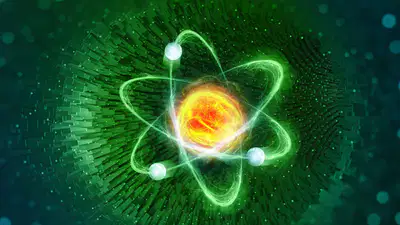
We've learned that:
Protons determine the element of an atom
Neutrons determine how stable an atom is
But what about electrons?
What About Electrons?
6
Open Ended
What purpose do you think electrons have in an atom?
7
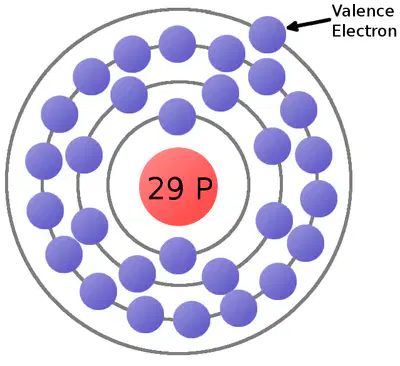
For every proton in the nucleus, there is an electron orbiting around it
For every positive charge, there is a negative charge, so the total charge on an atom is zero
For atoms, the atomic number is also equal to the number of electrons
Electrons balance protons
8
Fill in the Blanks
9
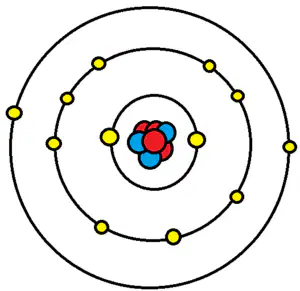
Electrons do not orbit the nucleus in random places
Electrons orbit the nucleus in energy levels that are different distances from the nucleus
Every level can hold a certain number of electrons
energy Levels
10
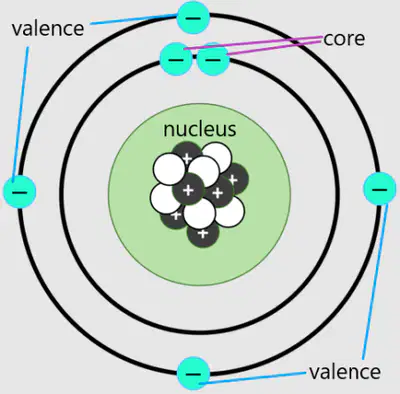
There are two types of electrons:
Valence electrons are the electrons in the outermost energy level
Core electrons are the rest, between the valence electrons and the nucleus
Types of Electrons
11
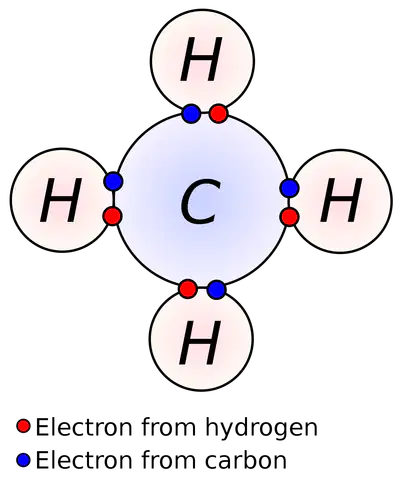
Valence electrons allow atoms to bond to other atoms
This forms chemical compounds
What Do Valence Electrons Do?
12
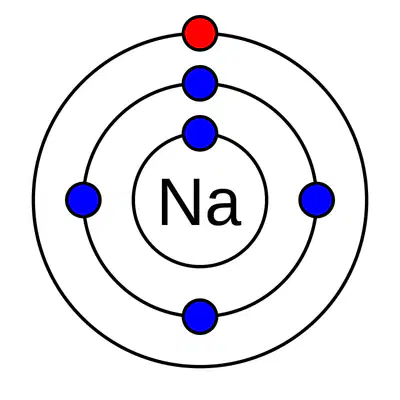
The number of valence electrons determine:
What kinds of chemical bonds can form
How many chemical bonds can form
So, how can you determine how many valence electrons an atom has?
How Many Valence Electrons?
13
Using The PEriodic Table!

The group (column) of the periodic table equals the number of valence electrons for every element in that group!
14
Open Ended
You can't use the rule in the previous slide to determine the valence electrons in an atom for some groups on the periodic table. Which are those groups?
15
Multiple Choice
How many valence electrons are in an atom of sulfur (S)?
3
6
16
Can't Be Determined
16
Multiple Choice
How many valence electrons are in an atom of astatine (At)?
6
7
85
Can't Be Determined
17
Multiple Choice
How many valence electrons are in an atom of ruthenium (Ru)?
5
8
44
Can't Be Determined
Atoms and Elements: A Review
Unit 1, Section 1
Show answer
Auto Play
Slide 1 / 17
SLIDE
Similar Resources on Wayground

16 questions
Newton's 3 Laws of Motion Notes
Presentation
•
8th Grade
16 questions
Waves and their Behavior
Presentation
•
8th Grade
16 questions
Newton's 3rd Law
Presentation
•
8th Grade
12 questions
Solutions
Presentation
•
8th Grade
13 questions
Scalars vs Vectors
Presentation
•
8th Grade
14 questions
Properties of Matter
Presentation
•
8th Grade
14 questions
Asexual vs Sexual Reproduction
Presentation
•
8th Grade
15 questions
Intro to Periodic Table
Presentation
•
8th Grade
Popular Resources on Wayground
24 questions
PBIS-HGMS Day 10

Quiz
•
6th - 8th Grade
10 questions
HCS SCI 03 Summer School Review 3
Quiz
•
3rd Grade
11 questions
Home Scope
Quiz
•
7th - 8th Grade
15 questions
HCS SCI 05 Summer School Assessment 3 Review
Quiz
•
5th Grade
35 questions
Lufkin Road Middle School Student Handbook & Policies Assessment
Quiz
•
7th Grade
18 questions
Geo 11.3 Area of Circles and Sectors
Quiz
•
9th - 11th Grade