
10 Importance - Terms and Techniques

Presentation
•
English
•
10th Grade
•
Practice Problem
•
Easy

Jonathan Croucher
Used 4+ times
FREE Resource
20 Slides • 19 Questions
1

2

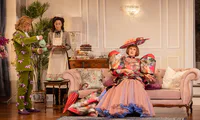
A collection of new terms you need to use when talking about The Importance of Being Earnest.
3
Comedy of Manners
A text that focuses on social commentary and critique. The techniques are more verbal rather than physical (like slapstick). There is an emphasis on wit and character interactions. The characters are often basic and represent different aspects of society (the bossy and snobby older lady, the young romantic and innocent girl, the deceitful and lazy bachelor). Eg. Pride and Prejudice.
4
Multiple Choice
In a comedy of manners, the characters are likely to be stereotypes.
Yes
No
5
Multiple Choice
A comedy of manners will focus on lots of physical fighting and violence.
Yes
No
6
Multiple Choice
A comedy of manners will teach you something about the society it focuses on.
Yes
No
7
Multiple Choice
Which of the following does NOT appear in a comedy of manners?
Death and serious problems.
Ridiculous situations.
Criticism of the society.
Wit
8
Snobbery
People in the play are upper class. When you become obsessed with class and status and look down on those who are lower class, this is snobbery. Eg. Lady Bracknell rejects Jack because he has no family connections.
9
Romantic Stories
A romance is a traditional story that is about a man pursuing a woman and wooing her. Wooing is when a man tries to win the love and affection of a woman. There are often trials and difficulties that the man has to overcome to win the girl. The ending is often marriage and "happily ever after." Like a fairy tale.
10
Social Status
A person's position or importance in relation to other people within a society. In Victorian England, it was based on your class which was often determined by the family you were born into.
11
Arranged Marriages
Rich people in Victorian England would arrange marriages for their children. Often the marriages were arranged based on social status. Sometimes, people would "marry up" meaning they would marry someone who would raise their social status. Rich women would rarely "marry down." This is part of the reason Lady Bracknell rejects Jack.
12
Fill in the Blanks
A type of marriage that is organised by the parents.
13
Multiple Choice
What determined your social status in Victorian England?
Income
Birth family.
Occupation
Address
14
Fill in the Blanks
Word for a man trying to get a woman to love him.
15
Open Ended
In what ways is our society different from Victorian England?
16
Etiquette
A series of rules and expectations that controlled the way people behaved. Etiquette was highly valued in Victorian Society. An example in the play is Algy getting Lady Bracknell to leave the room so that Jack can propose. It was against etiquette to leave a single man and woman alone together in a room.
17
Superficial
Technically means that something is on the surface or not very deep. When people are concerned about shallow and unimportant things. Eg. Gwendolen is obsessed with Jack's first name.
Eg. When Miss Prism gets her bag back at the end and is only focused on having it back and not realising why Jack had the bag.
18
Trivialising
When something important is made unimportant. This is a major criticism that Wilde has of upper class Victorian society. They place a lot of importance on things that are silly and unimportant. Wilde often juxtaposes important and trivial things.
Eg. Cecily in her diary 'To-day I broke off my engagement with Ernest. I feel it is better to do so. The weather still continues charming.'
19
Social Commentary / Critique
When an author or playwright criticises or points out the strengths and weaknesses of a particular society. Wilde is commenting on his own Victorian society. Critique tends to be a more negative and critical type of commentary.
20
Fill in the Blanks
A set of rules that controlled the way people behaved in society.
21
Multiple Choice
Which if the following is NOT trivial?
Fashion
Choosing a person to marry.
The colour of a person's hair.
The weather.
22
Fill in the Blanks
The opposite of deep.
23
Open Ended
Check through your notes and the quotes from the play. What is another example of the characters being superficial or trivial?
24
How does Oscar Wilde create humour and satire in the play?
25
Satire
Criticising something through comedy and mockery. Not preaching. Not just slapstick or entertaining comedy. Satire is usually aimed at people in power. It is often a type of social commentary.
26
Dramatic Irony
In a play, the audience can see the significance of something that the characters cannot see. The significance is often the opposite of what the character thinks. Eg. Lady B saying that Algernon could never be untruthful when we know that he is constantly untruthful.
Eg. Gwendolen being excited about the name Ernest when we know that it is not his real name.
27
Juxtaposition
Placing two things side by side. It usually involves putting two things together that are very different in order to create contrast and humour.
Eg. Cecily: They have been eating muffins. That looks like repentance.
28
Contrived Situations
Ridiculous and unbelievable situations that rely on massive coincidences. These are an example of situation comedy (where we get the word sit-com). These help to create humour and add to the absurd nature of the play.
29
Reversal of Expectations
Wilde will often subvert our expectations by reversing what we expect. He will substitute something that is the opposite of what we expect to surprise us. This can also be used to show how the characters have strange priorities.
"Divorces are made in Heaven."
30
Witty Dialogue
Dialogue is when two people are talking back and forth. Wit is brief, insightful and humorous commentary. Using a quick Reversal of Expectations is a type of wit. Wit is usually cutting and brief.
LB: Never speak disrespectfully of Society, Algernon. Only people who can’t get into it do that.
31
Epigrams
A pithy (short) saying or remark expressing an idea in a clever and amusing way. They are often insightful.
Eg. ALGERNON. All women become like their mothers. That is their tragedy. No man does. That’s his.
32
Farce
A type of comedy that focuses on buffoonery, crude characterisation and ridiculous situations. Buffoonery is behaviour that is ridiculous but amusing. Crude characterisation is when the characters in a play are not very complex or deep. This play is occasionally farcical, but it is more focused on wit and the comedy of manners.
Eg of farce: Jack and Algy fighting over muffins.
33
Multiple Choice
Cecily is Jack's
Aunt
Ward
Cousin
Girlfriend
34
Multiple Choice
Gwendoolen is primarly interested in Jack because
Her mother would disapprove
She thought it was romatic that he was found in a handbag.
He has a lot of money and can up her social status
His name is Ernest.
35
Multiple Choice
Bunbury is
Algy's friend who is always ill.
Jack's friend who is always in trouble.
Algernon's friend who is always in trouble.
A suit that is competing for Gwendolen's hand in marriage.
36
Multiple Choice
What aspect is Lady Bracknell horrifed about when it comes to Jack?
He is ignorant
He smokes
He was found in a handbag
He does not own enough property
37
Multiple Choice
When Jack returns to his country estate, he is wearing:
Mourning clothes
His best tea party attire
Fancy clothes for the theatre
Work clothes for the farm
38
Multiple Choice
Algernon and Jack both make plans to...
Win over Lady Bracknell
Leave town and never return
Be christened by Dr Chasuble
Attend a dinner party at Lady Bracknell's Country Estate
39
Multiple Choice
Jack finds out at the end of the play that
His real name is Ernest, after all.
His mother is Miss Prism
Lady Bracknell is his sister
He is engaged to a wealthy woman named Rose and has a ticket on the Titanic.
Show answer
Auto Play
Slide 1 / 39
SLIDE
Similar Resources on Wayground

36 questions
Present Tenses
Presentation
•
10th - 11th Grade
35 questions
Romanticism and Dark Romanticism
Presentation
•
10th Grade
34 questions
UNIT 6: GENDER EQUALITY (GRAMMAR)
Presentation
•
10th Grade
33 questions
Logical Fallacies and Rhetoric
Presentation
•
10th Grade
33 questions
Grade 9 General Unit 6 Lesson 6
Presentation
•
9th Grade
32 questions
Electronics
Presentation
•
10th Grade
34 questions
9.27 Prefix/Suffix
Presentation
•
KG
34 questions
How to properly start a letter - and how to end it
Presentation
•
10th Grade
Popular Resources on Wayground
10 questions
How much do you know about our Portrait of an Eagle?

Quiz
•
10th Grade
10 questions
Fast Food Slogans
Quiz
•
6th - 8th Grade
21 questions
Continents and Oceans
Quiz
•
6th Grade
20 questions
Parts of Speech
Quiz
•
5th Grade
16 questions
Subject & Predicate
Quiz
•
5th Grade
25 questions
Multiplication Facts
Quiz
•
5th Grade
12 questions
Map Skills
Quiz
•
3rd Grade
22 questions
Continents and Oceans
Quiz
•
5th Grade
Discover more resources for English
20 questions
Context clues
Quiz
•
10th Grade
15 questions
ENG 10 Grammar: 18.1 Prepositions or Adverbs P. 34
Quiz
•
10th Grade
10 questions
Making Inferences and Drawing Conclusions

Interactive video
•
6th - 10th Grade
10 questions
Crafting an Effective Thesis Statement
Interactive video
•
6th - 10th Grade
10 questions
Exploring Coordinating Conjunctions with FANBOYS
Interactive video
•
6th - 10th Grade
10 questions
Distinguishing Theme and Main Idea
Interactive video
•
6th - 10th Grade
20 questions
Subject Verb Agreement
Quiz
•
10th Grade
10 questions
Identifying Simple, Compound, and Complex Sentences
Interactive video
•
6th - 10th Grade