

Ionic Bonding Lesson

Presentation
•
Chemistry
•
9th - 12th Grade
•
Easy
Standards-aligned

Monica McClure
Used 16+ times
FREE Resource
34 Slides • 9 Questions
1

2

3

4

5

6

7

8

9

10

11

12

13

14

15

16
17

18

19

20

21

22

23

24

25

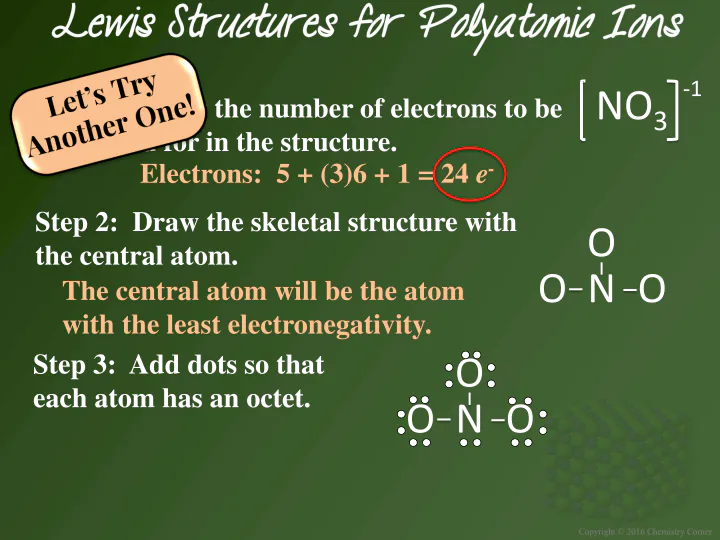
Step 1: Count the number of valence electrons to be
accounted for in the structure.
Step 2: Draw the skeletal structure with the central
atom. Show shared pairs of electrons by using a —
(dash) instead of dots.
NH4
+1
The central atom will be the atom
with the least electronegativity or
carbon if present.
N
H H
H
H
Electrons: 5 + (4)1 – 1 = 8 e-
Hydrogen will never be the central
atom—it can only form one bond.
If more than one carbon is present,
they will be attached in the center.
N
H
H
H
H
26

27

28

29

30
31

32

33

34

35
Multiple Choice
molecule
ion
isotope
element
36
Multiple Choice
negative
positive
neutral
ficticious
37
Multiple Choice
negative
positive
neutral
ficticious
38
Multiple Choice
N
N-3
N-5
N+5
39
Multiple Choice
metalloids
metals
nonmetals
40
Multiple Choice
Number of protons
Mass of the atom
Number of total electrons
Number of valence electrons
41
Multiple Choice
Ca
Al
K
F
42
Multiple Choice
They form hard, brittle crystals with characteristic shapes
They have low melting points
They have low boiling points
They contain no charged particles
43
Multiple Choice
oppositely charged ions
similarly charged ions
neutral ions
neutral atoms
Show answer
Auto Play
Slide 1 / 43
SLIDE
Similar Resources on Wayground

37 questions
Ionic Compounds - Async Lesson
Presentation
•
9th - 11th Grade
34 questions
Macromolecules
Presentation
•
9th - 12th Grade
35 questions
Introduction to Bonding
Presentation
•
9th - 12th Grade
37 questions
The Mole Concept - An Introduction
Presentation
•
9th - 12th Grade
40 questions
Quizizz Lesson: Unit 5 Part 1: Ionic Bonding Basics
Presentation
•
10th - 12th Grade
39 questions
Reaction Types & Stoichiometry w/Moles
Presentation
•
9th - 12th Grade
37 questions
Mole Chemistry
Presentation
•
9th - 12th Grade
40 questions
Naming Polyatomic Compounds
Presentation
•
9th - 12th Grade
Popular Resources on Wayground
10 questions
How much do you know about our Portrait of an Eagle?

Quiz
•
10th Grade
10 questions
Fast Food Slogans
Quiz
•
6th - 8th Grade
21 questions
Continents and Oceans
Quiz
•
6th Grade
20 questions
Parts of Speech
Quiz
•
5th Grade
16 questions
Subject & Predicate
Quiz
•
5th Grade
25 questions
Multiplication Facts
Quiz
•
5th Grade
12 questions
Map Skills
Quiz
•
3rd Grade
22 questions
Continents and Oceans
Quiz
•
5th Grade
Discover more resources for Chemistry
20 questions
Metric Conversions
Quiz
•
11th Grade
20 questions
electron configurations and orbital notation
Quiz
•
9th - 12th Grade
26 questions
Atomic Structure, Isotopes and Ions
Quiz
•
10th Grade
20 questions
Periodic Trends
Quiz
•
10th Grade
5 questions
Atomic Theory Intro Video

Interactive video
•
10th Grade
20 questions
COUNTING ATOMS
Quiz
•
10th Grade
20 questions
Practice: E-Con, Orbital Notation, Noble Gas Notation
Quiz
•
10th Grade
11 questions
Balancing Chemical Equations
Presentation
•
9th Grade