Search Header Logo
HW #3

HW #3

Assessment

Presentation

Biology

12th Grade

Medium

Created by

Mr. Villafuerte

Used 3+ times

FREE Resource

3 Slides • 22 Questions

1

HW 9/12

2

Multiple Choice

Question image
Some shrimp and crab live and capture food from within the tentacles of giant anemones. 
1

Parasitism

2

Commensalism

3

Mutualism

3

Multiple Choice

Question image
A pearlfish spends the day inside the alimentary tract, or intestines, of a sea cucumber. The fish emerges from the sea cucumber at night to feed on small crustaceans. The pearlfish gets a safe place to live. The sea cucumber does not gain anything from the relationship, nor is it harmed. 
1

Mutualism

2

Commensalism

3

Parasitism

4

Multiple Choice

A cymothoid isopod lives inside the mouth of a snapper fish. The isopod severs blood vessels in the fish’s tongue, causing the tongue to atrophy and degenerate.The isopod then hooks its pereopods, or legs, to the base of the fish’s tongue,essentially replacing the tongue. The isopod stays there for the rest of its life, feeding on blood, mucus, and stray pieces of food from the fish.
1

Commensalism

2

Parasitism

3

Mutualism

5

Multiple Choice

Question image
A boxer crab carries a pair of small anemones in its chelipeds, or claws. When approached by a predator, the crab waves the stinging tentacles of the anemones to deter the predator. The anemones benefit from the small particles of food dropped by the crab during feeding. 
1

Commensalism

2

Mutualism

3

Parasitism

6

Multiple Choice

An alpheid shrimp digs and maintains a deep burrow. While underground, the shrimp is safe. Above ground, it is vulnerable to predators. A go by fish lives in the burrow with the shrimp. The go by fish sits at the entrance, keeping watch for predators, and signals the shrimp with a flick of its tail when it is safe to come out. Or, if a predator swims by, the go by darts into the burrow and the shrimp retreats further inside.These two animals are completely dependent on each other—the go by benefits by getting a burrow to live in and the shrimp knows when predators are near. 
1

Parasitism

2

Mutualism

3

Commensalism

7

Multiple Choice

Corals feed off the byproducts of a microscopic algae living within their own tissue,called zooxanthellae. The photosynthetic activity of the algae is vital to the survival of the coral animals, which use the energy to extract calcium from the seawater and build their calcareous skeletons. The zooxanthellae are protected by the hard coral and obtain plant nutrients from the coral. 
1

Mutualism

2

Commensalism

3

Parasitism

8

Multiple Choice

The siboglinid tube worm, found at deep-sea hydrothermal vents and cold seeps,has no digestive tract. It relies on symbiotic bacteria that live in the tube worm’s tissues. The bacteria oxidize hydrogen sulfide or methane for the worm.
1

Mutualism

2

Commensalism

3

Parasitism

9

HW 9/13

10

Multiple Choice

Which one is NOT an example of a decomposer?
1

mushroom

2

leaves

3

mold

4

worm

11

Multiple Choice

Examples of a producer
1

frog

2

algae

3

worm

4

mouse

12

Multiple Choice

Example of a decomposer
1

fungus

2

mouse

3

plants

4

frogs

13

Multiple Choice

Question image
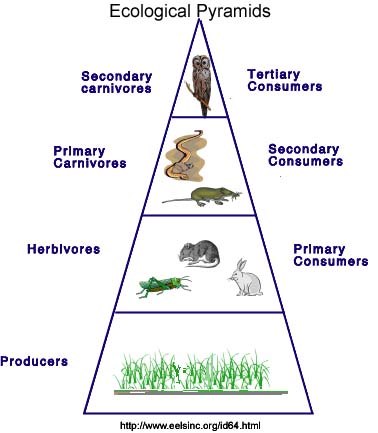
What is a producer?
1

an organism that gets energy from eating other organisms

2

an organisms that uses sunlight to make its own food

3

an organism that gets energy from eating dead organisms, non-living material or waste

4

an organism that uses chemical energy to make its own food

14

Multiple Choice

Question image
If there is 1000 Kcal available in the producers in trophic level 1, how much energy is available in the herbivores in trophic level 2?
1

10 Kcal

2

1 Kcal

3

100 Kcal

4

1000 Kcal

15

Multiple Choice

Question image
If these organisms were arranged in a food pyramid, which organism would have the least amount of total energy available?
1

coyote

2

insect

3

lizard

4

shrub

16

Multiple Choice

Question image
The largest group of organisms found in a food web would be:
1

Primary Consumers

2

Producers

3

Decomposers

4

Tertiary Consumers

17

Multiple Choice

A third-level consumer has to be which type?
1

Carnivore.

2

Decomposer.

3

Producer.

4

Herbivore.

18

HW 9/14

19

Multiple Choice

A secondary consumer 
1

eats primary consumers

2

eats producers

3

eats plants

20

Multiple Choice

What is the term for a place an organism lives?

1

Species

2

Community

3

Niche

4

Habitat

21

Multiple Choice

Question image
Which organism in this food chain is a secondary consumer?
1

Fish

2

Grass

3

Grasshopper

4

Hawk

22

Multiple Choice

A niche ________________.

1

is the function that an organism performs in the food web of that community.

2

includes everything else the organism does and needs in its environment.

3

is specific to each individual animal and plant.

4

All of the above.

23

Multiple Choice

Question image

What is shown in the image?

1

Niche

2

Habitat

24

Multiple Choice

The lion lives on the savanna. 
1

habitat

2

niche

25

Multiple Choice

The lion is a carnivore. 
1

habitat 

2

niche

HW 9/12

Show answer

Auto Play

Slide 1 / 25

SLIDE