

Enzymes - As Level

Presentation
•
Biology
•
11th Grade
•
Practice Problem
•
Medium

Ike Novalina
Used 3+ times
FREE Resource
33 Slides • 9 Questions
1
Enzymes
As Level
2
Lesson 1
The characteristics of enzymes and the mode of action of enzymes
3
Multiple Choice
Enzymes are fibrous proteins that catalyse reactions inside cells.
True
False
4
Multiple Choice
What enzyme that can digest amylum?
protease
lipase
amylase
lactase
5
Enzymes
globular protein which functions as a biological catalyst
speeding up reaction rate by lowering activation energy without being affected or used up by the reaction it catalyse.
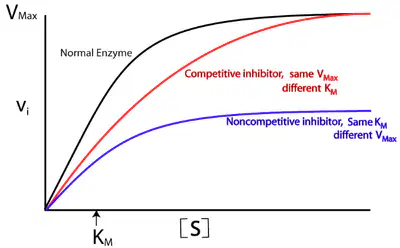
specific to certain substrate by its R-group
6
Two important properties of catalysts:
Catalysts speed up chemical reactions.
Catalysts remain unchanged at the end of the reaction.
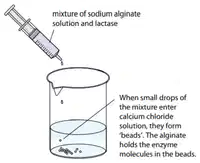
7
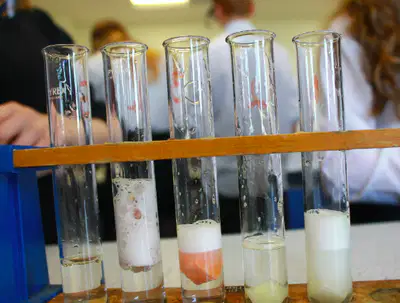
A student investigated the effect of several different catalysts on the rate of decomposition of hydrogen peroxide to water and oxygen. The speed of the reaction was judged by how ‘fizzy’ or frothy the contents of the tube became when the catalyst was added (oxygen is a product of the reaction and forms bubbles).
The student used iron filings and manganese dioxide as inorganic catalysts. They also used a commercial preparation of the enzyme catalase and pieces of liver and pieces of potato tuber, both of which contain catalase. Catalase catalyses the decomposition of hydrogen peroxide.
Results showed:
catalase, liver and potato were much more efficient than the inorganic catalysts
pure catalase was more efficient than the liver and potato
liver was more efficient than potato
ground-up liver was more efficient than piece of liver.
Try to explain the student’s results.
8
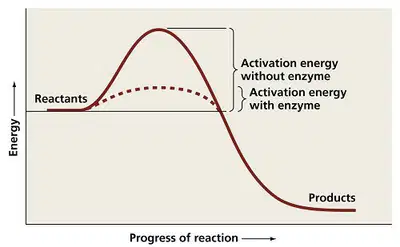
Activation energy
9
Open Ended
Explain how enzymes lower the activation energy needed to allow reactions to proceed.
10
how enzymes lower the activation energy needed to allow reactions to proceed
brings reactants close together in active site
to form ESC so bonds break /form more easily
11
Enzymes that are secreted outside the cell.
Example:
protease, lipase, maltase, etc.
Extracellular enzymes
Enzymes that are produced inside and used inside the cell.
Example:
ATPase, helicase, polymerase, etc.
Intracellular enzymes
Two types of enzymes
12
Open Ended
Describe how enzymes take part in chemical reactions. [4]
13
Describe how enzymes take part in chemical reactions.
catalyst
active site
complementary to specific substrate
works like lock and key/induced fit to form enzyme-substrate complex
lowers activation energy
remain unchanged in the end of reaction
14
Open Ended
Studies suggest that telomerase is a flexible molecule when binding its substrate. The active site changes its shape slightly to allow the formation of the enzyme-substrate complex.
Name the theory that describes this mode of enzyme action.
15
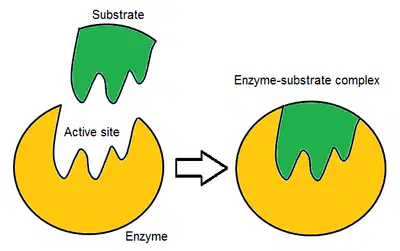
Active site
Enzymes are composed of long chains of amino acids that have folded into a very specific three-dimensional shape which contains an active site.
An active site is a region on the surface of an enzyme to which substrates will bind and catalyses a chemical reaction.

16
Action mode of enzymes
17
Open Ended
Explain with your own word how does the enzyme work based on lock and key hypothesis.
18
Action mode of enzymes (lock and key hypothesis)
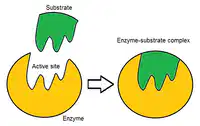
The substrate has complementary shape to the enzyme's active site
The enzyme is the lock, and the substrate is the key
Allows formation of enzyme-substrate complex (ES complex), hydrogen bonds formed between the active site and substrate
The enzyme catalyses the reaction by lowering the activation energy and being unchanged after the reaction
19
Open Ended
Explain with your own word how does the enzyme work based on induced fit hypothesis.
20
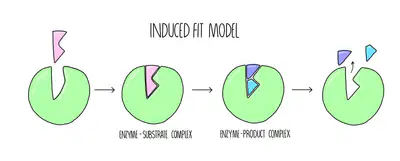
Action mode of enzymes (induced fit hypothesis)
substrate shape not exactly complementary to active site shape
active site changes shape slightly when substrate enters /binds so active site and substrate now complementary
allows formation of enzyme-substrate complex
21
Lesson 2
How can the rate of an enzyme- catalysed reaction be measured?
22
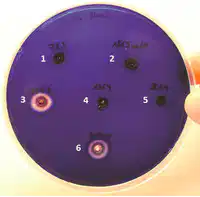
The effect that enzymes have on the rate of reactions can be measured in two ways:
By measuring the rate at which the reactants disappear from the reaction mixture
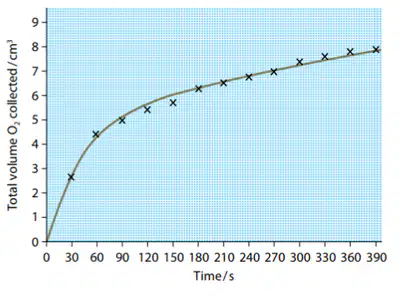
By measuring the amount of product accumulated over a period of time.
23
Course of reaction
Initially, there’s a large number of substrates and every enzyme has a substrate in its active site. The rate at which the reaction occurs depends only on how many enzymes there are and the speed at which the enzyme can convert the substrate into product, release it, and then bind with another substrate.
However, overtime, there are fewer substrates to bind with enzymes; the reaction gets slower, until it eventually stops. The rate of an enzyme-controlled reaction is always fastest at the beginning.
24
Lesson 3
Factors that affect enzyme activity: temperature, pH, substrate concentration and enzyme concentration
25
How temperature affect the enzyme action
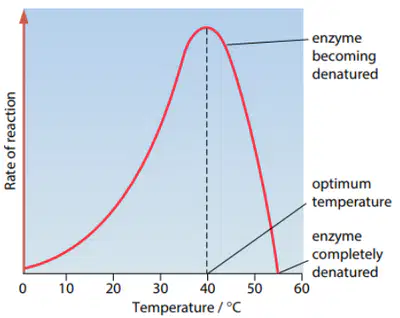
As the temperature increases, the kinetic energy and the enzyme activity increases as there’s more collisions until optimal temperature is reached (usually 40oC). At optimal temperature, maximum rate of reaction is achieved. If the temperature continues to increase beyond optimal temperature, the rate of the reaction begins to decrease as more kinetic energy breaks the hydrogen bonds in the secondary and tertiary structure of enzyme. This changes the shape of the enzyme and its active site and causes the substrate to no longer fitt. The enzyme is denatured.
26
How pH affect the enzyme action
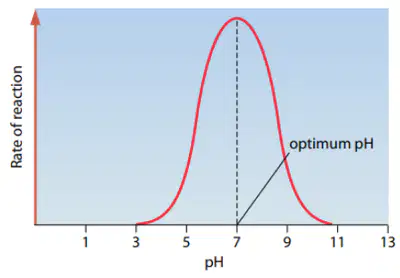
Any change in the pH value of the medium around the enzyme will cause ionic and hydrogen bonds to be damaged, this will change the 3-D shape of the enzyme and deform the active site. The substrate will therefore not be able to t into active site so the reaction slows down or stops. The effects of pH is reversible within certain limits but if the pH is far from optimal value, the enzyme gets denatured.
27
How pH affect the enzyme action
Any change in the pH value of the medium around the enzyme will cause ionic and hydrogen bonds to be damaged, this will change the 3-D shape of the enzyme and deform the active site. The substrate will therefore not be able to t into active site so the reaction slows down or stops. The eects of pH is reversible within certain limits but if the pH is far from optimal value, the enzyme gets denatured.
28
How enzyme concentration affect the enzyme action
As the concentration of enzymes is increased, there are more available active sites for substrates to fit into. More enzyme-substrate complexes are formed, more products are formed and the rate of reaction is increased. The limiting factor is the enzyme concentration.
Once all substrates have formed enzyme- substrate complexes, a further increase in concentration will have no effect on the rate of reaction. At this point, the limiting factor is the substrate concentration. During comparison, look at initial rate to ensure differences in reaction rate are caused only by differences in enzyme concentration.
29
How substrate concentration affect the enzyme action
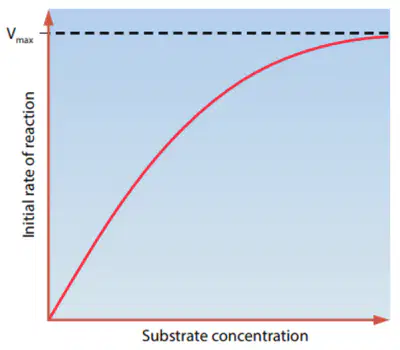
As the concentration of the substrates increases, there are greater chances of collision with enzyme. More enzyme-substrate complexes are formed, more products are formed and the rate of reaction is increased. The limiting factor is the substrate concentration. Once all enzymes are occupied and working at maximum rate (Vmax), a further increase in substrate concentration will have no effect on the rate of reaction. At this point, the limiting factor is the enzyme concentration.
30
Theoretical maximum rate velocity (Vmax):
the reaction rate is measured at different substrate concentrations while keeping the enzyme concentration constant. As substrate concentration is increased, reaction rate rises until the reaction reaches its maximum rate.
31
Michaelis–Menten constant (Km)
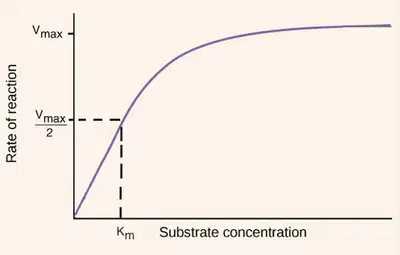
The substrate concentration that corresponds to half of Vmax is Km. Km measures the affinity of the enzyme for the substrate. The higher the affinity, the more likely the product will be formed when a substrate molecule enters the active site. The higher the affinity of the enzyme for the substrate, the lower the substrate concentration needed for this to happen. The higher the affinity, the lower the Km and the quicker the reaction will proceed to Vmax.
32
Multiple Choice

Yeast contains the enzyme catalase which catalyses the breakdown of hydrogen peroxide (H2O2) as shown. 2H2O2 --> 2H2O + O2. Yeast was added to a solution of hydrogen peroxide and the total volume of oxygen released was recorded every 30 seconds for 2 minutes. All other variables were standardised. The data is shown in the table.
What explains the pattern of the data?
The rate of reaction increases as more enzyme–substrate complexes are formed.
The rate of reaction increases as the enzyme reaches its maximum velocity (Vmax).
The volume of oxygen released decreases as the enzymes begin to denature.
The volume of oxygen released decreases as more substrate is converted into product.
33
Multiple Choice
The Michaelis–Menten constant, Km, is a measure of the affinity of an enzyme for its substrate. 1 The higher the affinity, the lower the Km.
2 The lower the affinity, the slower the reaction will be.
3 At Km, half the active sites of the enzyme are occupied by the substrate.
Which statements about Km are correct?
1, 2 and 3
1 and 2 only
1 and 3 only
2 and 3 only
34
Lesson 4
Factors that affect enzyme activity: inhibitors
35
Group discussion
36
Competitive inhibitor
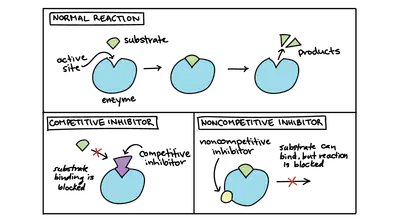
has a similar shape to the substrate and ts into the active site. This reduces the number of enzyme-substrate complexes formed and the rate of reaction decreases. It is said to be reversible because it can be reversed by increasing the concentration of the substrate.
37
Non-competitive inhibitor
has a different shape to the substrate and ts into a site other than the active site. While the non-competitive inhibitor is bound, the tertiary structure of the entire enzyme is distorted, preventing the formation of enzyme-substrate complexes and decreasing the rate of reaction regardless of substrate concentration.
38
Enzyme inhibition
39
Lesson 5
Immobilising enzymes
40
Group discussion
41
Immobilizing enzymes
The enzyme is mixed with a solution of sodium alginate.
Little droplets of this mixture are then added to a solution of calcium chloride.
The sodium alginate and calcium chloride instantly react to form jelly, which turns each droplet into a little bead. The jelly bead contains the enzyme.
42
Immobilizing enzymes advantages
may be able to obtain more product per unit time
can use higher temperatures / still active at higher temperatures / thermostable
does not denature if temperatures increase
immobilised enzyme can be reused
enzyme does not contaminate product
no effect on quality of product, e.g. taste
less purification of product
longer shelf-life of enzyme
Enzymes
As Level
Show answer
Auto Play
Slide 1 / 42
SLIDE
Similar Resources on Wayground

33 questions
A5 Revision
Presentation
•
11th Grade
38 questions
Translation
Presentation
•
11th - 12th Grade
40 questions
Cell Wall Lessons
Presentation
•
11th Grade
39 questions
The Animal Science Industry
Presentation
•
11th - 12th Grade
40 questions
Searching and Sorting Algorithms
Presentation
•
11th Grade
41 questions
Introduction to the Brain
Presentation
•
11th - 12th Grade
35 questions
Body Tissue Notes
Presentation
•
11th - 12th Grade
37 questions
Enzymes
Presentation
•
10th Grade
Popular Resources on Wayground
15 questions
Grade 3 Simulation Assessment 1

Quiz
•
3rd Grade
22 questions
HCS Grade 4 Simulation Assessment_1 2526sy
Quiz
•
4th Grade
16 questions
Grade 3 Simulation Assessment 2
Quiz
•
3rd Grade
19 questions
HCS Grade 5 Simulation Assessment_1 2526sy
Quiz
•
5th Grade
17 questions
HCS Grade 4 Simulation Assessment_2 2526sy
Quiz
•
4th Grade
20 questions
Equivalent Fractions
Quiz
•
3rd Grade
24 questions
HCS Grade 5 Simulation Assessment_2 2526sy
Quiz
•
5th Grade
20 questions
Math Review
Quiz
•
3rd Grade
Discover more resources for Biology
16 questions
AP Biology: Unit 1 Review (CED)
Quiz
•
9th - 12th Grade
20 questions
AP Biology: Unit 3 Review (CED)
Quiz
•
9th - 12th Grade
21 questions
AP Biology: Unit 6 Review (CED)
Quiz
•
9th - 12th Grade
14 questions
AP Biology: Unit 4 Review (CED)
Quiz
•
9th - 12th Grade
20 questions
Food Chains and Food Webs
Quiz
•
7th - 12th Grade
30 questions
AP Biology Unit 8 Review
Quiz
•
9th - 12th Grade
15 questions
Evidence of Evolution
Quiz
•
8th - 12th Grade
15 questions
Pedigrees
Quiz
•
7th - 12th Grade