untitled
Presentation
•
Mathematics
•
•
Practice Problem
•
Hard
Leah Leonard
FREE Resource
33 Slides • 31 Questions
1
Domain and Range of a Function
Some text here about the topic of discussion
The range of a function is the set of all possible output values (y) for the function. Includes all of the numbers on the vertical number line.
Range
The domain of a function is the set of all possible input values (x) for the function. Includes all the numbers on the horizontal number line
Domain
2
Absolute Value Function is written as f(x)= |x|. The graph looks like a V; the turning point is called the vertex.
3
PARENT FUNCTION
4
Graphing Absolute Value Functions with Transformations

5
Parameters a, h, k
a- slope
h-left or right
k-up or down
6
Parameters of the Absolute Value Function:
a Compresses or stretches the graph vertically (Graph will Push TO and Pull AWAY from the X-axis)
h Translates the graph of the absolute value function either to the left (+h) or right (-h) !
k Translates the graph of the absolute value function either to the up (+k) or down (-k) !
7
Multiple Select
Select all that apply. (May have more than one correct answer)
f(x) = |x - 6| + 2
Horizontal translation right 6 units
Horizontal translation left 6 units
Vertical translation up 2 units
Vertical translation down 2 units
8
Steps to Graphing
Find the vertex (-h, k)
Graph the vertex
EITHER ...
A. Move according to the slope
B. Create a table to represent your function and graph these points
9
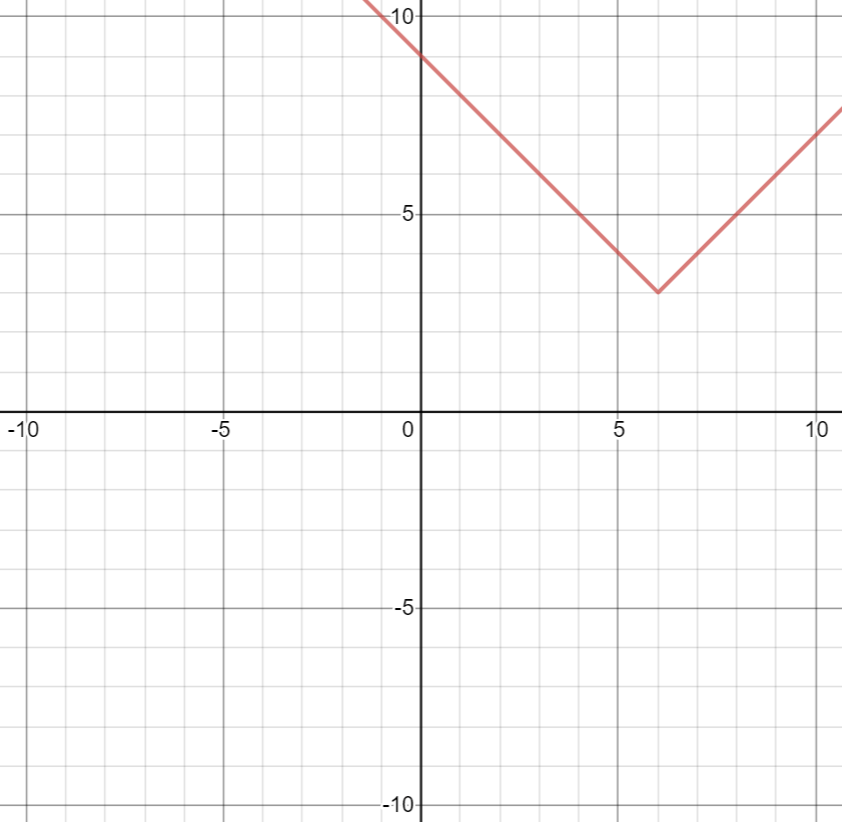
Multiple Choice
Choose the correct equation for the graph.
y=∣x−6∣−3
y=∣x−6∣+3
y=∣x+6∣+3
y=∣x+6∣−3
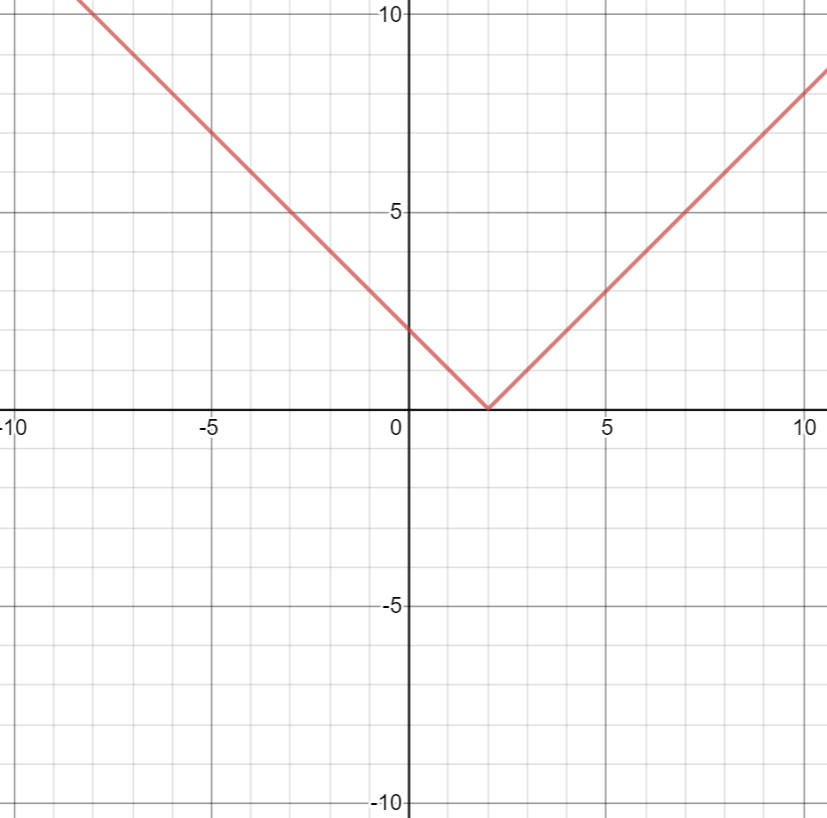
10
Multiple Choice
Choose the correct equation for the graph.
y=∣x+2∣
y=∣x−2∣
y=∣x∣+2
y=∣x∣−2
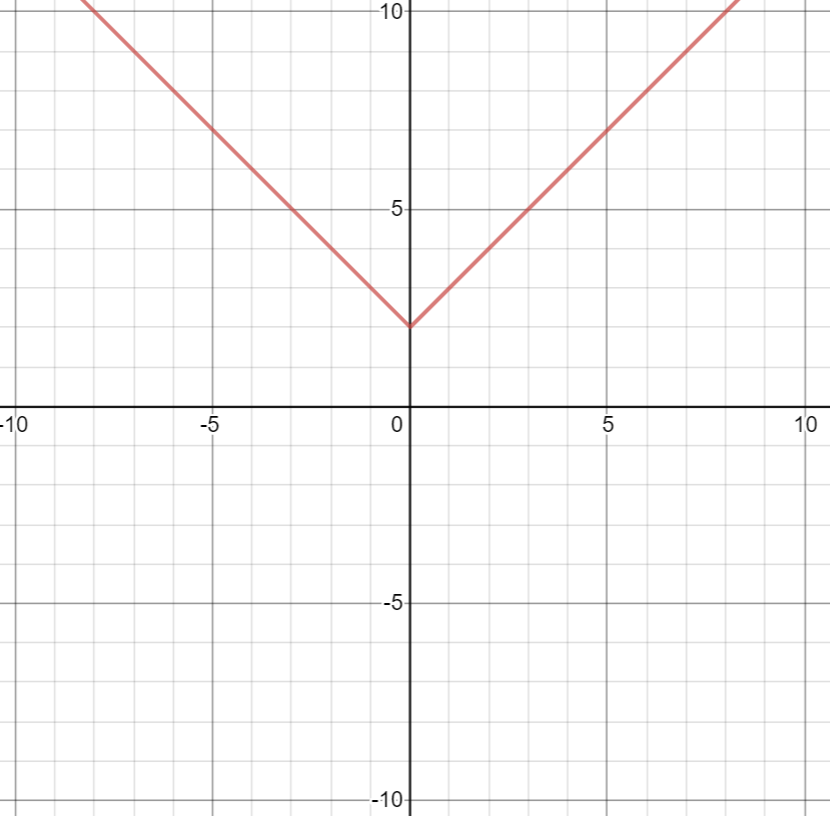
11
Multiple Choice
Choose the correct equation for the graph.
y=∣x+2∣
y=∣x−2∣
y=∣x∣+2
y=∣x∣−2
12
Horizontal Translation
This allows our function to move LEFT or RIGHT
** These are inside the parentheses **
(x – h) shifts right
(x + h) shifts left
13
Vertical Translation
This allows our function to move UP or DOWN
** These are outside of the parentheses **
+ k shifts up
– k shifts down
14
Reflection
When there is a negative sign in front of the equation, this means the function is being reflected over the x-axis!
15
Vertical Stretch and Vertical Shrink
Makes the graph more narrow or more wide
a > 1 = Vertical Stretch
0 < a < 1 = Vertical Shrink
16
Multiple Choice
Name the type of function:
piecewise function
linear function
quadratic function
step function
17
Multiple Choice
Given the piecewise function, evaluate f(2)
2
6
-2
14
18
19
Multiple Choice
Which type of function does the graph represent?
Horizontal Function
Linear Function
Step Function
Exponential Function
20
Multiple Choice
$125
$100
$150
$75
21
Multiple Choice
Morgan can start wrestling at age 5 in Division 1. He remains in that division until his next odd birthday when he is required to move up to the next division level. Which graph correctly represents this information?
22
Multiple Choice
Evaluate f(4)
2
4
6
0
23
Multiple Choice
What are the domain restrictions for the green piece of this function?
−2<x≤1
−1<x≤0.5
x≤−2
x>−2
24
25
26
Multiple Choice
x > 0
x > 4
All Real Numbers
x < 0
27
Multiple Choice
What is the range of the absolute value function?
y > 0
y > 4
All Real Numbers
y < 4
28
Limits
We will use the graph of f(x) shown to the right to answer some questions about limits.
29
Multiple Choice
Using the graph of f(x), what is
x→2−limf(x) ?x→2−limf(x)=−2
x→2−limf(x)=−1
x→2−limf(x)=0
DNE
30
Multiple Choice
Use the graph of f(x) to find
x→2+limf(x) .x→2+limf(x) = −2
x→2+limf(x)=−1
x→2+limf(x)=0
DNE
31
Multiple Choice
Use the graph of f(x) to find
x→2limf(x) .x→2limf(x) = −2
x→2limf(x)=−1
x→2limf(x)=0
DNE
32
Multiple Choice
Use the graph of f(x) to find
x→4−limf(x) .x→4−limf(x) = 0
x→4−limf(x)=1
x→4−limf(x)=2
DNE
33
Multiple Choice
Use the graph of f(x) to find
x→4+limf(x) .x→4+limf(x) = 0
x→4+limf(x)=1
x→4+limf(x)=2
DNE
34
To understand what limits are, let's look at an example.
We start with the function f(x)=x+2
The limit of f at x=3 is the value f approaches as we get closer and closer to x=3. Graphically, this is the y-value we approach when we look at the graph of f and get closer and closer to the point on the graph where x=3.
35
For example, if we start at the point (1,3) and move on the graph until we get really close to x=3 then our y-value (i.e. the function's value) gets really close to 5.
36
Similarly, if we start at (5,7) and move to the left until we get really close to x=3 y-value again will be really close to 5.
37
For these reasons we say that the limit of f at x=3 is 5.
You might be asking yourselves what's the difference between the limit of f at x=3 and the value of f at x=3, i.e. f(3).
38
So yes, the limit of f(x)=x+2 at x=3 is equal to f(3), but this isn't always the case. To understand this, let's look at function g. This function is the same as f in every way except that it's undefined at x=3.
39
Just like f, the limit of g at x=3 is 5. That's because we can still get very very close to x=3 and the function's values will get very very close to 5.
So the limit of ggg at x=3 is equal to 5, but the value of g at x=3 is undefined! They are not the same!
That's the beauty of limits: they don't depend on the actual value of the function at the limit. They describe how the function behaves when it gets close to the limit.
40
Multiple Choice
What is a reasonable estimate for the limit of h at x=3?
2
3
4
The limit does not exist!
41
We also have a special notation to talk about limits. This is how we would write the limit of f as x approaches 3
The symbol "lim" means we're taking a limit of something.
The expression to the right of "lim" is the expression we're taking the limit of. In our case, that's the function f.
The expression x→3 that comes below "Iim" means that we take the limit of f as values of x approach 3.
42
Multiple Choice
What is a reasonable estimate for x→6 limf(x)
-5
-3
6
The limit does not exist!
43
Multiple Choice
Which expression represents the limit of x2 as x approaches 5?
lim 52
x2→ 5lim
x→5limx2
x→25limx
44
A limit must be the same from both sides.
45
Now take, for example, function hhh. The y-value we approach as the x-values approach x=3 depends on whether we do this from the left or from the right.
46
When we approach x=3 from the left, the function approaches 4. When we approach x=3 from the right, the function approaches 6.
When a limit doesn't approach the same value from both sides, we say that the limit doesn't exist.
47
Multiple Select
Which of the limit exist?
x→3limg(x)
x→5limg(x)
x→6limg(x)
x→7limg(x)
48
Multiple Choice
Find x→0−limf(x) .
0
-5
-6
Does Not Exist
49
Multiple Choice
Find x→0+limf(x) .
0
-5
-6
Does Not Exist
50
Multiple Choice
Find x→0limf(x) .
0
-5
-6
Does Not Exist
51
Multiple Choice
Find x→5limf(x) .
0
-5
-6
Does Not Exist
52
We have special notation to talk about limits.....
53
Please copy into your notes:
54
Please copy into your notes:
55
Fill in the Blanks
Type answer...
56
Fill in the Blanks
Type answer...
57
Fill in the Blanks
Type answer...
58
Copy into your notes:
If a limit Does Not Exist write DNE or dne
59
60
61
Fill in the Blanks
Type answer...
62
Fill in the Blanks
Type answer...
63
Definition of a Limit
64
Limits from a Graph
* Limits at a point
* Left & Right Limits
* Limit Does No Exist
Domain and Range of a Function
Some text here about the topic of discussion
The range of a function is the set of all possible output values (y) for the function. Includes all of the numbers on the vertical number line.
Range
The domain of a function is the set of all possible input values (x) for the function. Includes all the numbers on the horizontal number line
Domain
Show answer
Auto Play
Slide 1 / 64
SLIDE

Similar Resources on Wayground
57 questions
Genes and Punnett squares
Presentation
•
9th - 12th Grade
58 questions
01.31.2025_4.6A/C/D_Williams_Math
Presentation
•
4th Grade
61 questions
Beyond the Mississippi
Presentation
•
10th Grade
58 questions
Long Test in Math 7
Presentation
•
7th Grade
60 questions
Intro to American Government
Presentation
•
12th Grade
57 questions
Measures of Center
Presentation
•
8th - 12th Grade
59 questions
NAMING BINARY IONIC COMPOUNDS
Presentation
•
10th - 12th Grade
61 questions
Climate Zones
Presentation
•
7th Grade
Popular Resources on Wayground
10 questions
Factors 4th grade
Quiz
•
4th Grade
10 questions
Cinco de Mayo Trivia Questions
Interactive video
•
3rd - 5th Grade
13 questions
Cinco de mayo
Interactive video
•
6th - 8th Grade
20 questions
Math Review
Quiz
•
3rd Grade
20 questions
Main Idea and Details
Quiz
•
5th Grade
20 questions
Context Clues
Quiz
•
6th Grade
20 questions
Inferences
Quiz
•
4th Grade
19 questions
Classifying Quadrilaterals
Quiz
•
3rd Grade
Discover more resources for Mathematics
16 questions
3D Shapes
Quiz
•
KG - 1st Grade
24 questions
5th Grade Math EOG Review
Quiz
•
KG - University
13 questions
Time
Quiz
•
KG - 2nd Grade
20 questions
Place Value
Quiz
•
KG - 3rd Grade
21 questions
Inches
Quiz
•
KG - 2nd Grade
14 questions
Identifying Shapes
Quiz
•
KG - 9th Grade
15 questions
Single digit addition and subtraction
Quiz
•
KG - 1st Grade
44 questions
Geometry EOC Review
Quiz
•
KG - University