
- Resource Library
- Social Studies
- Civics & Government
- The Legislative Branch
- The Legislative Branch... The Two Houses (lesson)

The Legislative Branch... The Two Houses (LESSON)

Presentation
•
Social Studies
•
9th - 12th Grade
•
Practice Problem
•
Easy

Marlon Coleman
Used 4+ times
FREE Resource
24 Slides • 1 Question
1

Topic 4, The Legislative Branch...[ 4.2 ] The Two Houses
2

[ 4.2 ] The Two Houses
Learning Objectives
•Explain how House seats are distributed and describe the length of a term in the House.
•Explain how House seats are reapportioned among the States after each census.
•Describe a typical congressional election and congressional district.
•Analyze the formal and informal qualifications for election to the House and the Senate.
•Compare the size of the Senate to the size of the House of Representatives.
•Explain how and why a senator's term differs from a representative's term.
3

[ 4.2 ] The Two Houses
Key Terms
•apportioned
•reapportion
•single-member district
•at-large
•gerrymandered
•off-year elections.
•Randy 'Duke' Cunningham
•incumbent,
•James Madison
•Woodrow Wilson
•Robert C. Byrd
•continuous body.
•constituencies
•Bob Packwood
4

The House
Every other autumn, hundreds of men and women seek election to the House of Representatives. Most of them try to attract supporters and win votes with posters, yard signs, billboards, flyers, buttons, and other eye-catching campaign materials.
Nearly all make their “pitches” with radio and television spots, newspaper ads, and Web sites. As you read, you will discover the general shape of the office that all of those candidates so eagerly pursue.
5

The House
•Size of House
•Terms for Representatives
6

The House
The size of the House of Representatives has changed dramatically over time. For example, the 1st Congress had 65 members, while the 112th Congress had 435 members.
7

Reapportionment of Congress
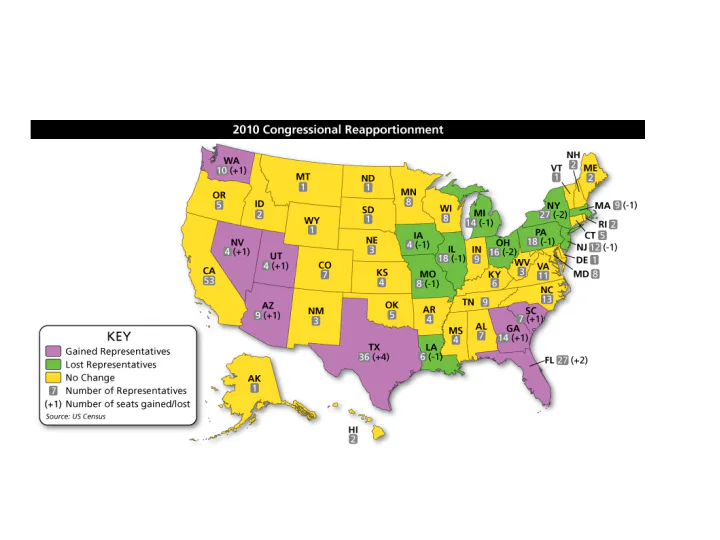
Article I of the Constitution directs Congress to reapportion the seats in the House every ten years, after each census (Article I, Section 2, Clause 3). Until a first census could be taken, the Constitution set the size of the House at 65 seats. That many members served in the First and Second Congresses (1789–1793). The census of 1790 showed a national population of 3,929,214 persons; so in 1792, Congress increased the number of House seats by 41, to 106.
8

Reapportionment of Congress
•A Growing Nation
•Reapportionment Act of 1929
•Congressional Districts
•Gerrymandering
•Wesberry v. Sanders, 1964
•Partisan Gerrymandering
9
Reapportionment of Congress
The 2010 census determined how the 435 seats in the House were reapportioned among the States. Analyze Maps What regions gained or lost population?
10

Reapportionment of Congress
The graph shows how House seats were reapportioned after each census. Analyze Graphs How did the number of seats change for each of the four States between 1970 and 2010?
11

Reapportionment of Congress
Congressional districts are redrawn by each State following each census, and can take unusual shapes. Analyze Maps Why might District 2 be so much smaller than the other districts?
12

House Elections
According to the Constitution, any person whom a State allows to vote for members of “the most numerous Branch” of its own legislature is qualified to vote in congressional elections (Article I, Section 2, Clause 1). The Constitution also provides that
13

House Elections
•Setting the Date
•Off-Year Elections
14

House Elections
People line up to vote in 2008. Gerrymandering affects the political influence of a group of people by putting them in a single district, or by splitting them among several districts.
15

House Elections
The President’s party typically loses congressional seats in off-year elections. Analyze Charts What are advantages and disadvantages of having the President help keep congressional seats?
16

Qualifications for Office in the House
You know that there are 435 members of the House of Representatives, and that each one of them had to win an election to get there. Each one of them also had to meet two quite different sets of qualifications to win office: the formal qualifications for membership in the House set out in the Constitution and a number of informal qualifications imposed by the realities of politics.
17

Qualifications for Office in the House
•Formal Qualifications
•Imposing Additional Standards
•Informal Qualifications
18

Qualifications for Office in the House
At age 29, Florida Congressman Patrick Murphy was the youngest member of the 113th Congress.
19

The Senate-Size, Election, and Terms
You should not be very surprised by these facts: Nearly a third of the present members of the Senate once served in the House of Representatives; none of the current members of the House has ever served in the Senate.
Indeed, many of the men and women who now serve in the House look forward to the day when, they hope, they will sit in the Senate. As you read, you will come to see why the Senate is often called the “upper house.”
20

The Senate-Size, Election, and Terms
•Senate Size
•Election to the Senate
•Term of Office
21

The Senate-Size, Election, and Terms
Senators Harry Reid (left) and John McCain (right) meet with Mikheil Saakashvili, President of Georgia. The Senate is often called 'the world's most exclusive club.'
22

The Senate-Size, Election, and Terms
The number of seats in the House grew rapidly until 1929. The number of seats in the Senate grew more slowly and then leveled off. Analyze Graphs What are the reasons for these trends?
23

Qualifications for Office in the Senate
A senator must meet a higher level of qualifications for office than those the Constitution sets for a member of the House. A senator must (1) be at least 30 years of age, (2) have been a citizen of the United States for at least nine years, and (3) be an inhabitant of the State from which he or she is elected (Article I, Section 3, Clause 3. Note that a senator need not have lived in the State for any particular period of time).
24

Qualifications for Office in the Senate
Some argue that political careers are still more difficult for women. Former Senator Clinton has said cracking 'glass ceilings' is 'the great unfinished business of the 21st century.'
25
Dropdown
Topic 4, The Legislative Branch...[ 4.2 ] The Two Houses
Show answer
Auto Play
Slide 1 / 25
SLIDE
Similar Resources on Wayground

21 questions
Roosevelt´s Diplomacy
Presentation
•
8th - 12th Grade
19 questions
Aztec and the Incas conquest
Presentation
•
8th - 12th Grade
19 questions
Federal Court System
Presentation
•
9th - 12th Grade
20 questions
Bill of Rights
Presentation
•
9th - 12th Grade
20 questions
Abraham Maslow's Hierarchy of Needs
Presentation
•
9th - 12th Grade
22 questions
WWI Homefront & Technology
Presentation
•
9th - 12th Grade
21 questions
Cold War EOC Review
Presentation
•
9th - 12th Grade
18 questions
West African Kingdoms
Presentation
•
9th - 12th Grade
Popular Resources on Wayground
10 questions
How much do you know about our Portrait of an Eagle?

Quiz
•
10th Grade
10 questions
Fast Food Slogans
Quiz
•
6th - 8th Grade
21 questions
Continents and Oceans
Quiz
•
6th Grade
20 questions
Parts of Speech
Quiz
•
5th Grade
16 questions
Subject & Predicate
Quiz
•
5th Grade
25 questions
Multiplication Facts
Quiz
•
5th Grade
12 questions
Map Skills
Quiz
•
3rd Grade
22 questions
Continents and Oceans
Quiz
•
5th Grade
Discover more resources for Social Studies
10 questions
Exploring the Age of Exploration: Key Events and Figures

Interactive video
•
6th - 10th Grade
17 questions
1.3 Review
Presentation
•
11th Grade
10 questions
Exploring the 13 Colonies Regions
Interactive video
•
6th - 10th Grade
8 questions
Smith Unit 5 Quick Check #1 Big Business, Monopolies &Technology
Quiz
•
11th Grade
46 questions
Unit 1 Test REVIEW Ancient Greece and Rome
Quiz
•
9th - 12th Grade
10 questions
Exploring Ancient Mesopotamia Through Song
Interactive video
•
6th - 10th Grade
27 questions
Supply & Demand Test Review
Quiz
•
12th Grade
36 questions
Unit 5 Key Terms
Quiz
•
11th Grade - University