

23-24 Unit 3 Lesson 5: Periodic trends

Presentation
•
Chemistry
•
10th Grade
•
Medium

Katie Smit
Used 3+ times
FREE Resource
51 Slides • 11 Questions
1
Wed 10/4- Unit 3 quiz
Mon 10/9 Unit 3 test
Thurs 10/12 -Benchmark 1 on Units 1-3 (end of Q1)
Fri 10/13- NO SCHOOL, TWD
Announcements/Reminders
Bellwork:
Agenda
Finish graphs (10 minutes)- due at 11:59PM
Oxidation states review
Periodic trends
Complete pages 12-14 in the workbook for HW.
form on GC
Wed 10/4- Unit 3 quiz- 20 MC
History/arrangement of PT
prop. of metals/non-metals
oxidation states
families
2


“Happy” Elements
•All elements want to be
“happy”
•https://youtu.be/C7dPqrmDWxs
•An atom wants a stable
outer energy level to
make them “happy”
3

4


Octet Rule
•Atoms will form bonds with other atoms in
order to have eight valence electrons.
• Can share or transfer electrons with other
elements
• Elements will not just lose or gain electrons. They will
give to another element or take from another element
5

6

7

8
Multiple Choice
What is the oxidation number of Na in Na+ ?
0
+1/2
+1
-1
9
Multiple Choice
How many valence electrons do elements in Group 15 have?
15
5
4
10
Multiple Choice
How many electrons are required to fill the outer shell for elements in Group 15
15
3
5
11
Multiple Choice
How many valence electrons are required to fill the outer shell for elements in Group 17?
17
1
7
12
Multiple Choice
What is the charge, or oxidation number, for elements in Group 17?
+ 1
-7
-1
13
Multiple Choice
What is the charge, or oxidation number, for elements in Group 13?
+ 3
-5
+13
14
Multiple Choice
What is the charge, or oxidation number, for elements in Group 14?
14
+4/-4
-16
15
Multiple Choice
Ionization energy (I.E) is...
Energy needed to destroy an atom
the amount of energy required to remove an electron from the outer shell (PEL) of an atom
16
Multiple Choice
What is First ionization energy (I.E) ?
the amount of energy required to remove the first electron from an atom
17
Multiple Choice
the ability of an atom to attract electrons
18
Multiple Select
What is an "Atomic Radius"? (Select all that apply)
½ the distance between two adjacent nuclei
Half the diameter of an atom
Distance between the nucleus and the electron cloud
the diameter of an atom
19


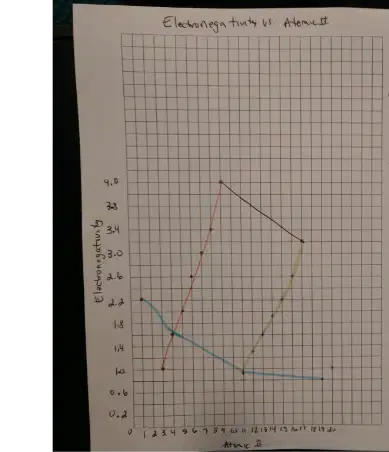
Trends graphs- When you look at your graphs, what trends
do you see across periods 2&3, and down groups 1 & 17?
20


Trends graphs- When you look at your graphs, what trends
do you see across periods 2&3, and down groups 1 & 17?
21

22

Nuclear pull aka electron affinity
sodium vs fluorine
►
electron affinity
►
atomic radius
►
ionization energy
►
electronegativity
23

24

25


Why?
26
Why?
# PELs
increase
Increasing nuclear charge
27


Ionic Radius
• Do you find ionic radius on Ref Table S?
28
Ionic Radius
• Rule: All positive ions will be smaller than their
"parent" atoms because they formed by losing e-
29


• Rule: All negative ions will be larger than
their "parent" atoms because they formed
by gaining e-.
30


31


More Periodic trends…
Which Group 1 metal is the most
reactive?
32


• What is the trend for reactivity for the metals in
group 1?
• What is the trend for reactivity of metals/ metallic
character of elements across a period?
33
increases
decreases
• What is the trend for reactivity for the metals in
group 1?
• What is the trend for reactivity of metals/ metallic
character of elements across a period?
34


What is the most reactive
metal on the periodic table?
35
What is the most reactive
metal on the periodic table?
36


Reactivity of non-metals/
non-metallic character
37
decreases
increases
Reactivity of non-metals/
non-metallic character
38


Reactivity of non-metals/non-metallic character
► Which element is the most reactive
non-metal on the periodic table?
e-
39
Reactivity of non-metals/
non-metallic character
► Which element is the most reactive
non-metal on the periodic table?
► Fluorine
e-
40


First Ionization Energy
Can be looked up on Reference Table S
► Unit?
► KJ/mol
41


What is it?
42
What is it?
► Ionization energy is the amount of energy required to remove an electron
from the outer shell (PEL) of an atom
► The first ionization energy is the amount of energy required to remove the
first electron from an atom
43

What are the trends for first IE?
Look at your graph!
44


What are the trends for first IE?
decreases
increases
45


Why?
46
Why?
# PELs
increase
Increasing nuclear charge
47


48


Explaining the trend…
► Increasing # PELS
► valence e- are ?
49
Explaining the trend…
► Increasing # PELS
► valence e- are farther from
nucleus, therefore they are easier
to remove
50


Explaining the trend…
Increasing nuclear charge
electrons are....?
51
Increasing nuclear charge
electrons are more difficult to remove
52

Effective Nuclear Charge
The shield between the
nucleus and the
electron is the primary
influence on the
effective nuclear
charge.
Effective nuclear
charge: charge felt on
valence electrons
Zeff = Z – S
Zeff = Effective Nuclear Charge
Z = # of protons
S = Number of inner “core” electrons
You will not need to do this calculation, but it is a
VERY good guide to figuring out nuclear pull!
53

54


Electronegativity (aka Electrolove)
► The ability of an atom to attract electrons
► introduced by Linus Pauling in 1932 who defined the new atomic property
as:
► "The power of an atom in a molecule to attract electrons to itself."
55


► Which element on table is best at gaining
e-?
► Fluorine
► It is __________.
e-
4.0
56


What are the trends for electronegativity?
57
What are the trends for electronegativity?
decreases
increases
58


► Note: Noble gases do not have electronegativity values.
► Why not?
59

60

61

62

Wed 10/4- Unit 3 quiz
Mon 10/9 Unit 3 test
Thurs 10/12 -Benchmark 1 on Units 1-3 (end of Q1)
Fri 10/13- NO SCHOOL, TWD
Announcements/Reminders
Bellwork:
Agenda
Finish graphs (10 minutes)- due at 11:59PM
Oxidation states review
Periodic trends
Complete pages 12-14 in the workbook for HW.
form on GC
Wed 10/4- Unit 3 quiz- 20 MC
History/arrangement of PT
prop. of metals/non-metals
oxidation states
families
Show answer
Auto Play
Slide 1 / 62
SLIDE
Similar Resources on Wayground

60 questions
Naming, balancing, and pH review 12/14
Presentation
•
10th - 11th Grade
56 questions
Copy of G2_K9_L11_22-23
Presentation
•
KG
55 questions
G10_5.2: Classifying Chemical Reactions
Presentation
•
10th Grade
57 questions
Periodic Table
Presentation
•
10th Grade
56 questions
Naming Ionic Compounds with Polyatomic Ions
Presentation
•
10th Grade
58 questions
Struktur Atom
Presentation
•
10th Grade
56 questions
Energy Changes in Reactions
Presentation
•
9th - 10th Grade
57 questions
Prehistory
Presentation
•
9th - 10th Grade
Popular Resources on Wayground
10 questions
Safety Day 2026 – Student Review

Quiz
•
9th Grade
21 questions
Continents and Oceans
Quiz
•
6th Grade
20 questions
Parts of Speech
Quiz
•
5th Grade
16 questions
Subject & Predicate
Quiz
•
5th Grade
25 questions
Multiplication Facts
Quiz
•
5th Grade
12 questions
Map Skills
Quiz
•
3rd Grade
22 questions
Continents and Oceans
Quiz
•
5th Grade
15 questions
Rounding Decimals
Quiz
•
5th Grade
Discover more resources for Chemistry
20 questions
electron configurations and orbital notation
Quiz
•
9th - 12th Grade
25 questions
Writing and Naming Binary Ionic compounds
Quiz
•
10th Grade
20 questions
COUNTING ATOMS
Quiz
•
10th Grade
20 questions
Physical or Chemical Change/Phases
Quiz
•
8th Grade - University
15 questions
Periodicity Module Exam Practice Quiz
Quiz
•
9th - 12th Grade
20 questions
Naming Ionic Compounds
Quiz
•
10th Grade
45 questions
Chem Unit 3 Review
Quiz
•
10th Grade
16 questions
History of the Atomic Theory
Quiz
•
10th Grade