

Unit 1 Common Assessment Skills REview

Presentation
•
English
•
9th Grade
•
Practice Problem
•
Medium
+32
Standards-aligned

Paula McKee
Used 8+ times
FREE Resource
12 Slides • 17 Questions
1

Unit 1 Common
Assessment 2023
STUDY GUIDE
“Is Survival Selfish?”
2

PARTS OF AN ARGUMENT - PAGE 21
Claim
Author’s position on the topic or issue; central idea of the
argument
Reasons
Explanations that support the claim; should follow clear
and logical organization
Evidence
Facts, statistics, personal experiences, statements by
experts; supports the reasons and ultimately the claim
Conclusion
Revisits the claim with a persuasive closing statement
In an argument, an author expresses a position on an issue and then attempts to support
that position. A successful argument persuades readers to agree with the author’s claim, or
position. To analyze an argument, you must first outline its basic parts.
3
Multiple Choice
An author's position on a topic or issue is the
conclusion
evidence
reasons
claim
4
Multiple Choice
explanations that support the claim
conclusion
evidence
reasons
claim
5
Multiple Choice
facts, statistics, personal experiences, or statements by experts that support your resons in an argument
conclusion
evidence
reasons
claim
6

●CONTEXT CLUES: the words or ideas expressed before and after— provides us with
the information we need to fully understand or interpret the ideas in the passage.
●RHETORICAL QUESTION (PAGE 21)
○Rhetorical questions are questions that DO NOT CALL FOR AN ANSWER. They
are intended to engage the audience and make a point. In other cases, an author
may rely on faulty logic or rhetorical devices meant to deceive the audience.
●FACT VS. OPINION
○A fact is a statement that can be verified.
○An opinion is a statement that expresses a feeling, an attitude, judgment, or a
belief.
7
Multiple Choice
Do not require an answer but help the author make a point
Context clues
rhetorical questions
facts
opinions
8
Multiple Choice
can be verified
Context clues
rhetorical questions
facts
opinions
9
Multiple Choice
feelings, judgments, or personal beliefs
Context clues
rhetorical questions
facts
opinions
10

● TONE (PAGE 49)
○ the author’s attitude towards the subject. Authors shape a
work’s tone through topics they choose to explore, word
choices, and images those words create. Elements to consider
when evaluating tone include:
■ Words with positive or negative connotations
■ Use of formal or informal language
■ Repetition of significant words or phrases
● FIRST PERSON POINT OF VIEW: A character in a story telling it
from their perspective. Uses personal pronouns (I, me, my, we)
●
COMPARE/CONTRAST
○
Looking at what is the same and what is different
11
Multiple Choice
the author's attitude toward a subject created by words with positive and negative connotation and repetition
tone
first-person point of view
compare-contrast
12
Multiple Choice
a character in a story telling the story
tone
first-person point of view
compare-contrast
13
Multiple Choice
looking for what is the same and what is different
tone
first-person point of view
compare-contrast
14

●
INDEPENDENT/DEPENDENT (SUBORDINATE) CLAUSES (PAGE
71)
○
A clause is a group of words with a subject and a verb.
○
There are two types of clauses: an independent clause can stand
alone as a sentence; a dependent clause cannot.
○
Dependent clauses act as modifiers, adding meaning to
independent clauses.
○
Dependent clauses often begin with words like these:as if, as,
since, than, that, though, until, whenever,where, while, who, why.
These words are subordinating conjunctions that clarify the
connection between the clauses.
15

KNOW YOUR DEPENDENT CLAUSES.
●
Theyhad transferred me to another Kommando, the construction
one, where twelve hours a day Ihauled heavy slabs of stone.
○
This sentence contains one independent clause and one
dependent clause. Notice how the independent clauseThey had
transferred me to another Kommando, the construction one forms a
complete thought and can stand alone as a sentence. The
dependent clause, which is underlined, provides additional
information about the independent clause, but it cannot stand
alone. The two types of clauses function together to convey the
author’s meaning.
16
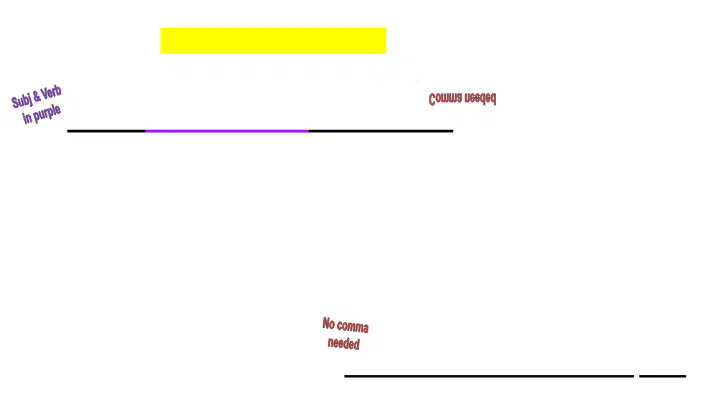
KNOW YOUR DEPENDENT CLAUSES.
● Snow began to fall. (Independent Clause)
● While I was waiting for the bus, snow began to fall.
○ If a dependent clause begins a sentence, it
usually is followed by a comma. If a dependent
clause follows the independent clause, there
usually is no comma preceding (coming before)
it.
■ Snow began to fall while I was waiting for the bus.
17
Multiple Choice
a group of words that has a subject and a verb
clause
phrase
subject
verb
18
Multiple Choice
a clause that CAN stand alone
subordinate
phrase
dependent
independent
19
Multiple Choice
words like After, Although, When, Whenever, Where, Wherever, Until, Unless, Before, Because, If, So, So that, and Since
participles
subordinating conjuncitons
coordinating conjunctions
participles
20
Multiple Choice
a clause that CAN'T stand alone
participle
phrase
dependent
independent
21

● COLONS (PAGE 19)
○ Use a colon before a list of items, especially after
expressions like “the following” and “as follows”
○ Use a colon after a sentence that introduces another
sentence that explains it.
■ This is what they were to me: real-life boogeymen whose
origins and intentions I could never fathom.
● The two-part sentence provides readers with a
question (What were the Robinsons to Steve?)
followed by its answer (monsters he cannot
understand).
22

Use of Colons
Purpose
Example
● Illustrate or provide an example of what was just stated
○ I was fixated on one thing: food.
● Introduce a quotation or dialogue
○ But Mrs. Levin was insistent: “if it’s okay, I would like to give
him these myself.”
● Introduce a list
○ And my hearing was finely tuned. I knew the stride pattern of
each member of the family: Betty shuffled, Reggie had longer
steps, and Willie’s plodding was the easiest to detect.
23
Multiple Choice
Which one is NOT a use of the colon
between the preposition and the object of the preposition
after a complete sentence to introduce a list of itsms
provides an exampe of what was just stated
introduce an explanation or quotation
24

●SEMICOLONS
○Use a semicolon to join two closely related independent clauses.
○Use a semicolon between independent clauses joined by conjunctive
adverbs or transitional expressions like however, therefore, nevertheless,etc.
○A semicolon (rather than a comma) may be needed to separate
independent clauses joined by a coordinating conjunction when there are
commas within the clauses.
○Read the following sentence:
■
For Hazel and his followers, it was never a question of if they would
find a home; it was simply a matter of when.
●The author’s use of the semicolon shows the relationship between
the two statements.
25
Multiple Choice
join closely-related sentences
periods
semicolons
26

●SEMICOLONS
○Use a semicolon to join two closely related independent clauses.
○Use a semicolon between independent clauses joined by conjunctive
adverbs or transitional expressions like however, therefore, nevertheless,etc.
○A semicolon (rather than a comma) may be needed to separate
independent clauses joined by a coordinating conjunction when there are
commas within the clauses.
○Read the following sentence:
■
For Hazel and his followers, it was never a question of if they would
find a home; it was simply a matter of when.
●The author’s use of the semicolon shows the relationship between
the two statements.
The members of the family were not nice to me; however, I survived.
27

●COMMA RULES - The FOUR I’s:
○Items in a series: Use commas to separate three or more items in a series.
EXAMPLE: Ameila and Rea worked on the lesson, looked up information on the internet,
and completed the assignment just before the bell rang.
○Interrupters: Use commas around the elements that interrupt the flow of the
sentence.
EXAMPLE: Roland found out that Finn, the football player in his class, was a really nice
guy.
○
Introducers: Use commas around words, phrases, or clauses that come at the
beginning of the sentence to introduce the main idea.
EXAMPLE: Whenever Aiden sits by William, they can’t keep from talking because they are
friends.
○Independent clauses: Use a comma before a the FANBOYS (coordinating
conjunction)
EXAMPLE: Liam told Hailie about the work she missed, so she was able to do it easily.
28
Multiple Choice
semicolons
join two independent clauses
add emphasis to boring sentences
decorate sentences so that they are prettier
make frowny face emojis
29
Multiple Choice
May follow a semicolon to make a transition to the next sentence (however, therefore, nevertheless)
participles
prepositions
subordinating conjunctions
conjunctive adverbs
Unit 1 Common
Assessment 2023
STUDY GUIDE
“Is Survival Selfish?”
Show answer
Auto Play
Slide 1 / 29
SLIDE
Similar Resources on Wayground

24 questions
Procedure Text: Recipe
Presentation
•
9th Grade
21 questions
Active/passive Voice
Presentation
•
8th - 9th Grade
20 questions
MITS Unit 5: Commas
Presentation
•
9th - 10th Grade
24 questions
New E1 Blitz Day 1
Presentation
•
9th Grade
22 questions
IB Learner Trait Vocabulary
Presentation
•
9th Grade
24 questions
Bias and Prejudice
Presentation
•
9th Grade
20 questions
Future Continuous
Presentation
•
9th Grade
20 questions
Gerund Phrases Lesson
Presentation
•
9th Grade
Popular Resources on Wayground
5 questions
A Home on the Shore

Quiz
•
3rd Grade
28 questions
US History Regents Review
Quiz
•
11th Grade
6 questions
A Horse Tale
Quiz
•
3rd Grade
20 questions
Math Review
Quiz
•
3rd Grade
10 questions
Juneteenth History and Significance

Interactive video
•
5th - 8th Grade
20 questions
Dividing Fractions
Quiz
•
5th Grade
55 questions
A Long Walk to Water Final Review
Quiz
•
6th - 8th Grade
10 questions
Equation Word Problems
Quiz
•
7th Grade
Discover more resources for English
20 questions
Insurance
Quiz
•
9th - 12th Grade
10 questions
Juneteenth: History and Significance
Interactive video
•
7th - 12th Grade
20 questions
Summer Geometry QUIZ (Week 2)
Quiz
•
9th Grade
6 questions
Mayan Mathematics part 1
Presentation
•
9th - 12th Grade
25 questions
Biology Regents Review
Quiz
•
9th Grade
40 questions
Flags of the World
Quiz
•
KG - Professional Dev...
10 questions
Unit 9 Quiz
Quiz
•
9th - 12th Grade
60 questions
Biology Regents Review
Quiz
•
9th Grade