Search Header Logo
1st Quarter 2023 Review

1st Quarter 2023 Review

Assessment

Presentation

•

Biology

•

9th - 12th Grade

•

Easy

Created by

Anonymous Anonymous

Used 3+ times

FREE Resource

14 Slides • 36 Questions

1

media

2

media

3

media
media

4

media

5

media

6

media

7

media

8

media

9

10

Multiple Choice

Large bodies of water, such as lakes and oceans, do not quickly fluctuate in temperature. What is the reason for this phenomenon?
1
Water is an acid.
2
Water is a versatile solvent.
3
Water has a high heat capacity.
4
 Water acts as a buffer.

11

Multiple Choice

Why does ice stay at the top of oceans instead of sinking to the bottom?
1
 Ice is colder than liquid water.
2
Ice is less dense than liquid water.
3
Ice is more dense than liquid water.
4
Ice is warmer than liquid water.

12

Multiple Choice

Water is often called the "universal solvent" because many substances can be dissolved in water. What property of water allows it to be such a versatile solvent? 
1
purity
2
polarity and cohesion
3
high heat capacity
4
expansion upon freezing

13

Multiple Choice

Question image
 Small insects can walk across the surface of calm water. Their feet push the surface of the water down slightly, somewhat like a person walking across a trampoline, but they do not break the surface. What is the best explanation for why this happens?
1
The insects are light enough so that they do not break the hydrogen bonds holding the water molecules together
2
The insects actually use their wings to hover slightly above the water's surface and they only skim it with their feet
3
The insects' feet are non-polar, so they are repelled by the polar water molecules and are pushed away from the water's surface
4
The insects are small enough to see the individual water molecules, so they are able to step carefully from one molecule to the next

14

Multiple Choice

Water makes up approximately 60% of the human body and plays a vital role in regulating body temperature. Which property of water makes it good at regulating temperature?
1
Water is a good solvent.
2
Water exhibits strong cohesion.
3
. Water has an unusual crystalline structure.
4
Water has a high capacity for heat.

15

Multiple Choice

A florist places a bouquet of white carnations in water containing blue dye. After a time, the flowers turn blue. What process helped the carnations to change color?
1
Specific heat 
2
Surface tension
3
Cohesion and adhesion of water molecules 
4
Formation of covalent bonds between hydrogen and oxygen molecules

16

Multiple Choice

Water has a much higher specific heat than most other covalent compounds. What do you predict might happen if water had a low specific heat instead?
1
Flooding would occur and animals would be forced to migrate
2
 Harmful organisms living in water would reproduce at a rapid rate
3
Organisms that are sensitive to changes in temperature would die
4
Plants would not have enough water to effectively carry out photosynthesis

17

Multiple Choice

 Which of the following characteristics of water is not a result of hydrogen bonding?
1
adhesive strength
2
capillarity
3
cohesive strength
4
All of the above are a result of hydrogen bonding.

18

Multiple Choice

 Many fish and aquatic plants can survive a cold winter because the layer of ice that forms at the top of the lake insulates the water below and prevents the lake from freezing solid. What unique property of water contributes to this effect? 
1
Water absorbs heat when it evaporates and forms a gas 
2
 Water expands and becomes less dense when it freezes.
3
Water molecules completely separate into ions in solutions.
4
 Water forms hydrogen bonds with ions and other polar substances. 

19

media

20

21

22

Multiple Choice

Question image
The diagram shows the general structure of an amino acid. Which type of molecule is formed from amino acids?
1
lipids
2
proteins
3
carbohydrates
4
nucleic acids

23

Multiple Choice

You are analyzing a compound in the laboratory. You find that it is made up of carbon, hydrogen, and oxygen in a ratio of two hydrogen atoms for each carbon atom. How will you classify the compound?
1
lipid
2
protein
3
carbohydrate
4
nucleic acid

24

Multiple Choice

Fats, oils and cholesterol are all types of what?
1
cell membranes
2
hormones
hormones
3
lipids
4
fatty acids

25

Multiple Choice

RNA and DNA are which type of macromolecules?
1
carbohydrate
2
lipid
3
nucleic acid
4
protein

26

Multiple Choice

Many plants have waxy coatings on some surfaces. This coating reduces water loss because it is not water-permeable. This waxy coating is which of the following types of organic molecule?
1
protein
2
carbohydrate
3
nucleic acid
4
 lipid

27

Multiple Choice

A sugar, a phosphate group, and a nitrogen base form the building blocks of which organic compound?
1
carbohydrates
2
lipids
3
nucleic acids
4
proteins

28

Multiple Choice

The human body maintains a temperature of around 98.6 degrees at all times. Enzymes are involved in almost every chemical reaction in the body. Which of the following describes the connection between these two statements? 
1
Enzymes function best at a specific temperature.
2
The body needs to be warm to prevent hypothermia.
3
The body is kept relatively warm to prevent too much enzyme action. 
4
There is no connection between the two statements. 

29

Multiple Choice

Like complex carbohydrates, proteins are macromolecules that serve many functions and can be chemically broken down and restructured. Both proteins and complex carbohydrates are which of the following?
1
 polymers of smaller subunits
2
sequence of sugars
3
lipids of large molecules
4
nucleotides of DNA

30

Multiple Choice

 In living organisms, lipids function mainly as:
1
Sources of stored energy and transmitters of genetic information
2
Sources of stored energy and components of cellular membranes
3
Transmitters of genetic information and catalysts of chemical reactions
4
Catalysts of chemical reactions and components of cellular membranes

31

Multiple Choice

Question image
What is the function of macromolecule subunit below?
1
energy
2
catalyst
3
stores genetic information
4
composes the majority of the cell membrane

32

media
media

33

34

Multiple Choice

The human body maintains a temperature of around 98.6 degrees at all times. Enzymes are involved in almost every chemical reaction in the body. Which of the following describes the connection between these two statements? 
1
 Enzymes function best at a specific temperature.
2
The body needs to be warm to prevent hypothermia.
3
The body is kept relatively warm to prevent too much enzyme action.
4
 There is no connection between the two statements. 

35

Multiple Choice

The enzyme lactase will break down the sugar lactose into which of the following components? 
1
 monosaccharides
2
nucleic acids
3
amino acids
4
phospholipids

36

Multiple Choice

As food travels through the digestive system, it is exposed to a variety of pH levels. The stomach has a pH of 2 due to the presence of hydrochloride acid (HCl), and the small intestine has a pH ranging from 7 to 9. HCl converts pepsinogen into pepsin, an enzyme that digests proteins in the stomach. Which of the following most likely happens to pepsin as it enters the small intestine?
1
 It becomes inactive.
2
It begins to replicate.
3
 It's shape changes to engulf large proteins.
4
It's activity increases to digest more proteins.

37

Multiple Choice

Question image
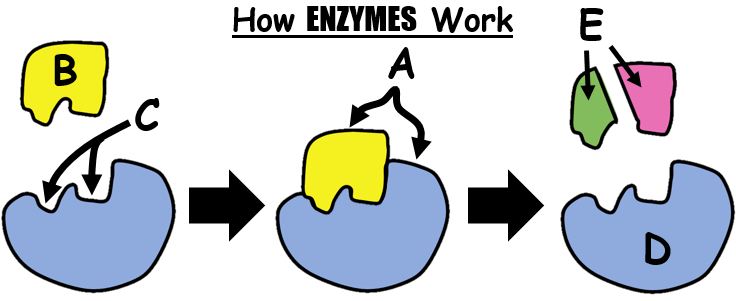
In the diagram, what is letter A? 
1
product
2
substrate
3
enzyme-substrate complex
4
active site

38

Multiple Choice

The human body maintains a temperature of around 98.6 degrees at all times. Enzymes are involved in almost every chemical reaction in the body. Which of the following describes the connection between these two statements? 
1
 Enzymes function best at a specific temperature.
2
The body needs to be warm to prevent hypothermia.
3
The body is kept relatively warm to prevent too much enzyme action.
4
 There is no connection between the two statements. 

39

Multiple Choice

What is the purpose  of an enzyme?
1
give permission for the reaction
2
raise activation energy
3
speed up reactions
4
control how many reactions occur

40

Multiple Choice

Where do substrates bind on an enzyme?
1
voltage-gated channels
2
surface receptor
3
calcium channels
4
active site

41

Multiple Choice

What makes an enzyme substrate specific?
1
Size
2
Shape
3
Name
4
Location it is found in

42

Multiple Choice

What percentage of energy is passed on to the next trophic level?

1

5%

2

10%

3

50%

4

90%

43

Multiple Choice

Question image
What is the ecological role of the krill in this food chain?
1
Tertiary Consumer
2
Producer
3
Primary Consumer
4
Secondary Consumer

44

Multiple Choice

Which of the following organisms are autotrophic?
1
Flower
2
Rabbit
3
Wolf

45

Multiple Choice

What is maximum number of organisms that can live in one population in an ecosystem over time?
1
Limiting factor
2
Ecological Succession
3
10% Rule
4
Carrying Capacity

46

Multiple Choice

What starts every food chain or food web?
1
Producers
2
Primary Consumers
3
Secondary Consumers
4
The Sun

47

Multiple Choice

Question image

When a population grows past the ecosystem's carrying capacity, what happens to the population?

1

The population continues to grow

2

The population will go extinct due to limited resources

3

The population starts to die off to return to carrying capacity

4

The population grows, then finds a new carrying capacity

48

Multiple Choice

A population is...

1

All of the living and nonliving things in an area

2

Multiple species that live in one area

3

A group of one species in one area

4

None of these

49

Multiple Choice

Question image
All of the living and nonliving things in an area that interact with each other are called a/an ______.
1
community
2
habitat
3
population
4
ecosystem

50

Multiple Choice

Question image
In the energy pyramid here, which organisms have the most energy available?
1
Producers
2
Carnivores
3
Herbivores
4
Top Predator
media

Show answer

Auto Play

Slide 1 / 50

SLIDE